LONDON, 15 January 2026 – The global maritime landscape faced a challenging year in 2025, as the ICC International Maritime Bureau (IMB) recorded a significant uptick in piracy and armed robbery incidents. Despite the containment of Somali-based piracy through robust international naval coordination, the overall volume of attacks on commercial shipping has climbed, signaling a growing volatility in critical maritime transit corridors.
As global trade remains the lifeblood of the international economy, the surge in hostile activity—from vessel boardings to crew abductions—has prompted urgent calls for enhanced security cooperation and renewed vigilance from stakeholders across the maritime industry.
The 2025 Landscape: Main Facts and Escalating Threats
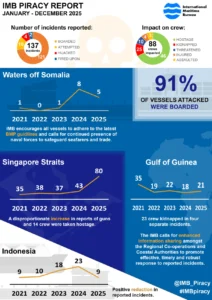
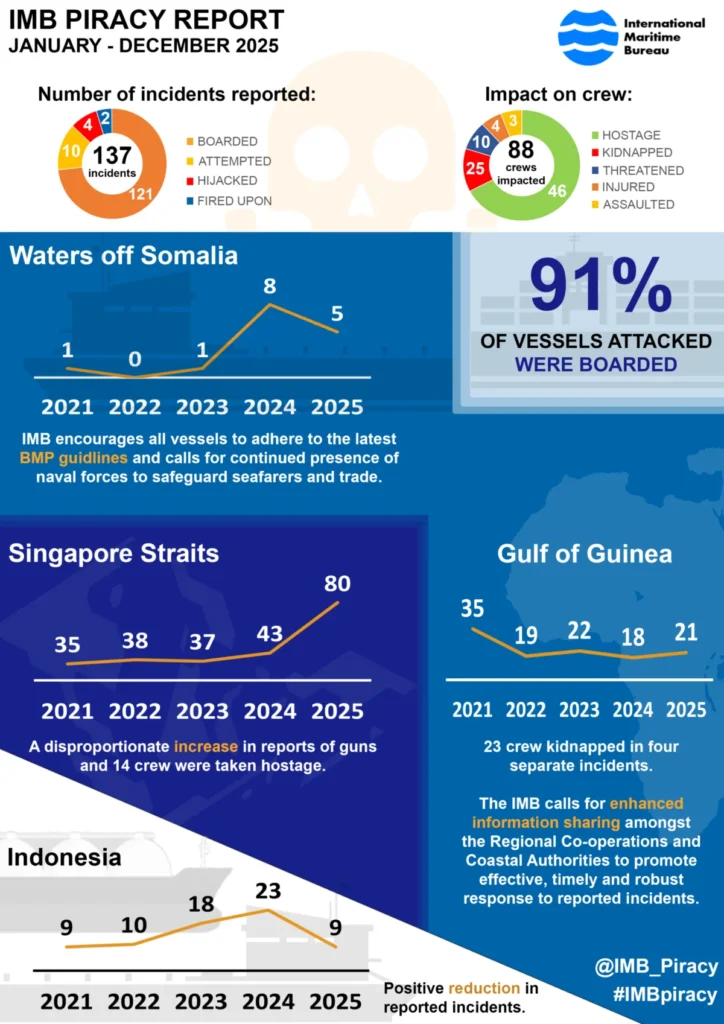
According to the IMB Annual Piracy and Armed Robbery Report, 2025 saw 137 recorded incidents against ships worldwide. This marks a notable increase from the 116 incidents reported in 2024 and 120 in 2023. The nature of these encounters paints a sobering picture of modern maritime insecurity: 121 vessels were successfully boarded, four ships were hijacked, two were fired upon, and 10 reported attempted attacks.
While the majority of these incidents have been classified by the IMB as "low-level" opportunistic robberies, the cumulative impact on the maritime sector is significant. The primary epicenter of these disturbances is the Singapore Straits, a vital artery for global commerce that has seen a concerning concentration of unauthorized boardings. Conversely, the threat of Somali piracy, which once terrorized the Indian Ocean, has remained largely contained, largely due to the sustained and visible presence of international naval task forces that continue to patrol the Horn of Africa.
Chronology of Trends: A Three-Year Comparative Analysis
To understand the trajectory of maritime crime, one must look at the shifting metrics over the past 36 months. The data suggests that while the frequency of attacks is on the rise, the nature of the violence is becoming increasingly sophisticated.
The Rise in Armed Confrontation
A particularly alarming trend identified in the 2025 report is the growing reliance on firearms by assailants. In 2025, guns were reported in 42 separate incidents, a stark rise from 26 in 2024. This trend suggests that criminal syndicates are becoming better equipped and more emboldened. In contrast, the use of knives—the traditional tool of opportunistic maritime robbers—dropped slightly to 33 incidents from 39 in 2024, indicating a shift toward more lethal force during boarding attempts.
Impact on Human Capital
The human cost of these incidents remains the most critical concern for shipping companies and international unions alike.
- Hostage Situations: In 2025, 46 crew members were taken hostage. While this represents a decrease from the high of 126 in 2024 and 73 in 2023, the psychological and physical toll remains immense.
- Kidnappings: The data reveals a disturbing spike in kidnappings, with 25 crew members reported kidnapped in 2025, compared to 12 in 2024 and 14 in 2023.
- Direct Violence: Beyond confinement, the report notes that 10 crew members were threatened, four were injured, and three were assaulted during these encounters.
These figures demonstrate that even as global naval patrols grow more effective at preventing large-scale hijackings, the threat to individual seafarers remains a persistent, evolving danger.
Supporting Data: Regional Hotspots and Operational Vulnerabilities
The Singapore Straits have emerged as the primary area of concern for shipmasters. The dense traffic in this waterway, combined with the proximity of multiple jurisdictions, creates a challenging operational environment where robbers can board, steal equipment or cargo, and vanish into the night before local authorities can effectively intercept them.
The IMB’s data suggests that these incidents are rarely random. They are often targeted, occurring under the cover of darkness, and frequently involve small, fast-moving skiffs that can maneuver alongside slow-moving container vessels or bulk carriers.
Global Incident Breakdown (2023–2025)
| Metric | 2023 | 2024 | 2025 |
|---|---|---|---|
| Total Incidents | 120 | 116 | 137 |
| Vessels Boarded | N/A | N/A | 121 |
| Crew Taken Hostage | 73 | 126 | 46 |
| Crew Kidnapped | 14 | 12 | 25 |
| Incidents involving Guns | N/A | 26 | 42 |
The fluctuations in hostage-taking versus kidnapping numbers reflect a changing business model for maritime criminals. Where hijackings once focused on the theft of entire vessels for ransom, modern criminal groups appear to be shifting toward the abduction of high-value crew members, a practice that allows for quicker, more discreet ransom negotiations.
Official Responses: A Call for Global Solidarity
The publication of the 2025 report has triggered immediate reactions from international maritime bodies. ICC Secretary General John W.H. Denton AO issued a stern reminder regarding the symbiotic relationship between maritime safety and global economic health.
"Maritime trade remains a cornerstone of real economic activity and growth," Denton stated. "The rise in reported maritime incidents highlights the importance of protecting seafarers and securing key shipping routes—not only for crew safety but for the stability of global supply chains and the economies that depend on them."
Denton emphasized that the solution cannot be unilateral. "Ensuring safe passage at sea requires sustained cooperation, with regional and international partners working together to safeguard maritime commerce. No single nation can patrol the entirety of the world’s oceans; success relies on information sharing, collaborative regional patrols, and a zero-tolerance approach to piracy in territorial waters."
Industry analysts have echoed this sentiment, noting that the "containment" of Somali piracy should serve as a blueprint. The success of the Combined Maritime Forces (CMF) and the EUNAVFOR Atalanta mission proved that when world powers coordinate their intelligence and naval assets, they can effectively suppress even the most entrenched pirate networks.
Implications: The Future of Maritime Security
The implications of the 2025 findings are far-reaching, touching upon insurance premiums, crew welfare, and the future of maritime law enforcement.
1. Insurance and Operational Costs
Increased risk in specific corridors often leads to higher War Risk Insurance premiums for shipping companies. These costs are inevitably passed down the supply chain, contributing to inflationary pressures on consumer goods. If the trend in the Singapore Straits and other hotspots continues, shipowners may be forced to implement more expensive onboard security measures, including private maritime security contractors (PMSCs) and hardening of vessels.
2. The Human Element
The mental health of seafarers is increasingly under the spotlight. Beyond the physical injuries sustained during boardings, the constant threat of violence is a significant stressor for crew members who spend months at sea. Maritime unions are calling for stronger protections, including "citadels" (secure rooms) on all commercial vessels and better integration of satellite-based monitoring systems that can alert authorities in real-time.
3. Legal and Jurisdictional Challenges
One of the most complex aspects of maritime security is the jurisdictional gray area. When an incident occurs in the territorial waters of a state, that state has the primary responsibility for law enforcement. However, if that state lacks the resources or the political will to aggressively prosecute maritime criminals, the international shipping industry suffers. The IMB is advocating for stronger legal frameworks that allow for the seamless extradition and prosecution of maritime criminals, ensuring that there are no "safe havens" for those who attack merchant vessels.
4. Technological Integration
As we look toward 2026 and beyond, the role of technology in maritime security will become more pronounced. Artificial Intelligence (AI) is already being tested to track suspicious vessel patterns, identifying behavior that deviates from standard transit lanes. Furthermore, the use of Unmanned Aerial Vehicles (UAVs) for long-range surveillance of high-risk areas could provide an early warning system for commercial vessels, allowing them to take evasive action before boarders can get within range.
Conclusion
The 2025 IMB report serves as both a warning and a call to action. While the international community has proven that it can suppress large-scale pirate threats through naval cooperation, the persistent rise in localized incidents demonstrates that the battle for maritime security is far from won.
As the global economy becomes increasingly interconnected, the safety of the men and women serving on the front lines of trade is paramount. Whether through the modernization of naval patrols, improved intelligence sharing, or the deployment of advanced surveillance technologies, the maritime industry must prioritize the security of its vessels. The goal is clear: to ensure that the world’s oceans remain a conduit for prosperity, rather than a theater for criminal exploitation. Only through a unified, persistent, and proactive approach can the international community guarantee the safety of the vital corridors upon which our modern world depends.