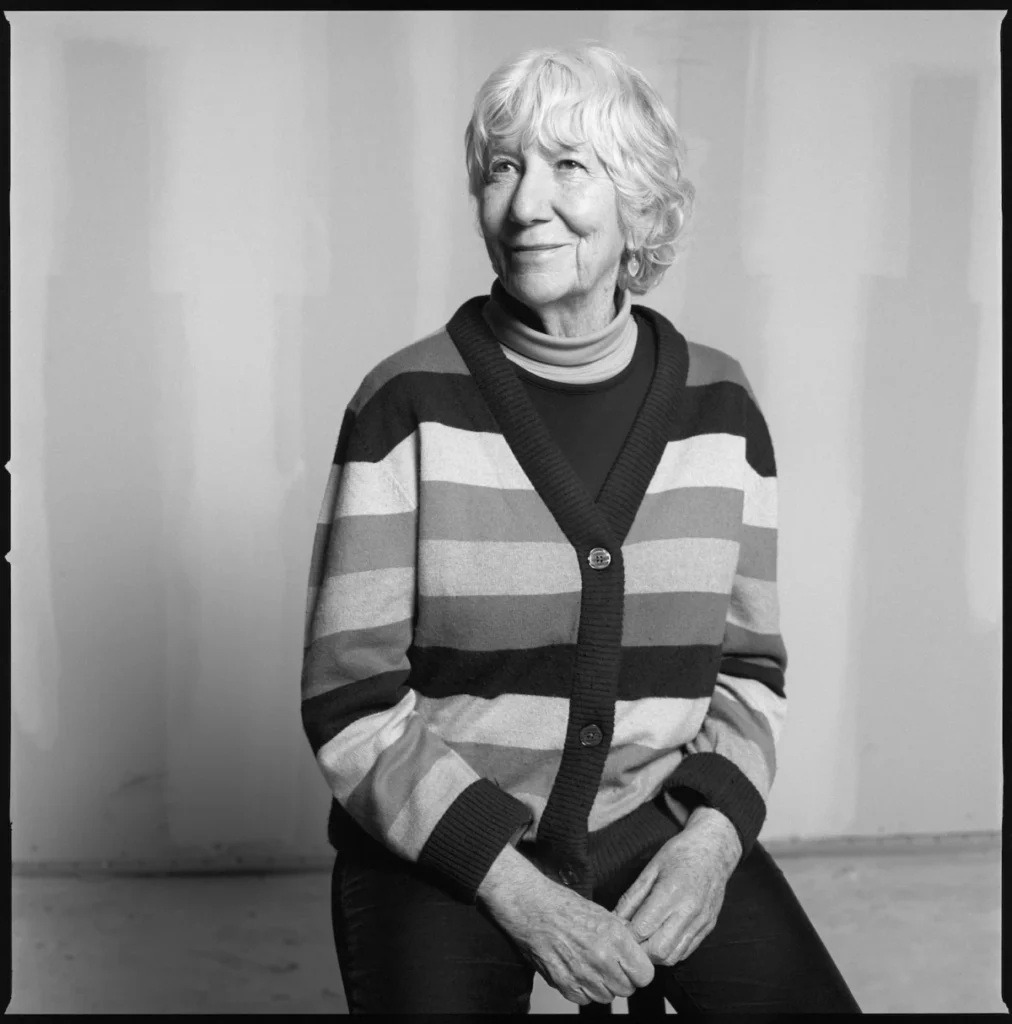
Mary Heilmann, a singular force in the landscape of contemporary abstraction whose work bridged the intellectual rigor of Minimalism with the sun-drenched, irreverent spirit of West Coast counterculture, passed away on Friday in Riverhead, New York. She was 86. Her studio announced the passing via an Instagram statement, noting that the artist died due to complications following a fall.
Heilmann’s death marks the conclusion of a career that defied the rigid silos of the art world. An artist who spent decades operating just outside the mainstream before finally being embraced by the institutions that had long overlooked her, she leaves behind a legacy defined by vibrant color, structural wit, and an unyielding commitment to the joy of painting.
A Life of Synthesis: From California to New York
Born Mary Ann Heilmann on January 3, 1940, in San Francisco, she was the daughter of Mary Florence Webb, a nurse, and John Sherman Heilmann, a civil engineer. Her upbringing was quintessential California; the family moved between the Bay Area and the burgeoning sprawl of Los Angeles, settling in the seaside village of El Segundo. This geographical duality—the industrial engineering of her father’s freeway projects and the fluid, organic rhythm of the Pacific surf—would become the foundational DNA of her aesthetic.
Heilmann’s formative years were steeped in the intellectual and social ferment of the late 1950s and 60s. She was an observer of the Beat Generation, an enthusiast of the emerging surf culture, and a witness to the burgeoning free speech movement. These experiences imbued her with a sensibility that favored freedom and spontaneity over the austere, detached logic that dominated the East Coast art scene at the time.
She began her formal artistic education in ceramics, earning a bachelor’s degree from the University of California, Santa Barbara, in 1962. It was at UC Berkeley, however, where she found her stride, studying under the legendary Peter Voulkos. Voulkos was a revolutionary who pushed the medium of clay into the realm of Abstract Expressionism, treating ceramic vessels as canvases for gestural, raw energy. This marriage of craft and high-modernist theory would become a hallmark of Heilmann’s own practice.
In 1967, armed with her MFA, Heilmann made the pivotal move to New York City. The transition from the West Coast to the grit of lower Manhattan served as a catalyst for her shift toward painting. She adopted acrylics with a fervor, favoring lush, high-key palettes that stood in stark contrast to the monochromatic sobriety favored by her contemporaries.
Chronology: A Career of Persistence and Recognition
Heilmann’s career was a testament to the power of perseverance. While she gained early notice—most notably her inclusion in the 1972 Whitney Annual, the precursor to the modern Biennial—she spent many of her middle years as an "artist’s artist," widely admired within the studio community but often under-recognized by the broader museum apparatus.

The Formative Decades (1970–1990)
During the 70s and 80s, Heilmann meticulously developed a vocabulary of simple geometric forms—circles, squares, and stripes—that functioned as containers for personal history. She famously titled her works after songs, memories, or specific landscapes, bridging the gap between the viewer’s lived experience and the abstract nature of the canvas. Her work during this period, such as her experiments with layering gestural compositions beneath hard-edge, masked-off shapes, allowed her to achieve a technical freedom that felt both deliberate and accidental.
The Institutional Breakthrough (1990–2010)
The 1990s marked a shift in her institutional standing. A survey at the ICA Boston in 1990 and her "All Tomorrows Parties" exhibition at the Vienna Secession signaled a growing international interest. However, it was the 2008 retrospective organized by the New Museum in New York—her first major solo show at a New York institution—that truly cemented her status. As art critic Dave Hickey noted in the catalog for that exhibition, Heilmann’s work "looted" the canons of Minimalism and Color Field painting, honoring their spirit while discarding their pretension.
The Late-Career Renaissance (2010–2026)
Following the New Museum show, Heilmann enjoyed a "steady parade" of exhibitions, proving that for some, the peak of a career is not a static point but a sustained climb. She exhibited at the Bonnefantenmuseum, the Hamburger Bahnhof, Whitechapel Gallery, and Dia Beacon. Her 2023–2024 show at the Whitney Museum, Mary Heilmann: Long Line, served as a triumphant retrospective of an artist who had mastered the art of staying current by remaining stubbornly, beautifully herself.
The Hauser & Wirth Partnership: "Our First Love"
A critical pillar of Heilmann’s professional life was her long-standing relationship with the gallery Hauser & Wirth. Joining the gallery in 1997, just five years after its inception, she became a foundational figure for the institution.
Iwan Wirth, the gallery’s president, offered a poignant reflection following her passing: "Manuela, Ursula, and I met Mary in the spring of 1994. We were introduced to her by the artist Patty Martori and we started to collect her work right away. Mary also introduced us to other artists she knew and admired like Louise Bourgeois. Our first project with Mary was her book The All Night Movie, which is kind of an autobiography as an artist book… Mary was really our first love."
This relationship was characterized by mutual respect and a shared appreciation for the intersection of life and art. Heilmann did not just produce objects; she produced environments. She designed furniture and collaborated on installations, viewing the gallery space not as a white cube to be filled, but as a site of social interaction and aesthetic experience.
Implications: The Legacy of a "New Abstractionist"
The significance of Mary Heilmann’s contribution to art history cannot be overstated. By the time of her 2008 retrospective, none other than Ellsworth Kelly had declared her "the best of the new abstractionists." This was high praise from an artist known for his own rigorous adherence to form, yet it captured the essence of Heilmann’s appeal: she managed to make abstraction feel human.

The Democratization of Abstraction
Heilmann broke the "boys’ club" barrier of 1960s and 70s abstraction by refusing to subscribe to its humorless, hyper-intellectualized tropes. She introduced pop culture, the memory of a highway, or the mood of a surf track into the equation, inviting the audience to engage with her work through feeling rather than just scholarly analysis.
Pedagogical Impact
For decades, Heilmann balanced her studio practice with a career in academia. As a professor at Stony Brook University and later at the School of Visual Arts in New York, she mentored generations of painters. Her teaching was not merely a financial necessity; it was an extension of her belief that art is a conversation. She encouraged her students to look outside the studio, to incorporate the "real world" into their compositions, and to find the humor in their own creative processes.
A Lasting Cultural Mark
Heilmann’s influence is visible in the work of countless contemporary painters who utilize bright, synthetic colors and bold, simple geometries. By stripping away the ego and focusing on the tactile, visceral quality of paint—often referring to her works as "sculptural material"—she provided a roadmap for how abstraction could remain vital and urgent in a digital, image-saturated world.
Conclusion: A Life Well-Painted
In her final years, Heilmann made her home in Bridgehampton, New York, a place she had visited since the 1960s. Living among the landscapes that she had spent decades translating into color and form, she remained an active, vital member of the community. She is survived by her nieces, Ann Jaime and Chris Heilmann, and her nephew, John Heilmann, Jr., along with their families.
As the art world mourns the loss of one of its most cherished figures, it is impossible not to view her body of work as a mirror to her life: generous, bold, and unapologetically vibrant. Mary Heilmann taught us that the canvas is not a barrier between the artist and the world, but a bridge. Whether through a perfectly placed stripe of cobalt blue or the rhythmic tension of a square, she found a way to map the complexities of the human experience onto the surface of a painting. Her work remains, as she often intended it, a place for us to gather, look, and feel.