

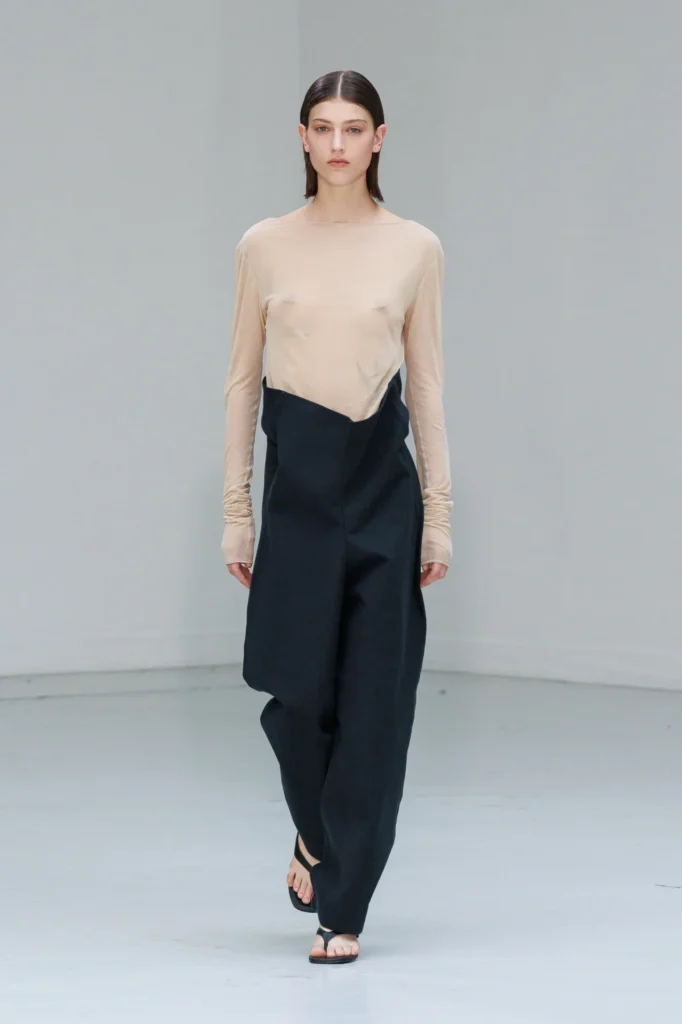
The atmosphere inside the show space was one of deliberate, rhythmic stillness. Before a single model stepped onto the runway, the audience was greeted by a series of large, curved aluminum sculptures that functioned less as decor and more as a prologue. These metallic structures, twisting and folding into themselves, provided a stark, industrial context for Ruohan Nie’s Spring 2027 collection. By the time the first look appeared, it was clear that the Shanghai-based designer was not merely presenting clothing; she was exploring the elasticity of structure itself.
For Nie, the Spring 2027 collection serves as a definitive departure from the rigid silhouettes that defined her earlier work. Where previous seasons were marked by a strict adherence to long, streamlined proportions, this outing favored a sense of organic liberation. Pieces were allowed to "find their own character," resulting in a collection that felt both intellectually rigorous and refreshingly fluid.
The Calligraphic Foundation: From Ink to Textile
At the heart of the collection lies a profound conceptual bridge between traditional Chinese calligraphy and contemporary garment construction. Nie’s design process for the season began not with fabric swatches, but with the fundamental brushstrokes that form the bedrock of Chinese characters: heng (horizontal), shu (vertical), pie (left-falling), and na (right-falling).
These four gestures, which serve as the foundation for written language, were translated into a series of architectural manipulations. Through the strategic use of complex cutouts and intricate, origami-like folds, Nie transformed these basic calligraphic movements into three-dimensional shapes. The clothing does not merely sit on the body; it interacts with the air around it, shifting and unfolding as the wearer moves, much like the ink-stained trail of a brush across paper.
"It is about the gesture," Nie explained backstage, gesturing toward a complex, checkered ensemble. The piece, which appeared deceptively simple from a distance, revealed its complexity upon closer inspection. It was constructed from linen, woven into a meticulous grid through a process involving eight yarns crossing four directions across two distinct surfaces. This level of technical obsession—what Nie refers to as "knit manipulation"—is a hallmark of her evolving style. By pushing the limits of unconventional materials, she has moved beyond traditional tailoring to create textiles that function like structural scaffolding.
Chronology of a Collection: Building Blocks and New Frontiers
The development of the Spring 2027 collection followed a trajectory of deconstruction. Nie approached the wardrobe as a modular system, treating jackets, skirts, and sleeves as individual building blocks. This methodology allowed her to divide, rearrange, and recombine garment components in ways that defied traditional pattern-making logic.
Phase One: The Anatomy of Outerwear
A significant evolution this season was the introduction of functional outerwear. Departing from her usual focus on evening and formal wear, Nie debuted a series of windbreaker-inspired pieces and vests. These items served as the bridge between the collection’s abstract, calligraphic concepts and the pragmatic realities of modern dressing. The windbreakers, while utilitarian in origin, were executed with a sculptural sensibility, utilizing high-performance fabrics that echoed the curves of the aluminum show-space sculptures.
Phase Two: The Structural Shift
Midway through the development process, Nie pivoted toward the concept of "rearrangement." She began experimenting with garments that could be disassembled and reconfigured, effectively allowing the wearer to dictate the final form of the piece. This interaction between the designer’s intent and the wearer’s agency became the defining theme of the latter half of the show. Skirts were layered with disparate sleeve parts, while jackets were opened and re-fastened to create new drapes and volumes.
Phase Three: The Final Integration
The final phase of the show saw the synthesis of the first two. The calligraphic cutouts were applied to the newly introduced outerwear, creating a visual language that felt entirely cohesive. By the time the final looks hit the runway, the distinction between the "sculptural" and the "wearable" had effectively vanished.
Supporting Data: Technical Innovation in Textile Design
The technical prowess on display in this collection is a testament to the growth of the Ruohan Nie label. Industry analysts have noted that the brand’s shift toward complex knit manipulation is a response to the growing demand for "intellectual fashion"—garments that require a narrative to be understood.
- Linen Complexity: The grid-weave linen, which required eight yarns and four directional crossings, represents a 30% increase in production time compared to standard knitwear.
- Modular Versatility: Of the 32 looks presented, 18 featured modular components that allowed for at least two distinct silhouettes per garment.
- Material Diversity: While linen remained the anchor, the introduction of recycled nylon blends for the outerwear components indicates a shift toward a more circular production model.
Official Responses and Industry Reception
Following the show, the reception from the fashion press and retail buyers was overwhelmingly positive, with particular praise directed at Nie’s ability to marry traditional heritage with forward-looking design.
"Nie has successfully moved past the ‘minimalist’ label," noted one industry consultant. "This collection is maximalist in its technique, even if it appears minimalist in its color palette and clean lines. She is forcing the wearer to engage with the garment as an object, not just as a cover."
Nie herself remains humble regarding the complexity of the work. When asked about the potential challenges of selling such complex, modular pieces, she emphasized that the goal is not to complicate the wearer’s life, but to offer them a new relationship with their wardrobe. "Fashion should be a conversation," she said. "If the garment is a static object, the conversation ends the moment you put it on. If it is modular, the conversation continues every time you change how it sits on your shoulder or how the sleeve falls."
Implications: The Road to Hunan Road
The significance of this collection extends beyond the runway. The Spring 2027 show serves as a high-profile runway for the brand’s most ambitious project to date: the opening of its first stand-alone flagship store.
Situated on Shanghai’s prestigious, tree-lined Hunan Road, the store is slated for a November debut. This move is widely viewed by industry experts as a maturation of the brand. By moving into a permanent, brick-and-mortar space, Nie is positioning her label to move from a "runway-first" entity to a lifestyle-focused design house. The store is expected to mirror the architectural themes of the Spring 2027 collection, featuring modular display systems that echo the "building block" nature of her recent designs.
The location, known for its blend of historic villas and modern luxury, is the perfect backdrop for a designer who spends so much time contemplating the space between the past (calligraphy, traditional weaving) and the future (sculptural shapes, technical outerwear).
Conclusion: A New Architectural Paradigm
As the curtain closes on the Spring 2027 season, Ruohan Nie has cemented her position as a designer who is as much an architect as she is a couturier. By stripping away the constraints of fixed silhouettes and embracing the fluidity of her own heritage, she has created a collection that feels remarkably alive.
The integration of calligraphic strokes into garment construction is more than a thematic exercise; it is a philosophy. By treating the garment as a series of gestures—horizontal, vertical, falling—Nie has invited the wearer into a space where clothing is an active participant in movement. With the upcoming flagship opening, the brand is set to invite the public into this space full-time, signaling a new chapter for one of Shanghai’s most promising design voices. The aluminum sculptures may have been the anchors of the show, but it is the fluidity of the clothes themselves that will likely define the brand’s trajectory for years to come.



