The international art market is currently witnessing an unprecedented renaissance in South Asian modernism. Once considered a niche interest for regional collectors, works by masters from India and Pakistan have ascended to the highest echelons of global trade. In 2024 and early 2025, auction sales for the category shattered the $100 million ceiling, driven by aggressive bidding at premier houses like Christie’s and Sotheby’s. However, this financial windfall has brought with it a predatory shadow: a sophisticated and rapidly expanding market for forgeries.
As valuations for artists such as S.H. Raza, M.F. Husain, and Sadequain reach stratospheric heights, the incentive for counterfeiters has shifted from amateurish imitation to high-stakes fraud. Experts now warn that the very success of the South Asian art market may be its greatest vulnerability, as a lack of comprehensive documentation and restrictive legal frameworks in the region allow fakes to circulate with alarming frequency.
Main Facts: A Market in Conflict
The dual nature of the South Asian art scene is currently defined by record-breaking prosperity and deep-seated systemic risk. On one hand, the "blue-chip" status of the Progressive Artists’ Group and their contemporaries is no longer in question. On the other, the infrastructure required to protect these assets—provenance archives, forensic authentication, and legal protections for whistleblowers—has failed to keep pace with the influx of capital.
The $100 Million Milestone
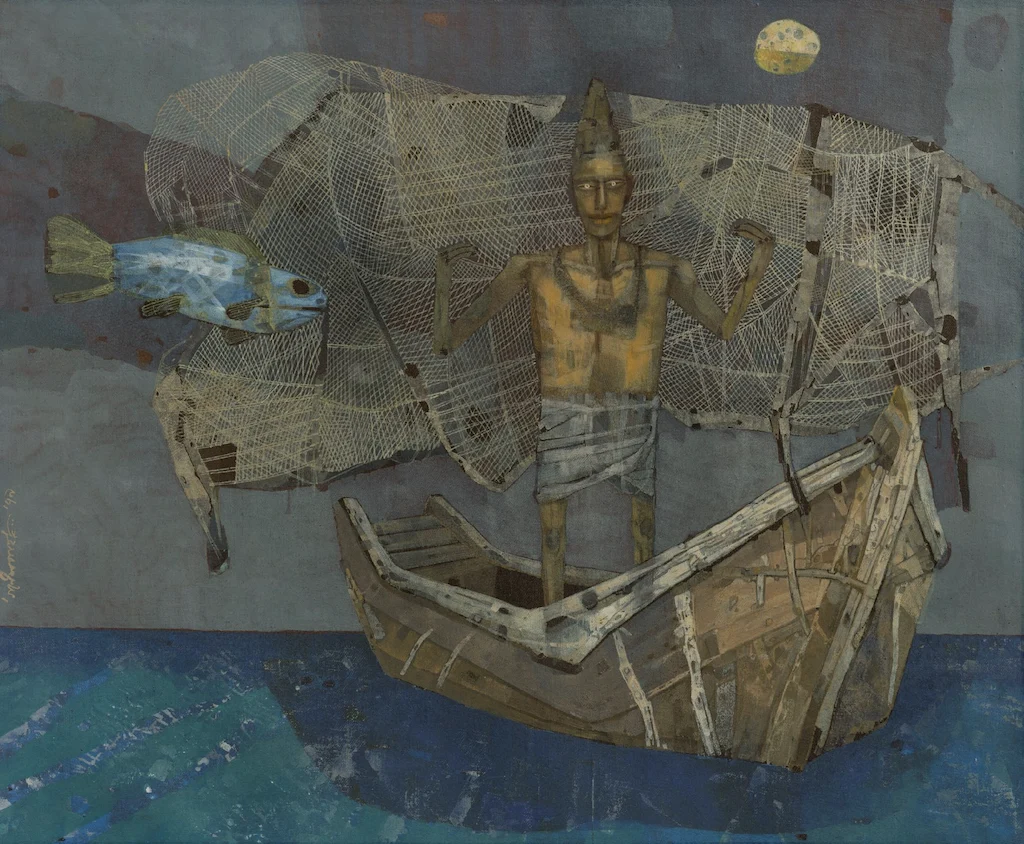
In the last calendar year, the cumulative auction turnover for South Asian modern and contemporary art exceeded $100 million. This milestone was punctuated by Christie’s first dedicated London auction of South Asian art since 2019, titled Sublime Shadows. The sale was a "white-glove" event, with every one of the 93 lots finding a buyer, totaling approximately $25.5 million. The standout performer was Ganesh Pyne’s The Fisherman, which fetched $5.22 million—more than ten times its low estimate—setting a new auction record for the artist.
The Scale of the Forgery Problem
While the headlines celebrate these figures, dealers on the ground describe a "menace" that is becoming increasingly difficult to contain. Dadiba Pundole, owner of the prestigious Pundole Art Gallery in Mumbai, estimates that as many as 10% of modern artworks sold privately in India are fakes. The issue is no longer confined to the "trophy" works of the most famous names; as prices rise, it has become economically viable for counterfeiters to target middle-market artists whose works sell in the five-to-six-figure range.
Chronology: From Regional Interest to Global Crisis
To understand the current crisis, one must look at the trajectory of the South Asian art market over the past two decades.
- The Early 2000s: The Initial Boom. Following India’s economic liberalization, a new class of wealthy domestic and diaspora collectors began repatriating modern masterpieces. Prices for the "Big Five" (Husain, Raza, Souza, Tyeb Mehta, and Gaitonde) began their steady climb. At this stage, fakes were relatively rare and often crudely executed.
- 2010–2020: Maturation and the "Spurt." As the $1 million mark became a common occurrence for top-tier works, the forgery industry professionalized. According to Pundole, the last 15 years have seen a significant "spurt" in the volume of counterfeit works entering the market, coinciding with the globalization of the category.
- 2021–Present: The Post-Pandemic Surge. The digital shift in the art world during the COVID-19 pandemic accelerated the problem. With more buyers purchasing art based on digital catalogs and WhatsApp images rather than physical inspection, the "gatekeeper" role of the experienced dealer was bypassed, allowing questionable works to move more freely across borders.
Supporting Data: The Anatomy of an Art Fraud
The evidence of a "shadow market" is found in the daily experiences of specialists and the cooling of specific artist categories.
The "WhatsApp Gallery" Phenomenon
In Pakistan, the scale of the issue is particularly visible through informal digital channels. Salima Hashmi, a renowned artist and academic based in Lahore, reports being sent images of 60 to 70 forged modern works every year via WhatsApp. These works are often offered by private sellers to unsuspecting buyers under the guise of "undiscovered" family heirlooms.
The Sadequain Precedent
The Pakistani modernist Sadequain serves as a cautionary tale for the entire market. Once a high-flyer whose works commanded six-figure sums, Sadequain’s market has notably cooled. Collectors and specialists attribute this directly to an influx of high-quality forgeries. Hameed Haroon, a prominent collector, noted that when a market becomes saturated with uncertainty, even "the real McCoy" loses its value because the "premium price" is predicated on authenticity. If a buyer cannot be 100% certain of a work’s origin, they simply stop buying.
Global Context: China and Japan
The problem is not unique to South Asia, providing a grim forecast of what can happen when fraud goes unchecked.
- China: Recently, two former managers of the Shanghai Jiahe Auction Co. were sentenced to over 12 years in prison for a fraud scheme involving $74 million. In one egregious instance, a vase sold for $247,000 as a Qianlong-era masterpiece was later valued at just $37—a modern reproduction.
- Japan: The Japanese market is still untangling the legacy of Wolfgang Beltracchi, the notorious German forger. His fakes have surfaced in Japanese museum collections (such as the Museum of Art, Kochi) and corporate holdings (Yamada Bee Company Group), highlighting how even institutional "eyes" can be deceived when a forger is sufficiently skilled.
Official Responses: Defensive Measures and Legal Barriers
Auction houses and veteran dealers have established several layers of defense, though these are often reactive rather than proactive.
The Role of the Specialist "Eye"
Manjari Sihare-Sutin, Head of Sotheby’s South Asian Modern and Contemporary department, emphasizes that the primary defense remains the trained eye. Her team rejects an average of two works for every auction due to authenticity concerns. When documentation is missing, the house relies on:
- Archives: Private databases of unpublished sketches, letters, and photographs.
- Artist Estates: Consultations with the families and foundations of deceased artists.
- Comparative Analysis: Side-by-side comparisons with known, authenticated works in museum collections.
The "Code of Silence" and Legal Risks
One of the most significant hurdles in cleaning up the South Asian market is the legal environment in India and Pakistan. Both countries have strict criminal defamation laws that can be weaponized against experts who publicly label a work as fake.
Mumbai dealer Shireen Gandhy explains that specialists often have to operate through a "private whisper" network. While an expert might tell a close associate "Don’t touch it" regarding a specific painting, they are often legally barred from making a public declaration that could damage the commercial interests of a seller, even if that seller is peddling a known forgery. This creates a lack of transparency that benefits the counterfeiters.
Implications: The Future of Market Confidence
The proliferation of fakes has far-reaching consequences that extend beyond the immediate financial loss to a single buyer.
Erosion of Institutional Trust
For a market to remain sustainable, it requires institutional participation—museums, public galleries, and corporate collections. When forgeries enter these "sanctified" spaces, as seen in the Japanese and Chinese examples, the entire category suffers a loss of prestige. For South Asian art, which has only recently gained a foothold in Western museums like the Tate and MoMA, a major forgery scandal could set back decades of progress.
The Vulnerability of Online Sales
The modern art trade is increasingly digital, with 15% of global sales now occurring online. This trend is a double-edged sword. While it expands the buyer pool, it removes the physical scrutiny that has historically protected the market. Smaller auction houses, which may lack the specialized expertise of a Sotheby’s or Christie’s, are particularly vulnerable to being used as conduits for "laundered" fakes that then acquire a provenance simply by having been sold at auction.
The Threat of the "Single Scandal"
The most pressing concern for the industry is the potential for a "market-clearing" scandal. As Dadiba Pundole warns, it only takes one high-profile lawsuit or a widely publicized failure of a "masterpiece" to knock the confidence of the entire sector. In a market where documentation is scarce and archives are rare, confidence is the only true currency.
Conclusion: A Precarious Peak
South Asian modern art is currently enjoying its "Golden Hour," but the light is casting long, distorted shadows. The transition from a regional market to a global one has outpaced the development of the necessary safeguards. To protect the legacy of artists like Raza, Husain, and Pyne, the industry must move toward greater transparency, the creation of robust catalogues raisonnés, and a legal environment where experts can speak the truth without fear of litigation.
Until then, the market remains a high-stakes environment where the "trained eye" is the only thing standing between a multi-million dollar investment and a worthless piece of canvas. The message from the experts is clear: as the value of South Asian art continues to rise, so too must the vigilance of those who trade in it.