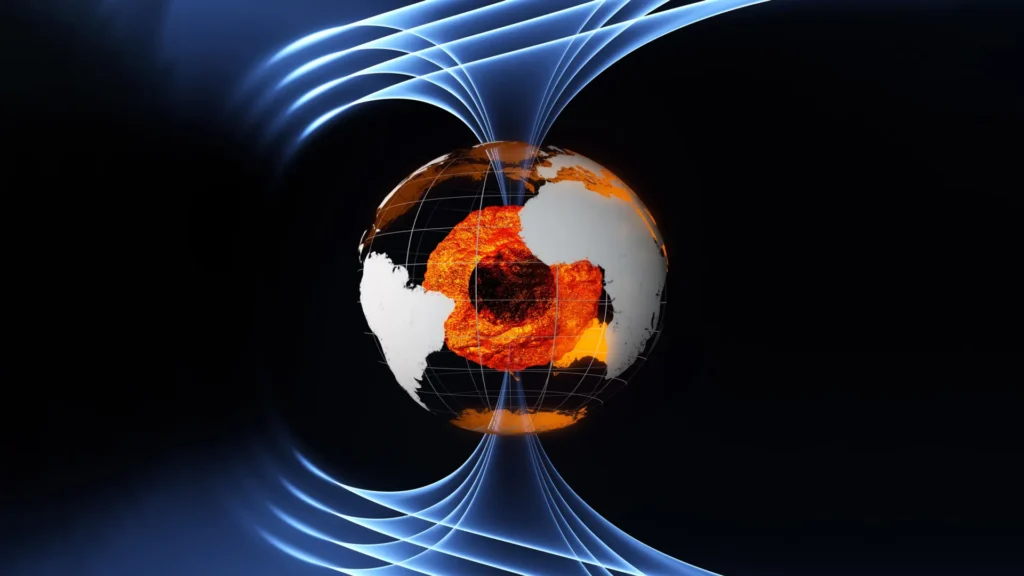
Deep beneath the Pacific Ocean, roughly 2,200 kilometers below the Earth’s surface, a massive, invisible engine is churning. For decades, geophysicists believed this engine—the molten outer core of our planet—operated with a predictable, steady rhythm. However, a groundbreaking study published in the Journal of Studies of Earth’s Deep Interior has shattered that consensus, revealing that the liquid iron powering our magnetic field is far more volatile than previously imagined.
By synthesizing nearly three decades of satellite data and ground-based observations, researchers have confirmed that in 2010, a vast region of molten material beneath the Pacific abruptly reversed its direction. This unexpected shift from a westward to an eastward flow has left the scientific community scrambling to understand the mechanics of the deep Earth and the potential implications for our planet’s protective magnetic shield.
The Engine of Life: Understanding the Geodynamo
To appreciate the significance of this discovery, one must understand the role of the outer core. Earth’s magnetic field is generated by a process known as the "geodynamo." As the planet rotates, the electrically conducting liquid iron in the outer core circulates around the solid inner core. This motion acts like a colossal electrical generator, creating the magnetic field that envelops our planet.
This field is not merely a scientific curiosity; it is a fundamental requirement for life. It acts as an invisible shield, deflecting the lethal barrage of charged particles and radiation emanating from the Sun. Without this protective barrier, our atmosphere would be slowly stripped away, and our modern technological infrastructure—ranging from global navigation satellites to power grids—would be left vulnerable to the volatile whims of space weather.
For years, the prevailing model of core dynamics suggested that the large-scale circulation of this liquid iron was dominated by a steady westward drift. While minor variations were expected, the general "current" of the core was thought to be consistent. The 2010 event, however, proved that the core is capable of dramatic, localized fluctuations that defy these established norms.
A Chronology of Turbulence: The 2010 Reversal
The timeline of this discovery is a testament to the power of international collaboration and the longevity of space missions. Researchers analyzed a massive dataset spanning from 1997 through 2025, drawing on information from a fleet of satellites including ESA’s Swarm and CryoSat missions, as well as the German CHAMP and the Ørsted mission.
The Turning Point
- 1997–2009: Magnetic data indicated that the broad, equatorial flow of iron beneath the Pacific was characterized by a weak westward motion. This aligned with the long-standing scientific view of core stability.
- 2010: A sudden, anomalous shift occurred. Satellite measurements detected that the region began a strong, persistent eastward flow. This was not a minor tremor but a significant reorganization of fluid dynamics deep within the mantle-core boundary.
- 2017: The core experienced a "geomagnetic jerk"—a rapid, localized change in the acceleration of the magnetic field. This event, now linked to the Pacific flow reversal, underscored how deeply connected surface observations are to the hidden churn of the core.
- 2020–Present: The eastward flow, which had dominated for a decade, began to show signs of weakening. This transition has led researchers to question whether the reversal was a transient pulse or the beginning of a long-term, cyclical shift in the planet’s internal rhythm.
Supporting Data: The Eyes in the Sky
The study of the Earth’s core is notoriously difficult. Because we cannot drill to such depths, we must rely on "remote sensing" of the magnetic field. The key to this research was the Swarm mission, launched by the European Space Agency (ESA) in 2013.
The Swarm constellation consists of three satellites carrying highly sensitive magnetometers. Because these satellites orbit in a highly coordinated fashion, they act as a "magnetic stethoscope," allowing scientists to isolate the signals originating from the core from the "noise" of the ionosphere, the oceans, and the Earth’s crust.
"Although Swarm was launched after the initial 2010 event, it provided the high-precision, continuous global coverage required to track the evolution of the flow," says Anja Stromme, ESA’s Swarm Mission Manager. "By moving away from a reliance on limited ground-based observatories, we can now observe the geodynamo in something approaching near-real-time. This is essential for distinguishing between short-lived fluctuations and permanent structural changes."
The data revealed wave-like accelerations and flow structures that were previously buried in the noise of older datasets. These findings indicate that the outer core is a highly turbulent environment, where regional changes can emerge and evolve within the span of a single decade.
Expert Perspectives and Official Responses
Frederik Dahl Madsen, lead author of the study from the University of Edinburgh’s School of Geosciences, believes this discovery opens a new chapter in geophysics. "The large-scale flow reversal beneath the Pacific raises profound questions," Madsen noted. "We are currently trying to determine if this is a short-lived fluctuation, a repeating oscillation, or a shift toward a new stable equilibrium. Our models show a potential connection between this flow reversal and changes in the behavior of the solid inner core, as inferred from recent seismological data."
The hypothesis that the inner core—a solid iron sphere—is "talking" to the outer core through gravitational or magnetic coupling is gaining traction. If the two layers are dynamically linked, it suggests that Earth’s internal cooling process is more complex than a simple steady-state model.
Elisabetta Iorfida, an ESA Swarm Mission Scientist, emphasizes the broader implications: "This study challenges the assumption that stable westward circulation is the absolute rule. We are seeing that the core-mantle boundary is a critical, high-energy region. The dynamic connection between the core and the lower mantle might be the missing piece of the puzzle in explaining why the magnetic field shifts as it does."
Implications: Why the Core Matters
While the events occurring 2,200 kilometers beneath our feet do not pose an immediate threat to the climate or human safety, they are central to the "predictive science" of our planet.
Navigational Accuracy
The magnetic field is the foundation of global navigation. Aircraft, shipping vessels, and even smartphones rely on magnetic compasses and models of the geomagnetic field. As the core’s flow changes, the magnetic North Pole shifts, and the intensity of the field varies. Understanding these core-driven changes is vital for maintaining the accuracy of the World Magnetic Model (WMM), which underpins global navigation systems.
Space Weather Resilience
The strength of our magnetic field fluctuates in response to the core’s dynamics. As we become an increasingly space-faring civilization, our reliance on satellites in Medium Earth Orbit (MEO) and Geostationary Orbit (GEO) increases. A deeper understanding of the geodynamo allows scientists to better model space weather, ensuring that satellites can be hardened or maneuvered to avoid the most intense radiation events triggered by solar flares.
The Deep Earth Connection
Perhaps most importantly, this research provides a window into the deep history and future of the planet. The core is the engine that drives plate tectonics, influences volcanic activity, and ultimately dictates the cooling rate of the Earth. If the outer core is undergoing rapid, decade-long reversals, it suggests that the interior of our planet is in a state of constant, fluid evolution.
As the scientific community continues to analyze the 2010 Pacific reversal, one thing is clear: the "stable" Earth we thought we knew is actually a world of hidden, turbulent energy. Future missions, building on the success of Swarm, will be tasked with monitoring these deep-seated currents, ensuring that as the Earth’s heart beats, we are watching the pulse. The discovery serves as a humbling reminder that while we may walk on the surface, we are merely observers of a vast, dynamic, and largely mysterious machine operating beneath our feet.