The global art landscape is currently witnessing a confluence of major institutional shifts, record-breaking market projections, and unprecedented diplomatic achievements. From the hallowed halls of the San Francisco Museum of Modern Art (SFMOMA) to the high-stakes auction rooms of Sotheby’s New York, and across the English Channel to the British Museum, the industry is bracing for a season defined by transition and monumental scale.
At the heart of these developments is the appointment of Anna Katz as the new Senior Curator and Head of Painting and Sculpture at SFMOMA, a move that signals a fresh curatorial direction for one of America’s premier modern art institutions. Simultaneously, the market is reeling from the announcement of the Nelly Arrieta de Blaquier and Carlos Pedro Blaquier collection, a $450 million windfall for Sotheby’s that features a rare, high-value Van Gogh. Perhaps most historic of all is the physical movement of the Bayeux Tapestry—a 900-year-old masterpiece that has finally crossed the Channel after nearly a century of diplomatic "non" from French conservators.
Main Facts: Leadership, Lucre, and Long-Awaited Loans
The art world is currently anchored by three primary narratives that intersect at the crossroads of scholarship, commerce, and international relations.
First, SFMOMA has finalized its search for a new curatorial lead. Anna Katz, formerly a curator at the Museum of Contemporary Art (MOCA) in Los Angeles, has been tapped to oversee the museum’s core department: Painting and Sculpture. Katz’s reputation for rigorous scholarship and her focus on expanding the canon—specifically through her work on the Pattern and Decoration movement—is expected to bring a new intellectual rigor to the San Francisco institution.
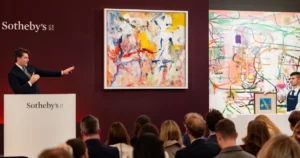
Second, Sotheby’s has secured the "white whale" of the autumn auction season. The collection of the late Argentine magnates Nelly Arrieta de Blaquier and Carlos Pedro Blaquier is estimated to fetch upwards of $450 million. This consignment is not merely a collection of artworks; it is a survey of Impressionist and Post-Impressionist mastery, featuring a Van Gogh landscape that could challenge price records for the artist’s late-period works.
Third, The Bayeux Tapestry has arrived in London. For the first time in its nearly millennium-long history, the 220-foot-long embroidery depicting the Norman Conquest has been transported to the British Museum. This loan, which was long considered a technical impossibility and a diplomatic non-starter, represents a pinnacle of cultural exchange between France and the United Kingdom.
Chronology: The Road to a Landmark Autumn
The Evolution of SFMOMA’s Curatorial Vision
The appointment of Anna Katz follows a period of transition for SFMOMA. After the museum’s massive expansion in 2016, the institution faced the dual challenges of the COVID-19 pandemic and a changing social landscape that demanded greater diversity and representation in its galleries. Katz’s career trajectory has prepared her for this moment. During her tenure at MOCA Los Angeles, she curated the acclaimed exhibition With Pleasure: Pattern and Decoration in American Art 1972–1985, which traveled to the Hessel Museum of Art. Her move to SFMOMA represents a strategic "brain drain" from Southern to Northern California, placing a scholar of contemporary history at the helm of a collection that bridges the gap between mid-century modernism and today’s experimental practices.
The Blaquier Legacy and the Auction Block
The Blaquier collection was built over decades by Carlos Pedro Blaquier and his wife Nelly Arrieta de Blaquier. As owners of Ledesma, one of Argentina’s largest agribusinesses, the couple moved in the highest circles of international society and art collecting. Throughout the mid-to-late 20th century, they quietly amassed a trove of European masterpieces. Following the passing of Carlos Pedro in early 2023 and Nelly in 2020, the estate has moved toward liquidation. Sotheby’s announcement this week marks the culmination of years of quiet negotiation between the heirs and the world’s leading auction houses.
The Bayeux Tapestry: A Century of "Non"
The timeline of the Bayeux Tapestry’s potential loan is a history of frustration for British curators.
- 1953: A request for the tapestry to be displayed during the coronation of Queen Elizabeth II was rejected by France on the grounds of the work’s extreme fragility.
- 1966: A request to mark the 900th anniversary of the Battle of Hastings was met with a similar refusal.
- 1980s-2023: Multiple attempts to secure the loan for various exhibitions were consistently blocked by conservators at the Musée de la Tapisserie de Bayeux, who argued that the linen and wool fibers could not withstand the vibrations of transport.
- 2024: Following a landmark diplomatic agreement between French President Emmanuel Macron and the UK government, and bolstered by new climate-controlled transport technology, the tapestry finally crossed the Channel.
Supporting Data: The Value of History and Art
The sheer scale of the Blaquier collection and the physical dimensions of the Bayeux Tapestry provide a quantitative look at the stakes involved.
The Blaquier Consignment by the Numbers
Sotheby’s estimates the total value of the Blaquier collection at approximately $450 million. The breakdown of the primary lots includes:
- Vincent van Gogh, Châtaignier en fleurs roses et blanches (1890): Estimated between $150 million and $200 million. Painted just weeks before the artist’s death in Auvers-sur-Oise, its provenance and condition make it one of the most significant Van Goghs to hit the market in a generation.
- Paul Cézanne, Harlequin: Estimated to exceed $120 million. Cézanne’s Harlequin series is considered a precursor to Cubism and is highly coveted by institutional buyers.
- Degas, Pissarro, and Renoir: Each artist is represented by works projected to sell for more than $25 million apiece.
The Engineering of a Masterpiece
The Bayeux Tapestry is not a tapestry in the traditional sense, but an embroidery on linen.
- Length: 224 feet (68 meters).
- Age: Roughly 950 years.
- Transport Logistics: The work was transported via the Channel Tunnel in a custom-engineered, vibration-dampening crate that maintained a constant temperature and humidity level. The crate was monitored by a team of twelve conservators who accompanied the artifact every mile of the journey.
Official Responses and Institutional Perspectives
The reactions from the institutions involved reflect a mix of relief, ambition, and pride.
At SFMOMA, Director Christopher Bedford praised the appointment of Anna Katz, stating that her "deep commitment to scholarship and her innovative approach to the history of art" would be "transformative" for the museum’s Painting and Sculpture department. Katz herself expressed a desire to "re-examine the permanent collection through a lens that honors both its historical weight and its potential for contemporary relevance."
Regarding the Blaquier Sale, Sotheby’s CEO Charles Stewart described the collection as "one of the last great private repositories of Impressionist art." He noted that the market for top-tier, "trophy" works remains resilient despite broader economic headwinds, suggesting that the Van Gogh will serve as a bellwether for the health of the high-end art market.
In the diplomatic sphere, the British Museum described the arrival of the Bayeux Tapestry as a "generational event." A spokesperson for the French Ministry of Culture noted that while the loan was a "gesture of profound friendship" toward the UK, it was also a "test case" for how extremely fragile historical textiles can be moved using modern technology.
Implications: What These Developments Mean for the Future
The convergence of these events suggests several broader trends in the art world.
The Professionalization of Curatorial Leadership
Anna Katz’s move to SFMOMA highlights a trend of major museums seeking out "scholar-curators" who have a proven track record of reviving overlooked movements. As museums face increasing scrutiny over their collections’ origins and diversity, leaders like Katz are being tasked with rewriting the narrative of art history within the gallery walls.
The Polarization of the Art Market
The $450 million Blaquier estimate underscores the continued polarization of the art market. While the "middle market" (works between $50,000 and $1 million) has seen some softening, the "apex market" remains incredibly strong. The presence of a $200 million Van Gogh indicates that ultra-high-net-worth individuals still view blue-chip art as a stable store of value and a status symbol par excellence.
Cultural Diplomacy as "Soft Power"
The Bayeux Tapestry loan is a textbook example of "soft power." In a post-Brexit era, the shared history of France and Britain—even a history defined by invasion and conquest—serves as a cultural bridge. The successful transport of the tapestry also sets a precedent for other "unmovable" objects. If a 900-year-old embroidery can safely cross the Channel, it opens the door for other international loans that were previously deemed too risky, potentially leading to a new era of global "blockbuster" exhibitions.
As the British Museum prepares for its September 10 opening and Sotheby’s prepares its auction rooms for the November season, the art world stands at a precipice. Whether through the appointment of new leadership, the sale of historic estates, or the movement of ancient artifacts, the coming months will redefine the boundaries of what is possible in the curation, valuation, and preservation of human creativity.