In the high-stakes world of cybersecurity, the Chief Information Security Officer (CISO) role has long been synonymous with high pressure, sleepless nights, and the expectation of near-invincibility. Often romanticized as the "digital firefighter," the CISO is expected to step in at a moment’s notice to quell breaches, manage evolving threats, and protect the crown jewels of the enterprise. However, this culture of "heroics" has reached a breaking point.
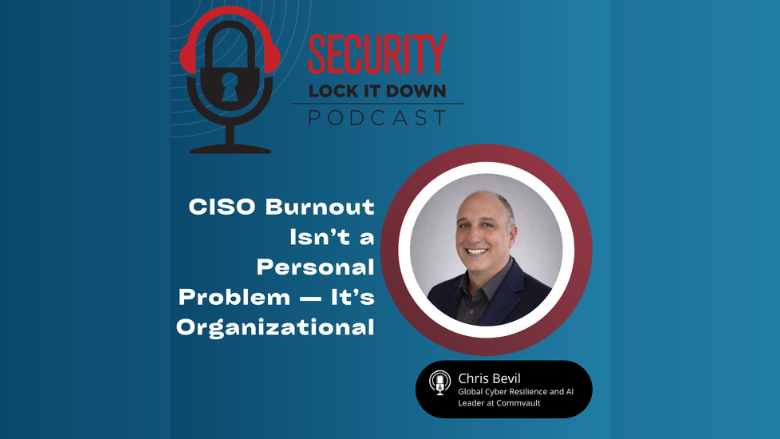
In a recent episode of Security Magazine’s Lock It Down podcast, Chris Bevil, Global Cyber Resilience and AI Leader at Commvault and a former CISO himself, challenged the industry’s status quo. Bevil argues that the pervasive epidemic of CISO burnout is not a personal failure of resilience, but a fundamental flaw in organizational design.
The Myth of the Perpetual Hero
For decades, the cybersecurity industry has operated on an unsustainable model. We celebrate the "hero"—the individual who works 80-hour weeks to patch a zero-day exploit or single-handedly manages a crisis. But as Bevil points out, this reliance on individual superhuman effort is the root cause of the industry’s talent drain.
"We have to stop treating sustainability as a personal wellness program and start really treating it as an organizational design problem," Bevil stated during the interview. When an organization relies on a "hero" to save the day every Tuesday, it is not a sign of a robust security posture; it is a sign of a fragile, broken system.
Chronology of a Crisis: How We Got Here
The evolution of CISO burnout can be traced through the changing landscape of the threat environment over the last decade:
- 2015–2018 (The Compliance Era): CISOs were primarily viewed as gatekeepers. The stress was high, but the scope was largely manageable, focusing on regulatory adherence and basic perimeter defense.
- 2019–2021 (The Digital Transformation Surge): With the rapid shift to remote work, the attack surface exploded. The CISO’s role expanded overnight from "protector" to "enabler of business continuity," creating a massive, permanent increase in workload.
- 2022–2024 (The Era of Sophistication): The rise of AI-driven attacks and the professionalization of ransomware gangs transformed cybersecurity into a 24/7, high-stakes battleground.
- 2025–Present (The Sustainability Breaking Point): As burnout rates hit record highs, the industry has realized that the "burn and churn" approach to security leadership is no longer economically or operationally viable.
Supporting Data: The Reality of the Stress
The burnout phenomenon is not anecdotal; it is supported by significant industry data. According to various industry surveys conducted over the last 24 months, nearly 60% of CISOs report that their work-related stress has reached "unmanageable" levels.
Furthermore, the average tenure of a CISO has plummeted, often hovering between 18 to 24 months. This churn is expensive. Replacing a CISO involves not only high recruitment costs but also the loss of institutional knowledge, which is critical during a security incident. When a CISO leaves due to burnout, the organization’s security posture effectively resets, creating a vacuum that attackers are quick to exploit.
The cost of this burnout extends beyond recruitment. Organizations with burnt-out security teams are statistically more likely to miss critical alerts. A tired, overwhelmed team is prone to "alert fatigue," where the sheer volume of notifications leads to the normalization of deviance—a state where minor warnings are ignored until they snowball into a catastrophic breach.
Organizational Design: The Path to Maturity
If burnout is an organizational design problem, then the solution must be structural. Bevil suggests that the "next stage of maturity" for any enterprise is to build a security architecture—both technical and human—that does not require a hero.
1. Moving from Reactive to Proactive Resilience
Resilience is not just about having a backup plan; it is about building systems that are self-healing and automated. By leveraging AI to handle low-level triage, organizations can remove the "noise" from the daily life of a security analyst. If a system can automatically identify and neutralize a threat, the CISO doesn’t have to be the hero who stays up until 3:00 AM to perform the task.
2. Distributed Accountability
In many firms, the "CISO is responsible for security" mindset persists. This is a fallacy. Security is a business risk, not an IT problem. When the board of directors and executive leadership teams view security as a collective responsibility, the pressure on the CISO is decentralized. Moving security ownership into the business units reduces the burden on the central security team.
3. Sustainable Capacity Planning
Organizations must apply the same rigors of capacity planning to their human capital as they do to their server infrastructure. If the team is operating at 110% capacity, they are failing. A mature organization treats "headroom" as a strategic necessity. Having the ability to absorb a crisis without depleting the team’s long-term wellness is the hallmark of a resilient enterprise.

Implications for the Future of the Profession
The implications of Bevil’s insights are profound. For the aspiring CISO, the goal is no longer to be the most technically gifted person in the room; it is to be an architect of systems that endure. For the CEO and the Board, the implication is that they must stop rewarding "heroic" behavior and start rewarding "systemic sustainability."
If the industry continues to prioritize the "hero," we will continue to see the best talent exit the field. However, if we shift toward organizational design, we can create a sustainable environment where security is a steady-state function rather than a recurring emergency.
Official Perspective: The Role of Commvault and AI
As an AI leader, Bevil sees the infusion of machine learning as a critical component of this structural change. AI is not meant to replace the human element of security; it is meant to provide the "leverage" required to make human effort sustainable.
By automating the mundane, repetitive, and high-volume tasks that consume the average CISO’s day, AI allows leaders to pivot their focus toward strategic initiatives—such as risk management, governance, and business alignment. This is the shift from "firefighting" to "fire prevention," and it is the only way to ensure that the cybersecurity profession remains a viable, long-term career path for the next generation of talent.
Conclusion
Chris Bevil’s assessment serves as a wake-up call for the entire security industry. The "hero" archetype, while historically useful, has become an anchor dragging the profession down. By reframing burnout as a failure of organizational design, leaders can begin to implement the structural changes necessary to foster long-term health and stability.
To hear the full conversation on these critical topics, listeners are encouraged to tune into the Lock It Down podcast, available on Security Magazine’s website and all major podcast platforms, including Apple Podcasts. The path forward is clear: it is time to build organizations that don’t need heroes—because they are strong enough to withstand the storm on their own.