In the rapidly evolving landscape of contemporary art, the line between digital craftsmanship and algorithmic generation has become a flashpoint for public debate. This week, the Minneapolis-based Walker Art Center and acclaimed artist Olalekan Jeyifous found themselves at the center of a controversy sparked by social media allegations that the artist’s latest exhibition, Hydricosmic Litanies, relies on generative artificial intelligence—a charge both the museum and the artist vehemently reject.
The conflict highlights a broader cultural anxiety regarding the role of technology in creative practice. As generative AI tools become ubiquitous, museum-goers are increasingly hyper-vigilant, leading to a climate where complex digital methodologies are often misidentified as "AI slop." This incident serves as a critical case study in how institutions must communicate the technical processes behind contemporary art in an era of profound digital skepticism.
The Exhibition: A Vision of Diasporic Cosmologies
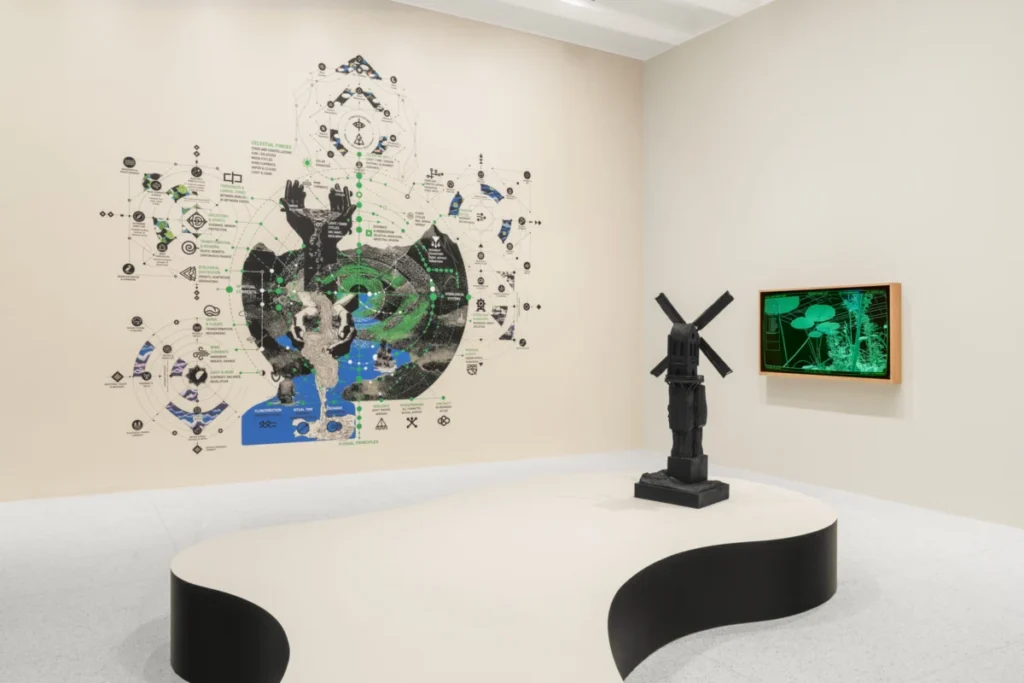
Hydricosmic Litanies is the first museum solo exhibition for Jeyifous, a Nigerian-born, New York-based artist, architect, and designer. Organized by Taylor Jasper, the Walker’s associate curator for visual arts, the exhibition is a sprawling, immersive environment that integrates video, sculpture, and soundscapes.
The thematic core of the show is deeply intellectual, drawing on African diasporic cosmologies to interrogate the historical and environmental impacts of colonization and industrialization. Inspired by the opening line of Ben Okri’s 1991 Booker Prize–winning novel The Famished Road—“In the beginning there was a river”—Jeyifous creates an imagined landscape centered on the Mississippi River. The installation design itself echoes a riverbed, with elevated platforms serving as islands that invite the viewer into a speculative, alternative geography.
In a statement on the Walker’s website, Jeyifous articulates the exhibition’s mission: “Rivers have long served as lifelines for ecological and cultural balance, but colonization and industrialization disrupted these reciprocal relationships, imposing systems of control and exploitation with lasting effects. This tension informs the exhibition’s materials and forms.”
Chronology of a Digital Controversy
The friction began in mid-August 2026, when a Reddit user identified as stvincentstreet published a post titled "AI slop alert" on the r/Minneapolis subreddit. The user, who had recently visited the Walker, expressed deep dissatisfaction, claiming the exhibition was saturated with "AI garbage."
The post gained significant traction, fueled by the user’s allegation that they had spoken to a Walker staffer—unauthorized to speak publicly—who supposedly confirmed that the works were created using generative AI and that the sculptures were machined from AI-generated 3D models. The user described the museum’s failure to label the work as "shady and wrong," sparking a wave of indignation among local art patrons who felt that the institution was attempting to pass off algorithmically generated content as high-level artistry.
By mid-August, the narrative had escalated, prompting a response from both the artist and the museum. The Walker Art Center, in an effort to quell the misinformation, acknowledged the miscommunication but declined to comment on the specific claims regarding unnamed staff members.
Supporting Data: Understanding the Artist’s Methodology
To understand the disconnect, one must look at Jeyifous’s history. An architect by training, his practice has always utilized advanced digital modeling and rendering software. For over two decades, he has operated at the intersection of speculative design and fine art.
Jeyifous explains that the confusion is not entirely new. "For more than two decades, people have asked some version of, ‘How did you make this?’" he told MPR News. "Those methods are commonplace within the discipline I emerge from, but less familiar to a general museum audience, so there has always been some uncertainty around how my images and objects are produced."
The artist argues that because the aesthetic of early, low-fidelity AI generators often mimicked the "sci-fi" and "speculative world-building" styles he has employed for years, the public has begun to view his work through a reductive, post-AI lens.
"Simply prompting images and presenting the results as my artwork is fundamentally at odds with how I’ve always worked," Jeyifous stated. His process is characterized by intense, iterative cycles—reconceptualization, manual modeling, precise rendering, and continuous refinement. This is a far cry from the instantaneous, prompt-based generation typically associated with platforms like Midjourney or DALL-E.

Official Responses and Curatorial Defense
The Walker Art Center has moved to clarify the situation through its leadership. Henriette Huldisch, the museum’s chief curator and director of curatorial affairs, provided a nuanced distinction between the use of AI as a crutch and the use of AI as a tool.
"He uses a range of sophisticated software and tools, many of which have AI embedded within them," Huldisch explained. In the modern design industry, software like Adobe Photoshop or professional-grade 3D modeling suites (such as Rhino or Blender) often include "smart" features—denoising, auto-filling, or predictive modeling—that technically utilize machine learning.
Curator Taylor Jasper further emphasized the labor-intensive nature of the project. "He works extremely iteratively," Jasper noted. "Everything goes through multiple stages of reconceptualization, of rendering, of visualization and revisualizing and visualizing again."
The museum’s stance is that the artistic intent and the human labor involved in these iterative processes far outweigh the utility of any single automated function within the software. Nevertheless, the institution acknowledged the need for transparency. Recognizing that public trust is fragile in the age of AI, the Walker announced plans to append clarifying language to the exhibition’s wall text, detailing the artist’s technological toolkit. "We’re listening and we’re learning with our visitors," said Huldisch. "And we are adding language."
Implications: The Future of Attribution
The Jeyifous controversy is a harbinger of a broader reckoning in the art world. As digital tools become more sophisticated, the distinction between a "tool" and an "author" becomes increasingly blurred.
1. The Burden of Transparency
Institutions are now facing a demand for "technological provenance." Just as visitors expect to know the materials of a sculpture (bronze, marble, found object), they now expect to know the "materials" of a digital work. Museums will likely need to develop new standards for labels that delineate between traditional digital fabrication and generative assistance.
2. The Devaluation of "Digital"
The term "AI slop" has become a pejorative that threatens to devalue genuine digital artistry. Artists who have spent years mastering software like Maya, ZBrush, or CAD are being unfairly grouped with hobbyists using simple text prompts. This creates an existential crisis for digital artists, who must now defend the legitimacy of their labor against a public that can no longer distinguish between the two.
3. The Institutional Pivot
The Walker Art Center’s decision to update its wall text is a pragmatic response to the digital age. By acknowledging the presence of embedded AI tools while defending the artist’s manual, iterative process, the museum is attempting to set a standard for "radical transparency."
4. A Legacy of Excellence
It is also worth noting the artist’s pedigree. Olalekan Jeyifous is not a novice using shortcuts. His work has been exhibited at the Studio Museum in Harlem, the Vitra Design Museum, and the Guggenheim Bilbao. He is a winner of the Silver Lion for a promising young participant at the 2023 Venice Architecture Biennale. His inclusion in the collections of the MoMA, the Art Institute of Chicago, and the SFMOMA suggests that his methodology has long been vetted by the most rigorous standards in the art world.
Conclusion
The outcry at the Walker Art Center is not merely about an exhibition; it is about the shifting definition of creativity. As we move forward, the art world must navigate the fine line between the democratization of creation and the preservation of artistic agency.
For Olalekan Jeyifous, the path forward involves continuing his practice while perhaps offering a clearer window into the "black box" of his digital studio. For the Walker, it means fostering an environment where dialogue—even when prompted by misinformation—leads to a more informed and nuanced understanding of how art is made in the 21st century. The exhibition, which runs through January 3, 2027, will undoubtedly continue to serve as a vital conversation piece, not only for its thematic depth regarding the Mississippi River and African diasporic cosmologies but as a landmark in the ongoing, high-stakes debate over the role of the machine in the human creative process.