The landscape of modern horology is often defined by a tension between nostalgia and innovation. While the "vintage-inspired" trend has dominated the market for over a decade, few brands successfully bridge the gap between mid-century charm and 21st-century material science. Trematic, a brand with deep roots in the 1950s Swiss watchmaking tradition that saw a triumphant resurrection in 2022, has positioned itself at this exact intersection. Their latest release, the Trematic T-Five Beigua Maris, is not merely a homage to the past; it is a sophisticated, contemporary reinterpretation of the classic skindiver, built with an uncompromising commitment to premium metallurgy and high-performance engineering.
Main Facts: The Anatomy of the T-Five Beigua Maris
At its core, the T-Five Beigua Maris is a 39mm dive watch that defies the typical categorization of "retro." While it adopts the silhouette of the iconic 1950s skindiver—a genre known for slim profiles and utilitarian elegance—its construction is entirely modern. The watch is crafted from Grade 5 titanium, a decision that places it in a different league than the standard stainless steel divers found at this price point.

The watch measures 11.3mm in thickness, expanding to 13.8mm when accounting for its domed sapphire crystal. With a compact lug-to-lug distance of 45.5mm and 20mm lug spacing, it is designed for exceptional comfort. Despite its refined dimensions, it offers a robust 300 meters of water resistance, ensuring that the watch is as capable in the ocean as it is stylish in a professional setting. The heart of the watch is the Swiss-made La Joux-Perret Caliber G101, an automatic movement that provides a 68-hour power reserve, outperforming many of its peers in the sub-$2,000 category.
Chronology: From 1950s Origins to Modern Rome
The story of Trematic is one of endurance and reinvention. Founded in the early 1950s, the brand was a respectable player in the golden age of mechanical watchmaking. Like hundreds of other Swiss manufacturers, Trematic was forced to cease operations during the tumultuous 1980s, a casualty of the Quartz Crisis that devastated the Swiss industry.

For decades, the name remained a footnote in horological history until its revival in 2022. Now headquartered in Rome, Italy, the brand has successfully pivoted its strategy, focusing on high-quality Swiss production while infusing its designs with a distinctly European aesthetic. The T-Five Beigua Maris represents the culmination of this new direction. Following the initial rollout of the AC 14, the T-Five Beigua Maris—first unveiled in November 2025—demonstrates a clear shift toward technical excellence. The naming convention itself is a testament to this: "Beigua" refers to the Monte Beigua region in northern Italy, a site known for its significant titanium reserves, while "Maris" (Latin for "of the sea") and "T-Five" (Grade 5 titanium) serve as a nod to the watch’s origins and its high-grade composition.
Supporting Data: Why Grade 5 Titanium Matters
To the uninitiated, the distinction between titanium grades might seem like marketing jargon, but in the world of high-end manufacturing, the difference is profound. Most "titanium" watches in the entry-to-mid-level luxury market utilize Grade 2, which is commercially pure titanium. While excellent for corrosion resistance, it is relatively soft and prone to minor scratches.

Grade 5 titanium, the alloy used for the T-Five Beigua Maris, consists of 90% titanium, 6% aluminum, and 4% vanadium. This chemistry results in a material that is significantly harder and stronger than Grade 2. While the tensile strength difference—where Grade 5 is nearly double that of Grade 2—is largely academic for a watch (as any force capable of deforming a Grade 2 case would likely cause severe injury to the wearer’s wrist), the hardness is a practical benefit. Over years of daily wear, the T-Five Beigua Maris will resist the "desk-diving" scuffs and micro-scratches that plague softer metals.
Furthermore, the machining of Grade 5 is notoriously difficult and expensive. It requires specialized tooling and slower production speeds, which is why it is typically reserved for watches costing five figures. By offering this material at a $1,320 price point, Trematic is effectively disrupting the cost-to-value ratio, providing a level of metallurgy usually reserved for luxury icons.

Official Perspectives: Design and Performance
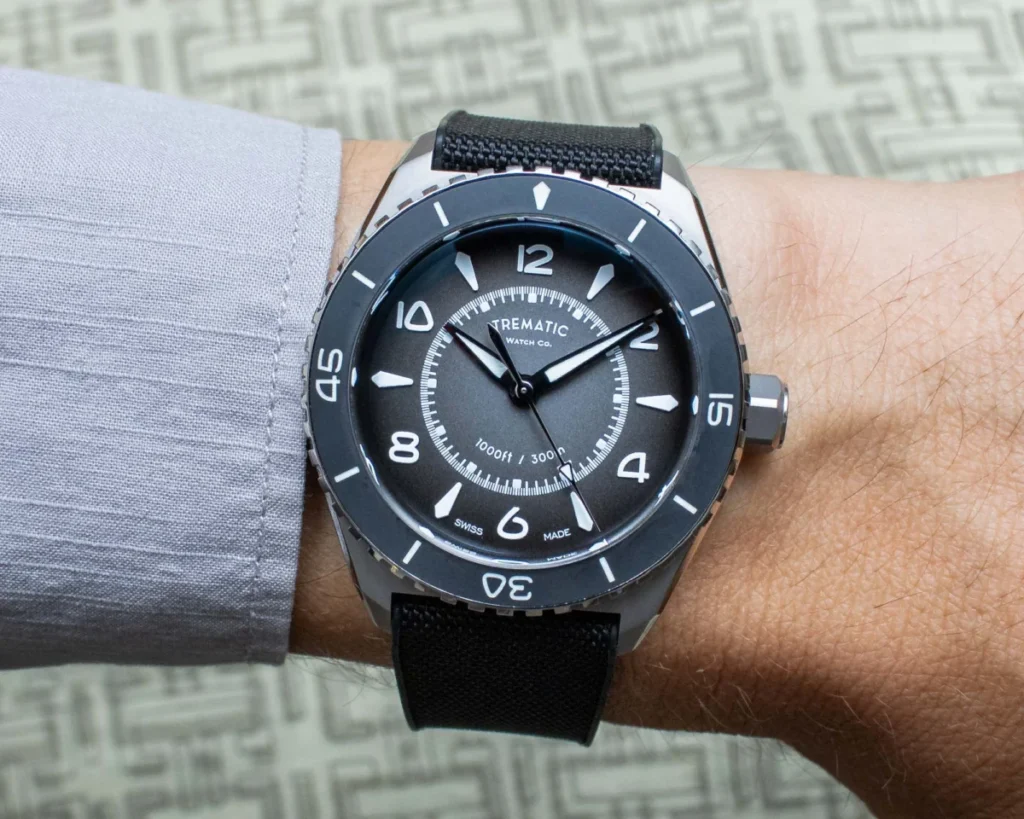
The design philosophy behind the T-Five Beigua Maris is one of intentional, balanced minimalism. The watch features a unidirectional rotating bezel with a matte ceramic insert and luminous Super-LumiNova inlays. The "Shadow" colorway, characterized by its gray gradient dial, offers the most subtle and classic look, whereas the "Desert" and "Marina" iterations provide bolder alternatives with fully luminous dials.
The use of Lumicast hour markers—solid blocks of Super-LumiNova—demonstrates Trematic’s commitment to low-light performance. While the execution in the "Shadow" variant, with its white-finished edges, presents a unique aesthetic, the overall legibility remains high.

However, even the most refined designs have their nuances. The minute track, while visually pleasing, has drawn some critique for its layout. Because the minute hand tapers and the track sits further inward than the tip of the hand, precise minute-by-minute reading requires a degree of familiarity. This is a common trade-off in design-forward pieces where aesthetic symmetry takes precedence over stop-watch precision.
Implications: A New Standard for Value
The market impact of the Trematic T-Five Beigua Maris is significant. For the consumer, it represents an opportunity to own a piece of high-grade engineering that historically would have been inaccessible. By leveraging the La Joux-Perret G101—a movement that rivals the performance of the Sellita SW200-2 Power+—Trematic has ensured that the watch is as reliable as it is attractive.

The implications for the broader industry are equally interesting. Trematic has proven that a mid-tier brand can avoid the "sticker shock" associated with premium materials by optimizing its supply chain and focusing on direct-to-consumer value. While many competitors continue to rely on standard 316L stainless steel, Trematic is forcing a conversation about whether the standard for a $1,000+ watch needs to be raised.
The Human Factor: Comfort and Wearability
Beyond the specs, the T-Five Beigua Maris is a triumph of ergonomics. The sandblasted finish, punctuated by high-polished accents on the lugs and bezel, catches the light in a way that feels organic and purposeful. The inclusion of two distinct FKM rubber straps—one a hybrid waterproof fabric and the other a traditional tropic-style—allows the wearer to customize the experience. The quick-release spring bars are a modern necessity that Trematic has implemented with care, and the perlage-decorated deployant clasp is a touch of luxury that confirms the brand’s attention to detail.

Conclusion: Is It the Right Watch for You?
The Trematic T-Five Beigua Maris is not a watch for someone looking for a "safe" Rolex Submariner homage. It is a watch for the enthusiast who values technical substance, appreciates the unique warm-to-the-touch feel of Grade 5 titanium, and desires a piece that stands apart from the crowd. At $1,320, it is arguably one of the most compelling value propositions in the current dive watch market. It manages to balance the weight of history with the lightness of modern titanium, creating a timepiece that feels as relevant today as it would have in the 1950s.
As the brand continues to evolve, the T-Five Beigua Maris will likely be remembered as the model that solidified Trematic’s reputation as a serious, forward-thinking manufacturer. It is a bold, modern, and highly capable instrument that proves the "skindiver" is far from a stagnant concept—it is a living, breathing design language that, in the right hands, can still surprise us.