Solar-powered timepieces have long been championed as the ultimate synthesis of practicality and horological convenience. By eliminating the environmental and maintenance-related burden of routine battery replacements, they offer a "set-and-forget" reliability that appeals to the modern, efficiency-minded collector. However, in the vast landscape of watch design, solar technology has historically been treated as a utility to be hidden. Manufacturers frequently mask solar cells beneath opaque or semi-transparent dials, prioritizing a traditional aesthetic over the technological marvel ticking beneath the surface.
With the launch of the Mondaine Doppio Solar Skeleton, the iconic Swiss manufacturer—best known for its adherence to the austere, Bauhaus-inspired design of the Swiss railway clock—has made a bold departure from its own tradition. By choosing to expose the solar panels in an open-worked dial, Mondaine invites the wearer to appreciate the power source that drives their watch. This article explores the design philosophy, technical prowess, and historical significance of this compelling new addition to the Mondaine catalog.

Main Facts: A New Perspective on Solar
The Mondaine Doppio Solar Skeleton represents a daring aesthetic pivot for a brand rooted in the strict minimalism of the Swiss Federal Railways. While the standard Doppio collection, which debuted in 2025, leaned into the brand’s signature restraint, the Solar Skeleton model embraces complexity.
The watch is housed in a 41mm 316L stainless steel case. With a thickness of 7.5mm (stretching to 9mm including the domed sapphire crystal), the watch maintains a slim, elegant profile. Its geometry is particularly noteworthy: the case is devoid of flat, "slab-sided" surfaces. Instead, the curved sides wrap gracefully toward the underside, ensuring the watch sits comfortably on the wrist despite its 42.5mm lug-to-lug span.

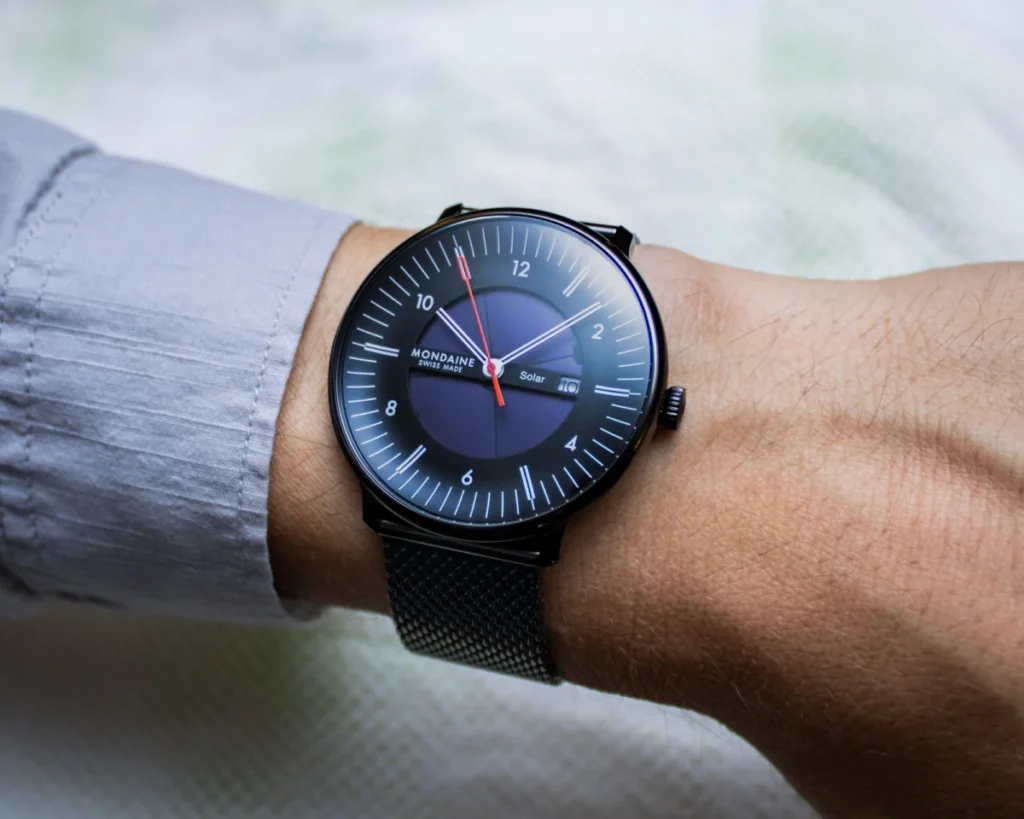
The most striking feature, however, is the dial. Eschewing the solid, iconic white face associated with Mondaine, the Solar Skeleton features a matte black dial with a dramatic central aperture. This open-worked design serves a dual purpose: it offers a visual "peek" into the movement’s solar-harvesting capabilities and adds a layer of industrial depth rarely seen in the brand’s output.
Chronology: The Evolution of Mondaine’s Light-Powered Legacy
To understand the Doppio Solar Skeleton, one must look back at the brand’s heritage. While many in the industry attribute the genesis of the solar-powered analog watch to the 1976 Citizen Crystron Solar Cell, Mondaine claims an even earlier foothold in the technology, pointing to proprietary developments as far back as 1973.

The "Doppio" line, introduced in 2025, was initially met with mixed reactions. Purists felt that the brand was drifting too far from the "Railway Clock" aesthetic that had defined its identity for decades. However, the release of the Solar Skeleton suggests that Mondaine is not abandoning its heritage, but rather building upon it. By experimenting with open-worked dials and contemporary case finishes, the brand is positioning itself to appeal to a younger, more design-conscious demographic that values technical transparency as much as historical pedigree.
Technical Specifications and Performance
At the heart of the Doppio Solar Skeleton lies the Swiss-made Ronda Caliber 215. This movement is a workhorse of the industry, chosen by Mondaine for its reliability and energy efficiency.

Energy Management
- Charging: The movement is highly sensitive to light; as little as one minute of direct exposure is sufficient to restart the watch from a completely depleted state.
- Power Reserve: Once fully charged, the Caliber 215 offers an impressive eight-month power reserve, allowing the watch to function flawlessly even when stored in total darkness for extended periods.
Design Details
The handset deviates from the standard Mondaine baton hands. The hour and minute hands are ultra-thin and skeletonized, consisting of two parallel white lines that hover over the solar panels. The signature red seconds hand—a nod to the Swiss railway signaling disk—remains, though it has been updated with an open-worked tip to maintain visual balance.
The case is available in two distinct configurations:

- Ref. MLE.41921.LBV: A classic polished stainless steel case paired with a sustainable, vegan-friendly grape leather strap.
- Ref. MLE.41921.SM: A modern, moody gunmetal IP-finished case paired with a high-quality stainless steel mesh bracelet featuring a secure, smooth-action latch-style clasp.
Supporting Data: The "Skeletonized" Challenge
The decision to expose the solar panels is not without its controversies. In traditional watchmaking, an open-worked movement is intended to showcase the beauty of gears, springs, and bridges. In the case of the Doppio Solar Skeleton, the "skeletonization" reveals functional electronics.
Close inspection of the dial reveals faint, radiating lines that originate from the center—the segments of the solar cell itself. These lines do not align with the hour markers, and the presence of technical connectors near the 2 o’clock position highlights that this movement was not originally designed for public display.

However, this "quirkiness" is precisely what gives the watch its character. By refusing to hide the solar cells, Mondaine is making a statement about the nature of the watch. It is a tool that relies on the sun, and the aesthetic imperfections are, in many ways, an honest representation of the technology. The inclusion of these elements provides a layer of industrial, almost avant-garde intrigue that sets the Doppio Solar Skeleton apart from the sterile, perfect dials of its predecessors.
Official Stance and Market Positioning
Mondaine’s pricing strategy for the Doppio Solar Skeleton is, as always, pragmatic. The model is priced at $465 USD for the strap version and $495 USD for the gunmetal mesh bracelet model.

In an era where "Swiss Made" carries a significant premium, Mondaine continues to offer accessible entry points into the Swiss watch market. The brand’s official messaging emphasizes that this watch is not a replacement for their traditional collections, but a tribute to their history as pioneers of light-powered technology. By offering a product that blends high-end aesthetics (like the gunmetal IP finish) with accessible solar technology, Mondaine is successfully carving out a niche that bridges the gap between mass-market utility watches and high-concept horology.
Implications: The Future of the "Everyday" Watch
The release of the Doppio Solar Skeleton carries significant implications for the future of the brand and the broader entry-level luxury market.

1. Diversification of Identity
Mondaine has proven that it is capable of evolving without destroying its core identity. By keeping the "Railway Clock" DNA in its standard collection while using the "Doppio" line to experiment with materials and layouts, the company is insulating itself against changing consumer tastes.
2. The Rise of "Sustainable" Horology
The use of vegan grape leather and the focus on solar power signal that Mondaine is responding to the global demand for sustainable luxury. As younger consumers prioritize environmental impact, the ability to promote a watch that requires no batteries and utilizes plant-based materials becomes a powerful marketing tool.

3. Industrial Transparency
The "flaws" in the dial design—the visible connectors and asymmetric lines—represent a broader trend in watchmaking where "honesty" is becoming a desirable trait. Consumers are becoming less interested in perfectly polished, hidden movements and more interested in seeing how their devices actually work.
In conclusion, the Mondaine Doppio Solar Skeleton is a fascinating study in contrast. It is a watch that respects the brand’s past while aggressively looking toward the future. It is not for the person who wants a subtle, standard railway clock; it is for the enthusiast who wants a conversation piece that celebrates the marriage of Swiss precision and the endless, renewable power of the sun. Whether or not one embraces the raw, industrial look of its exposed solar cells, the Doppio Solar Skeleton stands as a testament to Mondaine’s willingness to innovate, iterate, and, most importantly, shed light on the unseen mechanics of time.