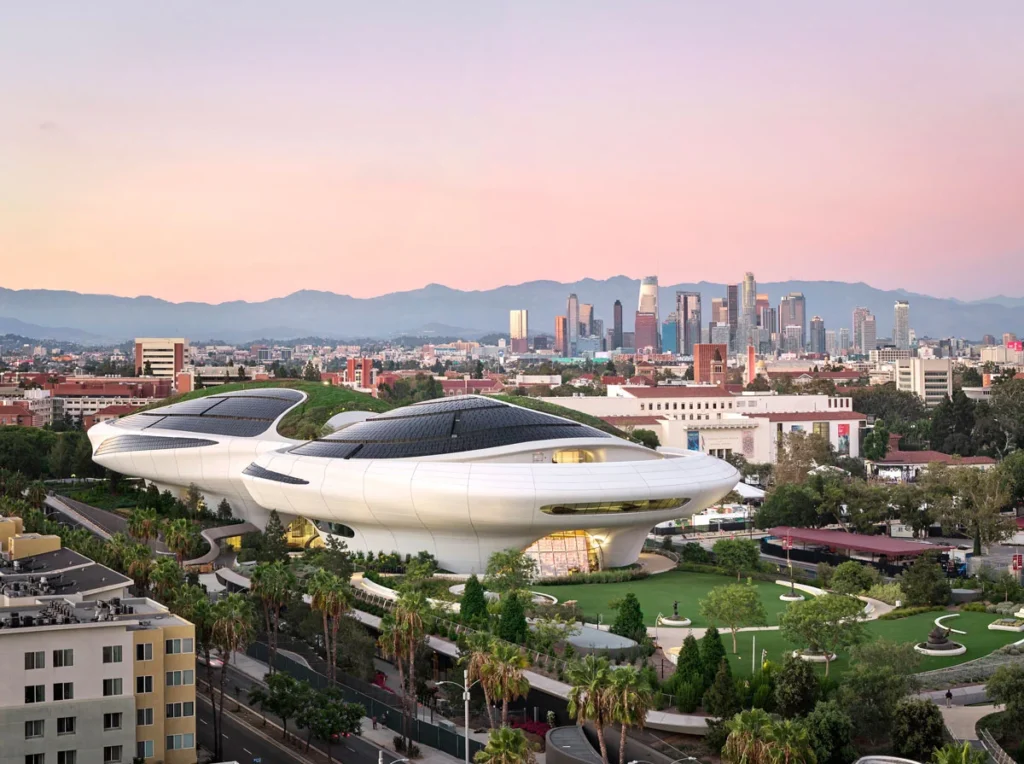
If a picture is truly worth a thousand words, the newly inaugurated Lucas Museum of Narrative Art in Los Angeles has paradoxically decided that it is not worth writing a single one. After nearly two decades of planning, a staggering $1 billion investment, and a series of high-profile site relocations, the institution—founded by filmmaker George Lucas and his wife, businesswoman Mellody Hobson—is finally opening its doors to the public on September 22, 2026.
Yet, as the fanfare of the opening subsides, a deeper, more critical question emerges: Does this architectural marvel, designed to celebrate the power of visual storytelling, function as a museum, or has it merely become a sprawling, gilded vanity project that prioritizes spectacle over substance?

A Chronology of Ambition and Obstruction
The path to the Lucas Museum’s debut in Exposition Park was anything but linear. George Lucas’s dream of creating a dedicated space for "narrative art"—a term he uses to describe works that tell a story—was originally slated for Chicago. When that fell through due to legal challenges, the project pivoted to San Francisco, only to face similar logistical hurdles.
The eventual landing in Los Angeles was met with immense anticipation. The project, which has spent the last eight years under construction, promised to bridge the gap between "high art" and popular culture, aiming to validate the medium of illustration—a field long sidelined by the rigid, Eurocentric hierarchies of traditional art history. However, the lengthy gestation period and the sheer scale of the funding have only heightened expectations. Now that the building is complete, the reality of the visitor experience stands in stark contrast to the lofty mission statement promoted in the museum’s marketing materials.

The Aesthetic Landscape: From Rockwell to the "Star Wars" Galaxy
The core of the museum’s collection is undeniably impressive. George Lucas has spent decades curating a deep, scholarly-level collection of Norman Rockwell’s work. Masterpieces such as Shuffleton’s Barbershop (1950) and The Gossips (1948) are displayed with a breadth that is, at times, truly breathtaking. The museum also makes a concerted effort to provide a dialogue between these classics and modern perspectives, such as pairing Rockwell’s The Runaway (1958) with Richard Williams’s searing 2014 commentary, The Militarization of the Police Department—Deadly Force.
However, the "narrative" quickly loses its coherence as one moves away from the Rockwell galleries. The institution attempts to categorize its vast holdings into themes like "Science Fiction," "Fantasy," "Romance," and "Adventure." While these labels sound enticing, the execution is uneven. The "History" gallery, in particular, feels like a disorganized hodgepodge of historical figures and events, ranging from Emiliano Zapata to John F. Kennedy, lacking any connective tissue or meaningful historical analysis.

Furthermore, the museum’s attempt to incorporate its founder’s cinematic legacy is hit-or-miss. While the Star Wars display is arguably the most dynamic and "narrative" exhibition in the building, featuring original set pieces and costumes, it serves as a glaring reminder of the missed opportunities elsewhere. The Star Wars display possesses a verve and clarity that the rest of the galleries, which often feel stagnant and academic, lack entirely.
Supporting Data: The Missing Intellectual Framework
The most significant failure of the Lucas Museum is the total absence of didactics. The museum has made a conscious, albeit misguided, decision to prioritize "looking" over "contextualizing." In the contemporary art world, where scholars and curators have spent decades working to dismantle the elitist barriers of the 18th-century art canon, the Lucas Museum’s refusal to provide wall text or educational labels feels like a regressive step.

A museum’s primary function, beyond the aesthetic preservation of objects, is the production of knowledge. By stripping away labels, the Lucas denies its visitors the ability to engage with the works on a deeper level. For instance, the inclusion of Rockwell’s The Problem We All Live With (1963–64) is a powerful, politically charged choice. Yet, without a single line of text to explain that the painting depicts six-year-old Ruby Bridges being escorted into a school to desegregate it, the image risks being misinterpreted—or worse, its historical weight rendered invisible to the average visitor.
When questioned about this lack of information, leadership at the museum points toward their $200 two-volume Taschen book. This "catalog-as-exhibition-text" approach is exclusionary. By hiding the curatorial argument behind a high paywall, the museum effectively tells the general public that the context behind the art is a luxury item rather than a fundamental right of the museum-going experience.

Official Responses and Internal Shifts
The museum’s internal landscape has also been subject to scrutiny. In May 2025, the institution laid off 15 full-time and seven part-time employees, with the cuts disproportionately impacting the Learning & Engagement and Museum Services teams. Despite these cuts, official press statements continue to insist that "education remains a central pillar" of the institution.
Yet, the 11-page opening press release notably omits the word "education" entirely. This dissonance between the museum’s stated mission and its staffing priorities suggests a troubling trend: the Lucas Museum may view itself as an elite repository of personal taste rather than a public-facing educational institution. Mellody Hobson has stated that the museum aims to celebrate the illustrators who have "narrated our lives in pictures," but one must ask: to whom are they narrating, if they refuse to speak to the audience?

The Implications of a Billion-Dollar Vanity Project
The implications for the future of the Lucas Museum are significant. While the building itself is an architectural triumph—a futuristic, cloud-like structure that adds 160 acres of green space to the heart of South Los Angeles—it faces an existential crisis. Can a museum succeed if it ignores the fundamental responsibility of providing context?
The gaps in the collection are glaring. While there is a strong focus on white, mid-20th-century male artists, the representation of women, queer artists, and non-Christian religious narratives is almost non-existent. The museum’s decision to relegate diverse voices to "rounding errors" in a collection of over 1,300 objects speaks volumes about the blind spots of its founders.

Furthermore, the "History of Narrative Art" gallery on the ground floor—which utilizes digital, backlit reproductions of masterpieces like the Sistine Chapel or the Aztec Sun Stone—feels more like a theme park attraction than a serious art historical exhibition. By prioritizing the "experience" of art over the physical encounter with authentic works, the museum undermines the very value of its own collection.
Conclusion: A Call for Evolution
The Lucas Museum of Narrative Art is, at its core, a private collection masquerading as a public institution. History shows that many of the world’s most respected museums, such as the Metropolitan Museum of Art or the Hammer Museum, began as the personal visions of individual collectors. The difference is that those founders eventually understood the necessity of handing the keys to the kingdom over to professionals—curators, educators, and historians—who could broaden the scope of the collection and provide the critical framework necessary for public discourse.

As it stands, the Lucas is an impressive monument to the tastes and whims of George Lucas. It provides a beautiful space and some truly exceptional works of art. However, until the museum decides to embrace the responsibility of being an educator rather than just an owner, the title "Museum of Narrative Art" will remain an unearned accolade. If the museum truly wishes to "tell the story of a society," it must start by telling the stories of the art it contains, rather than assuming that a picture, left to float in a vacuum, is enough.