

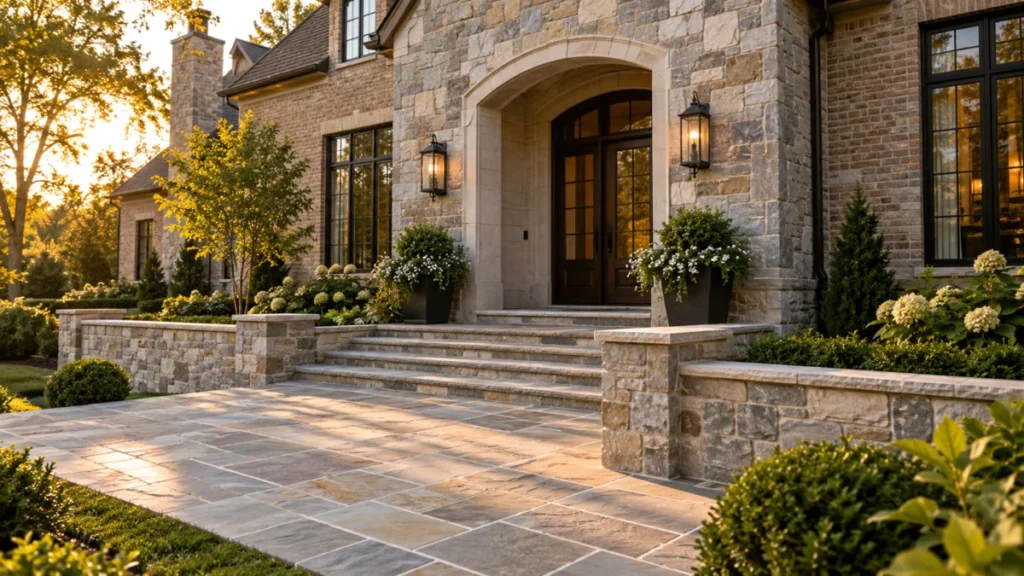
In the realm of high-end residential design, the true hallmark of prestige is not found in fleeting aesthetic trends or seasonal color palettes, but in the enduring language of permanence. As the luxury market continues to pivot toward properties that offer both legacy value and structural integrity, architectural masonry has re-emerged as the definitive medium for defining a residence’s character. From the tactile elegance of hand-chiseled limestone to the rhythmic precision of Flemish-bond brickwork, masonry provides a foundation of gravitas that defines the most sought-after estates in the world.
The Foundation of Architectural Identity
The exterior of a luxury home serves as its primary ambassador, communicating its pedigree to the world long before a guest steps through the foyer. Architectural masonry acts as the bridge between the structural skeleton of a home and its visual narrative.
The Psychology of Materials
Material selection is an exercise in intentionality. Limestone, with its pale, uniform hue and smooth finish, speaks to a classical, sophisticated elegance often associated with Beaux-Arts or Mediterranean villas. Conversely, reclaimed traditional brick brings an immediate sense of "established history," offering a warmth and texture that feels rooted in the land. Natural stone—whether slate, granite, or sandstone—introduces an organic, rugged individuality that demands attention through its sheer geological diversity.
The Power of Restraint
A common mistake in mid-tier development is the "everything everywhere" approach. True luxury, however, is defined by restraint. The most successful architectural compositions utilize masonry to anchor the home’s design. This might manifest as a dramatic arched stone entrance, a series of stately masonry columns flanking a private driveway, or the subtle framing of a bay window with contrasting brick quoins. By concentrating high-quality masonry at key focal points, architects can create an atmosphere of wealth and permanence without the design becoming visually chaotic.
A Chronological Perspective: From Heritage to Modernity
The appreciation for masonry in residential design has followed a distinct trajectory, evolving from functional necessity to an aesthetic status symbol.
- Pre-20th Century (The Era of Necessity): Masonry was the primary structural medium. The thickness of walls and the craftsmanship of joints were dictated by the requirement to support multi-story dwellings.
- Mid-20th Century (The Shift to Veneer): The rise of steel and wood-frame construction led to masonry becoming largely decorative—a "veneer" applied to the exterior to mimic the aesthetics of traditional stone and brick.
- The Modern Renaissance (The Current Climate): Today, we are seeing a synthesis of these eras. Homeowners are demanding the structural honesty of stone combined with modern engineering techniques that allow for greater glass-to-stone ratios. The emphasis has shifted back to artisanal quality, where the "hand of the maker" is once again a sought-after luxury feature.
Supporting Data: Why Masonry Retains Value
The economic argument for investing in high-quality masonry is robust. According to real estate valuation experts, properties featuring extensive natural stone or brick exteriors consistently command a price premium compared to those finished with composite siding or stucco.
- Life Cycle Longevity: While composite materials may degrade due to UV exposure or moisture in 15–20 years, masonry—when properly maintained—can last for centuries. This durability reduces the total cost of ownership over a 50-year horizon.
- Thermal Mass Benefits: Masonry materials possess high thermal mass, which helps regulate interior temperatures. By absorbing heat during the day and releasing it slowly at night, masonry-clad homes often report lower energy consumption for climate control.
- Fire Resistance: In regions prone to wildfire or extreme heat, masonry provides a non-combustible barrier that significantly enhances the safety profile of a residence, a factor increasingly scrutinized by high-net-worth insurance providers.
Expert Perspectives: The Science of Restoration
The preservation of existing masonry is as critical as new construction. Older luxury estates often feature brick or stonework that is impossible to replicate with modern manufacturing processes. The patina of age is an asset, not a liability.
"Preservation is not about keeping a building in a state of stasis; it is about respecting the integrity of the materials," notes a spokesperson for TOP Masonry & Tuckpointing. "When we encounter mortar deterioration or localized cracking, our priority is to intervene with techniques that match the original composition. Using a modern, rigid cement on a historical lime-mortar wall, for instance, can lead to catastrophic damage. Matching the porosity, color, and joint profile is essential to the longevity of the structure."
The Role of Professional Assessment
Specialized contractors serve as the guardians of architectural heritage. Their evaluation process typically includes:
- Petrographic Analysis: Determining the chemical makeup of historical mortars to ensure compatibility.
- Structural Audits: Checking for the underlying causes of movement or shifting that may be masked by surface repairs.
- Artisanal Repointing: The meticulous process of replacing worn-out mortar joints to restore the "seal" of the wall, preventing moisture ingress—the primary enemy of all masonry structures.
Extending the Living Space: The Exterior "Room"
In contemporary luxury design, the concept of the "home" has expanded to include the entire property. The terrace, the courtyard, and the garden path are no longer afterthoughts; they are treated as extensions of the formal living room.
Designing for Multiple Viewpoints
When planning outdoor masonry, architects must consider the "view from within." A limestone terrace should be designed as a visual extension of the indoor flooring, creating a seamless transition that pulls the eye outward. Whether it is a low-profile retaining wall that doubles as bench seating or a stone-clad outdoor kitchen, these features provide the structural framework that organizes the landscape.
By using masonry to define "outdoor rooms," architects create a sense of shelter and intimacy, even in expansive gardens. This creates a cohesive composition where the residence and its surroundings appear as if they grew from the same earth.
The Criticality of Craftsmanship and Detail
The difference between a "good" masonry installation and a "great" one is found in the margins. The quality of installation often dictates the property’s perceived value.
The Devil in the Details
- Joint Consistency: The uniformity of mortar lines is a direct reflection of the mason’s skill. Variations in width or depth can make even the most expensive stone look amateurish.
- Corner Transitions: The use of "quoins" or perfectly matched corner stones prevents the "veneer look" and ensures the wall appears structurally sound.
- Drainage and Flashing: Masonry is porous. Without proper drainage, flashing, and intentional slopes, water will eventually settle, causing efflorescence, freeze-thaw damage, or structural instability. These invisible details are what ensure that a home remains as beautiful in fifty years as it is on the day of completion.
Implications for the Future of Residential Luxury
As we look toward the future, the luxury market is moving away from the "disposable" architecture of the late 20th century. The implication for homeowners and investors is clear: the value of a property is increasingly tied to its ability to age gracefully.
Properties that rely on "statement" features often date quickly, but those that rely on the timeless principles of proportion, material quality, and continuity between architecture and landscape are immune to the whims of fashion. Masonry, with its deep historical roots and physical permanence, offers a path to creating homes that feel substantial and refined.
Ultimately, building with masonry is a commitment to a legacy. It is an acknowledgment that a home is more than a shelter; it is a long-term asset that, through careful design and expert stewardship, will continue to define its landscape for generations to come. By prioritizing craftsmanship, respecting the history of materials, and integrating the landscape with the structure, the modern homeowner can ensure that their residence is not just built for today, but designed to endure.



