
Introduction: A Brazilian Modernist Manifesto
As the sun dipped behind the skyline of Brooklyn’s Domino Square this past Tuesday, the atmospheric tension of New York Fashion Week was momentarily suspended. Against the backdrop of the city’s industrial waterfront, PatBo—the eponymous label founded by creative director Patricia Bonaldi—unveiled a spring collection that served as both a love letter to her homeland and a bold statement on the brand’s global evolution.
The presentation, held outdoors to better mirror the organic, sweeping landscapes that inspired the garments, was more than a runway show; it was a cultural assertion. For a brand that has spent two decades honing its identity in Brazil, this season signaled a departure from the purely fluid silhouettes of the past, moving toward a more structured, architectural, and experimental future.
The Chronology of a Vision: From Brazil to the World Stage
To understand the significance of this spring collection, one must first look at the trajectory of the label. PatBo, which has been a staple of Brazilian fashion for 20 years, marked its tenth anniversary in the United States this year. Over the last decade, the brand has transitioned from a localized success story into a global powerhouse, securing shelf space in high-end retailers including Saks Fifth Avenue, Bloomingdale’s, Revolve, and Bergdorf Goodman.
The chronology of this specific collection began months ago in the ateliers of Brazil, where Bonaldi and her team of artisans sought to bridge the gap between Brazilian modernism and contemporary international trends. While the industry has recently turned its gaze toward Brazil, labeling the country’s cultural output as "having a moment," Bonaldi remains characteristically grounded.
"Brazil has become an epicenter of global pop culture, and people often speak about the country as if it is suddenly having a moment," Bonaldi remarked during an interview following the presentation. "But for me, Brazil has always been the moment. What is changing is the way the world is looking at us."
The Aesthetic Shift: Maximalism Meets Architecture
The Spring collection is, by Bonaldi’s own admission, an exercise in unadulterated maximalism. "It’s a maximalist collection because that is what PatBo is," she stated. However, this season’s maximalism is refined. Where previous collections leaned heavily into the ethereal, fluid aesthetic that defined the brand’s early years, this iteration introduces a new vocabulary of shape.
Texture and Construction
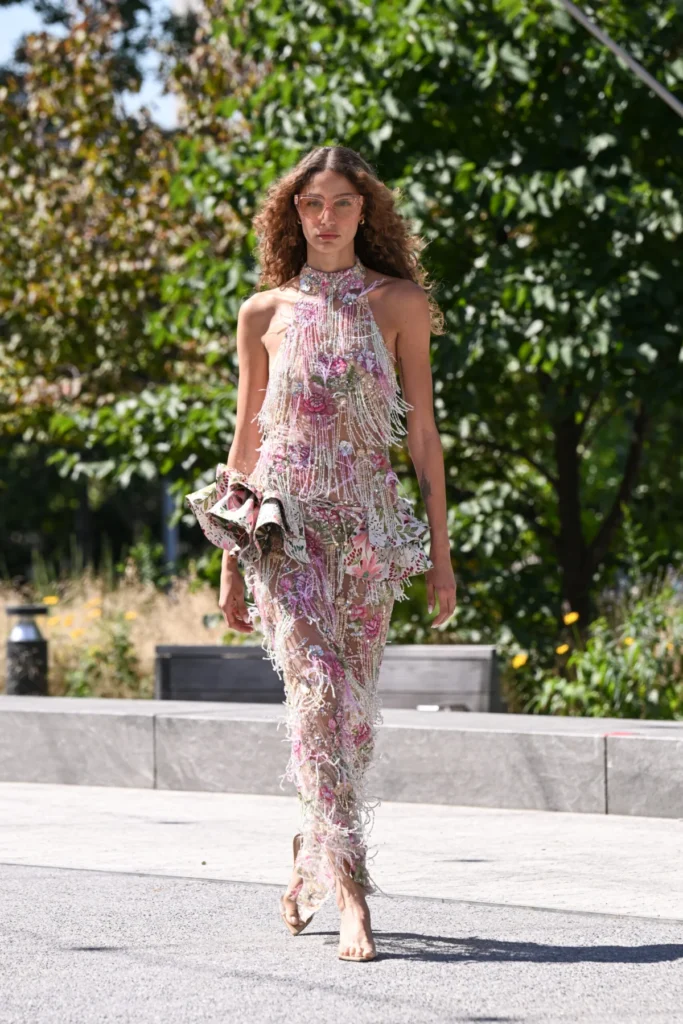
The hallmark of the collection was the interplay of textures. Signature fringe—an element so synonymous with PatBo that it has become a brand shorthand—returned, but it was recontextualized against rigid, sculptural volumes. Bonaldi experimented with transparency, layering mesh against intricate embroidery, and utilizing graphic cutouts to break up the visual density of the garments.
Structural Evolution
"I think we were always more fluid," Bonaldi explained when asked about the shift in silhouette. "Now we have these organic shapes and more architectural shapes, and we are building more in terms of patterns." This architectural rigor was most visible in the collection’s outerwear and formalwear, where jacquard fabrics were manipulated to create jackets and trousers that defied the softness typically associated with spring wardrobes.
Supporting Data: Artisan Craftsmanship and Retail Expansion
The success of PatBo is intrinsically tied to its manufacturing model. Every piece is produced in Brazil, relying on a deeply skilled network of artisans whose hand-embroidery and beadwork provide the "dimensional detailing" that elevates the garments from mere clothing to wearable art.

Beyond the Runway: Strategic Diversification
PatBo is not merely scaling its design complexity; it is also diversifying its product portfolio. In an industry where brand loyalty is increasingly tethered to lifestyle integration, Bonaldi is making calculated moves to capture more of her customer’s budget:
- Footwear Integration: Introduced during the Fall 2026 season, the footwear line has been designed to complement the structural shifts in the clothing, offering shoes that echo the brand’s new geometric focus.
- Eyewear Debut: For the upcoming spring season, the company is unveiling a full eyewear collection. This move is a classic brand-extension strategy designed to increase accessibility and brand visibility, allowing consumers to "buy into" the PatBo aesthetic at a lower entry price point than a couture-level evening gown.
Official Responses and Creative Direction
During the post-show press briefing, Bonaldi was vocal about the importance of evolution. While she remains fiercely protective of the brand’s Brazilian DNA, she is clearly eager to shed the "beachwear-only" pigeonhole that sometimes follows brands from warmer climates.
"I tried to be more experimental this season," she said. When pressed on which pieces she expects to resonate most with the market, she pointed to the beach dresses—a core pillar of the brand—but emphasized that the true commercial and critical "hit" would likely be the jacquard ensembles. "I think the jacquards will be a hit," she said, gesturing toward a jacket and pant set that showcased the height of the brand’s new tailoring capabilities.
The Implications for the Future
The implications of this collection are twofold: first, it marks a maturation of the PatBo brand; second, it confirms the rising influence of South American designers on the global luxury market.
Market Positioning
By moving into footwear and eyewear, PatBo is effectively positioning itself as a "total look" brand. This is a critical transition for a label that built its reputation on occasion-wear. By providing the accessories to match the clothing, PatBo is reducing the friction in the customer journey, ensuring that a shopper at Saks or Bergdorf Goodman can curate a full ensemble from the brand.
Cultural Diplomacy
The collection also serves a diplomatic function. By utilizing the language of Brazilian modernism—a movement known for its integration of the natural landscape into the built environment—Bonaldi is positioning her brand as a sophisticated cultural exporter. This is not "vacation fashion" in the traditional sense; it is a serious contribution to the global dialogue on sustainable luxury, craftsmanship, and structural design.
Conclusion: The "Moment" is Permanent
As the guests departed Domino Square, the overarching sentiment was one of clarity. PatBo has successfully navigated the transition from a niche, artisanal label to a sophisticated, international fashion house.
The spring collection succeeds because it refuses to compromise on its identity. It embraces the maximalist, the colorful, and the textural, while simultaneously proving that it can master the rigid, the structural, and the precise. For Patricia Bonaldi, the "moment" that the world is finally noticing is not a fleeting trend. It is the result of twenty years of labor, a deep respect for Brazilian craftsmanship, and a relentless commitment to an aesthetic that refuses to be quiet.
As the brand looks toward its next decade in the U.S. market, it is clear that PatBo is no longer just a participant in global fashion—it is a lead architect of its future. Whether through the intricate weave of a jacquard jacket or the precision of a new eyewear frame, the message is consistent: Brazil is here, it is structured, it is experimental, and it is here to stay.