
In the high-octane world of contemporary fashion, where seasonal trends are often dictated by the need for movement, spectacle, and the relentless pursuit of the "new," British designer Ashley Williams has taken a jarringly introspective detour. Her latest collection serves as a meditation on containment—a wardrobe designed for a life lived entirely within the confines of four walls. By mining the psyche of one of cinema’s most tragic, housebound figures, Williams has crafted a narrative that is as uncomfortable as it is deeply moving.
The Muse: Bonnie Grape and the Aesthetics of Stasis
The central figure anchoring this collection is Bonnie Grape, the matriarch from the 1993 cult classic What’s Eating Gilbert Grape. Portrayed by Darlene Cates, Bonnie is a character defined by her profound isolation, physical immobility, and the quiet tragedy of a life defined by her own living room.
Backstage, Williams articulated the philosophical underpinnings of the collection, noting that the work is "inspired by fighting battles that you’re never going to win." It is a rare admission in an industry that prizes victory, growth, and expansion. "It’s about the realization of your powerlessness," Williams added, "and finding the transcendence that exists within that acceptance."
This is not a collection about the girl who travels the world; it is a collection for the woman who has reconciled herself with the stillness of her own domestic landscape. By elevating the housebound experience, Williams transforms the mundane into the mythical, turning the act of "staying in" into a radical aesthetic choice.
Chronology: From Cinematic Trauma to Runway Triumph
The conceptual development of the collection followed a trajectory of obsession, refinement, and material experimentation. Williams began by revisiting the film, not as a narrative of dysfunction, but as an aesthetic study.
- The Character Study (Early Development): Williams spent months dissecting the visual language of the Grape household. She identified the "childlike read" of the character—the way in which extreme isolation can force an adult into a state of arrested development.
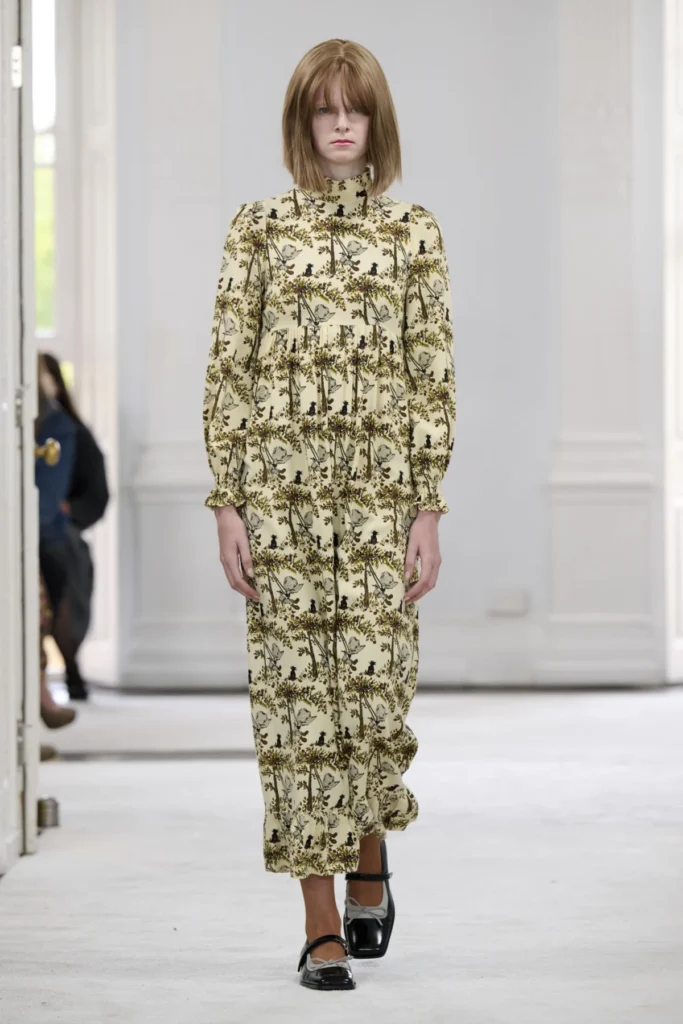
- The Aesthetic Codification: The designer settled on a signature look for her runway models: identical light pink lipstick paired with dirty blond, blunt-cut bob wigs. This uniformity created a "cloned" effect, stripping the models of their individuality to better reflect the monochromatic nature of Bonnie Grape’s world.
- Material Sourcing and Fabrication: The collection required fabrics that carried the weight of history. Williams utilized textiles that mimicked domestic environments—curtains, vintage bedding, and heavy, textured cottons—to ensure that the clothes felt lived-in rather than manufactured.
- The Final Presentation: The runway show itself was a masterclass in controlled atmosphere, where the clothes were presented as artifacts of a static life, culminating in the showcase of the Yvmin jewelry collaboration.
Supporting Data: The Anatomy of the Collection
To understand the collection, one must look at the specific design choices that bridge the gap between "housecoat" and "high fashion."
The Domestic Print
The most literal interpretation of the theme was the use of satin babydoll dresses printed with patterns resembling wooden wall paneling. This motif suggests a literal merging of the wearer with their environment—a visual metaphor for becoming part of the furniture. The inclusion of torn tights stuffed with bunnies and knitted teddies pushed the collection further into the realm of the surreal, emphasizing the regressive nature of deep, protracted isolation.
The Memory Archive
Perhaps the most poignant pieces were the reconstructed dresses. Williams sourced floral, grandmother-style prints and reworked them into contemporary silhouettes. These garments are designed to function as "frozen moments." By using fabrics reminiscent of curtains and old sheets, the designer tapped into the collective nostalgia of the domestic space—the idea that our most important memories are often formed in the most unglamorous of settings.
The "Happy Memories" Shirt
A standout piece was the long-sleeve dress shirt, worn with a matching cropped cape. The fabric, sourced from cotton sheets, featured hand-drawn, childlike illustrations of characters reading books and eating apples. Interspersed with these drawings were the words "happy memories." It was a stark reminder of Williams’s core thesis: that in the absence of a wider world, the smallest, most repetitive acts of joy become the foundation of one’s identity.
The Yvmin Collaboration: Jewelry as Mechanical Memory
No Ashley Williams collection would be complete without her signature accessories, and the ongoing partnership with Chinese jewelry brand Yvmin provided the perfect surrealist accent. The pieces were designed to feel like toys that had been repurposed into luxury items.
The standout items included:
- The Siamese Cat Belt: A faux-porcelain plastic belt featuring two cats locked in an embrace as the closure. It evokes the feeling of a comfort object, something to hold onto when the walls feel too close.
- The Music Box Watch: A chunky, oversized wristwatch that mimics the mechanics of a jewelry box. When examined closely, the dial reveals a miniature, dancing ballerina. It is a piece that demands attention while simultaneously evoking the quiet, rhythmic ticking of a clock in a silent house.
Official Responses and Industry Reception
Critics have lauded the collection for its refusal to cater to the "busy woman" trope that currently dominates the fashion market. Industry insiders have noted that while the aesthetic is niche, the emotional resonance is universal.
"Williams has done something quite daring," noted one fashion editor. "She’s taken the shame often associated with being ‘stuck’ and turned it into a romantic, albeit melancholic, style."
The collaboration with Yvmin has also been singled out for its technical ingenuity, with the mechanical wristwatch being hailed as one of the most innovative accessories of the season. By combining the playfulness of the toys of our youth with the cold, hard reality of luxury materials, the collection forces a conversation about why we value the objects we keep in our homes.
Implications: The Future of "Home-Body" Fashion
The implications of this collection extend far beyond the runway. As society continues to grapple with the aftermath of global shifts that forced millions into domestic confinement, Williams’s work feels prophetic. She is identifying a new kind of "home-body" chic—one that is not about comfort in the sense of loungewear, but in the sense of psychological safety.
This collection suggests that the future of fashion may lie in the "internal landscape." By focusing on the items that surround us in our most private moments, Williams is challenging the industry to find value in the domestic sphere. She posits that if we are to live our lives between four walls, we should treat those walls—and the objects within them—with the same reverence we would a curated wardrobe of high-fashion pieces.
Ultimately, Ashley Williams has succeeded in turning a tragic cinematic figure into a style icon. By embracing the powerlessness of Bonnie Grape, she has provided a blueprint for finding beauty in the stillness. It is a reminder that even when we feel trapped, the act of self-expression—of dressing, of curating, of adorning—remains one of the most powerful tools for maintaining sanity and identity.
In a world that demands we always be "on the go," Williams reminds us that there is a quiet, profound power in simply being, and in the clothes that hold us while we are there.