

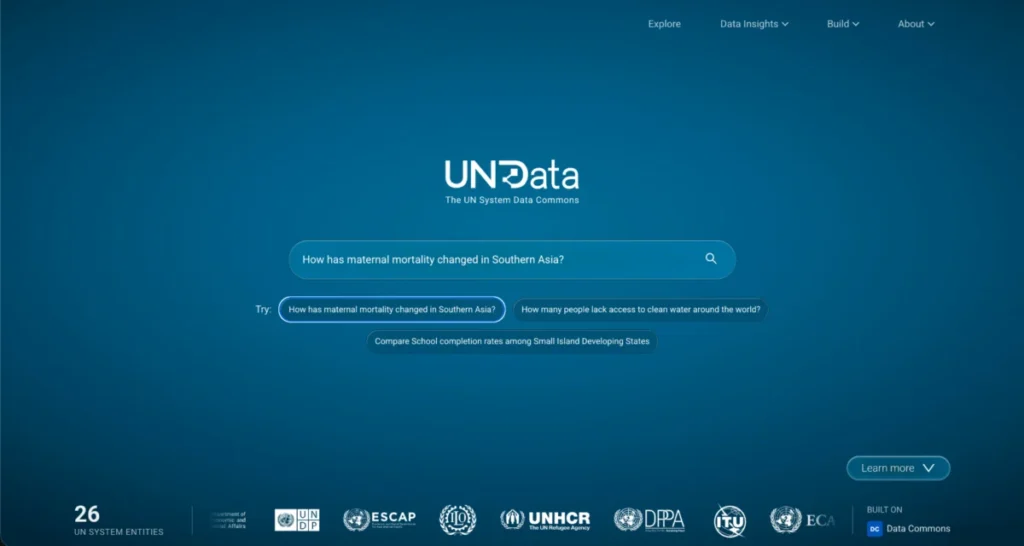
In a landmark move to modernize how the world interacts with authoritative statistics, the United Nations has officially unveiled the UN System Data Commons. Developed in strategic partnership with Google, this new digital infrastructure aims to harmonize the UN’s vast, fragmented collection of global development data, making it directly accessible and interoperable with modern artificial intelligence systems.
The initiative represents a fundamental shift in how international organizations disseminate information. By moving away from traditional, siloed database portals toward a machine-readable, AI-optimized framework, the UN is attempting to address a growing crisis in the digital age: the inability of generative AI to reliably access and cite verified, factual data.
The Problem: AI’s "Hallucination" Crisis
The launch comes at a critical juncture for the adoption of generative AI. While users are increasingly turning to chatbots and LLMs (Large Language Models) to answer complex questions about global development, health, and economic indicators, these systems have historically proven to be unreliable.
A recent UNICEF working paper—which analyzed the performance of six top-tier AI models, including OpenAI’s GPT-4o series, Anthropic’s Claude 3.5, and Google’s Gemini 2.0 and 2.5 Flash—revealed a startling lack of precision. When tested against 133,000 queries related to global development metrics, the models achieved an average accuracy score of just 21.2%.
João Pedro Azevedo, UNICEF’s chief statistician, highlighted that approximately 60% of responses failed to provide a usable numerical answer at all. When the models did provide figures, their consistency was abysmal; re-running the same queries just 48 hours later resulted in identical data points only half the time. This volatility highlights the danger of relying on "black-box" AI models for policymaking or academic research without a robust, verified data backbone.
The Mechanics of the UN System Data Commons
The new UN System Data Commons is built upon Google’s open-source Data Commons platform. Unlike the legacy UNData portal, which required users to manually search, filter, and download datasets, the new system utilizes a natural-language query interface.
Crucially, the platform supports the Model Context Protocol (MCP). This standard acts as a universal bridge, allowing AI agents to connect directly to external data sources. Instead of relying on a model’s "internal knowledge"—which is often outdated or prone to hallucinations—an AI equipped with MCP can "reach out" to the UN’s servers, fetch the latest, verified statistics, and integrate them into a response in real-time.
At launch, 20 UN entities have already contributed data, with plans to expand this to 26 and beyond. The organization has set an ambitious target: to migrate 80% of the entire UN system’s statistical datasets onto this new platform by 2027.
A Chronology of the Transformation
- 2018: Google launches the original Data Commons project, an ambitious effort to index public datasets into a common, queryable framework.
- 2023–2024: Generative AI usage spikes globally. UNICEF notices a massive increase in traffic to its data portals coming from AI-driven referral links (a 67% year-over-year increase by September 2026).
- Late 2025: Google introduces support for the Model Context Protocol (MCP), signaling a pivot toward "AI-native" data accessibility.
- December 2026: UNICEF and other UN agencies formalize the collaboration with Google, securing $2 million in capacity-building funding.
- January 2027 (Present): The UN System Data Commons goes live, replacing the legacy UNData portal and setting a new standard for AI-ready global statistics.
Supporting Data: The Rising Tide of AI Referrals
The urgency behind this project is supported by shifting user behavior. UNICEF’s data website, which attracts over six million visits per month, has seen a fundamental change in how users arrive at its pages.
Azevedo noted that referrals from AI assistants now account for roughly one in ten visits to the agency’s websites. As of September 14, 2026, sessions initiated by users clicking on links embedded within ChatGPT answers had grown by 67% compared to the previous year. This shift confirms that the UN can no longer rely on being a passive repository of information; it must actively provide the "ground truth" that powers these AI-driven inquiries.
Official Responses and Strategic Intent
The leadership behind the project emphasizes that this is not merely a technical upgrade, but a necessity for the integrity of global information.

"We are orders of magnitude more advanced in scale, scope, and flexibility, connecting for the first time across so many agencies across the UN system," said Shantanu Mukherjee, acting director of the UN Statistics Division. "We are taking this moment to also make our data AI-ready."
From the tech sector’s perspective, the goal is to create a sustainable, autonomous system. Prem Ramaswamy, who leads Google’s Data Commons team, explained that the partnership follows a "train-the-trainer" model. Google provided the $2 million in infrastructure and technical expertise, but the ultimate objective is for the UN to fully own, operate, and scale the system independently.
"The system is hosted on a UN-governed instance," Ramaswamy noted, emphasizing the importance of sovereignty in data governance. "It is intended to eventually be maintained and scaled independently by the UN."
Implications: The Future of Evidence-Based Decision Making
The integration of the UN System Data Commons with AI agents offers a glimpse into a more efficient, evidence-based future. In a recent demonstration, an AI agent connected to the new platform was tasked with analyzing the impact of the U.S. President’s Emergency Plan for AIDS Relief (PEPFAR) in Africa.
Without human intervention, the AI pulled data from multiple UN sources simultaneously—including HIV infection rates, AIDS mortality, and life expectancy—and generated a comprehensive, visual infographic with linked citations. This level of synthesis would have previously taken a human researcher hours, if not days, to compile.
However, the experts involved are quick to temper expectations regarding AI autonomy. Despite the availability of authoritative data, the interpretive layer remains a point of failure.
"Because models can misinterpret nuance, a human should always review the outputs before citing or publishing them," Ramaswamy cautioned.
The platform’s inclusion of source-tracking—which allows users to click through from an AI-generated statistic to the specific UN dataset of origin—is the final safeguard in this ecosystem. It ensures that while AI does the heavy lifting of data retrieval, the "provenance" or origin of that data remains transparent.
Looking Forward
As the UN pushes to bring the majority of its datasets onto the platform by 2027, the success of this project will likely serve as a blueprint for other international bodies. If global organizations can successfully standardize their data for AI consumption, they may finally be able to steer the trajectory of generative AI toward factual, research-backed outputs rather than speculative ones.
The Data Commons is not just a database; it is a defensive wall against misinformation. By ensuring that the world’s most critical statistics are the easiest to find and the most accurate to retrieve, the UN is positioning itself as the primary "knowledge source" for the AI era. Whether this leads to a more informed public or simply a more efficient way to generate errors depends, as ever, on the human element: the vigilance of the users and the rigors of the peer-review process that will continue to test the validity of these models.
For now, the UN System Data Commons stands as a vital bridge between the rigid, precise world of official statistics and the fluid, unpredictable world of artificial intelligence.