The Arctic is often described as the "canary in the coal mine" for global climate change, but beneath its rapidly thawing surface lies a massive, complex, and potentially volatile storage system: the permafrost. For decades, climate scientists have operated under a veil of uncertainty regarding the fate of the carbon locked within these frozen soils. As the planet warms, this ancient organic matter—the remnants of prehistoric plants and animals—is increasingly being flushed into the Arctic Ocean.
A groundbreaking study published in Nature Geoscience by researchers from the Alfred Wegener Institute (AWI) and MARUM—the Centre for Marine Environmental Sciences at the University of Bremen—has finally begun to demystify the journey of this carbon. By investigating the coastal waters off Qikiqtaruk (Herschel Island) in Canada, the team discovered that the seafloor acts as a far more effective carbon trap than previously assumed. The findings hinge on a surprising biological preference: the tiny microorganisms inhabiting the ocean floor are essentially "gourmet" eaters, favoring fresh marine nutrients over the ancient, weathered carbon spilling out from the thawing coast.
The Magnitude of the Frozen Storehouse
To understand the scale of the challenge, one must first appreciate the sheer volume of carbon currently held in the Arctic. Permafrost ecosystems—the layer of soil that remains frozen for two or more consecutive years—contain an estimated 1,300 gigatonnes of organic carbon. This represents a colossal reservoir of greenhouse gases waiting to be unleashed. An additional 400 gigatonnes are stored in river deltas and sub-sea sediments.
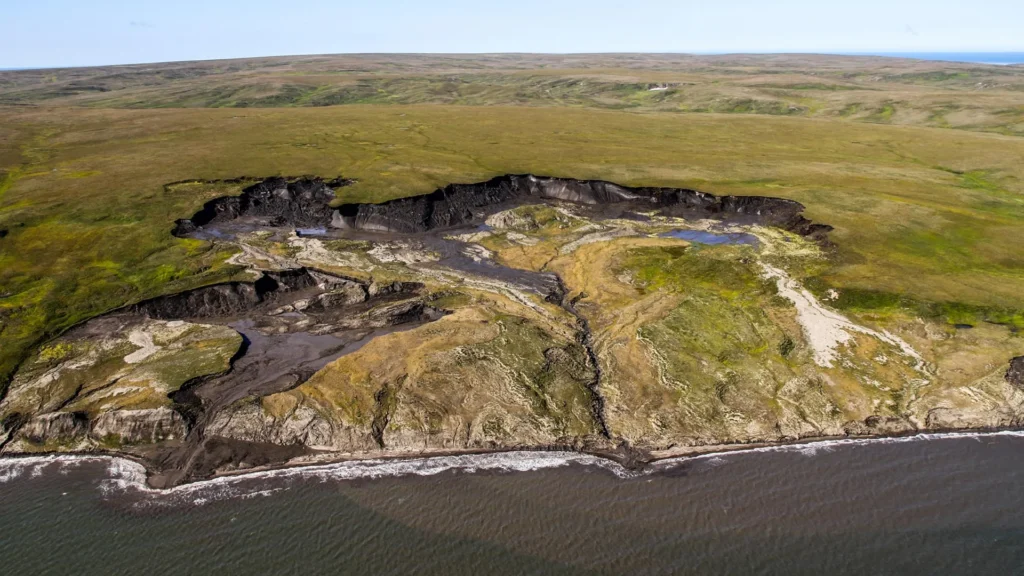
As the Arctic warms at a rate nearly four times faster than the global average, this structural integrity is failing. The ground is thawing, coastlines are collapsing, and vast quantities of terrestrial carbon are being swept into the Arctic Ocean. Dr. Manuel Ruben, lead author of the study from the AWI, notes that roughly 0.02 gigatonnes of carbon enter the sea annually. According to current projections, this outflow is expected to surge by 70 to 150 percent by the year 2100. Until this study, the critical question—how much of this carbon is converted into methane or carbon dioxide, and how much is permanently sequestered in the deep-sea abyss—remained largely a matter of conjecture.
A Chronological Investigation: From Land to Sea
The research team’s methodology was a masterpiece of forensic geochemistry. To determine the fate of this carbon, they collected sediment cores from various sites off the coast of Herschel Island. These cores serve as a geological tape recorder, containing layers of material deposited over the last 50 years.
The Timeline of Discovery:
- The Sampling Phase: Researchers extracted deep sediment cores, ensuring that they captured the historical progression of organic material.
- Isotopic Analysis: By utilizing carbon isotopes (specifically ¹³C and ¹⁴C), the team traced the origin and age of the organic matter. While ¹³C helped distinguish between terrestrial and marine sources, ¹⁴C provided the "age" of the carbon, allowing scientists to see whether microbes were consuming "old" permafrost carbon or "fresh" marine algae.
- Pore Water Examination: The team analyzed the water trapped between sediment grains. By measuring dissolved inorganic carbon, they could calculate exactly how much CO₂ was produced by microbial respiration at different depths.
The data yielded a surprising conclusion: despite the immense influx of terrestrial carbon, only about ten percent of it is actively converted into greenhouse gases. The vast majority of the organic matter remains buried in the seabed, effectively neutralized as a climate threat for the foreseeable future.
Supporting Data: The Selective Metabolism of Microbes
The core of the study’s impact lies in the behavior of the seafloor microorganisms. The isotopic markers revealed a distinct hierarchy in the microbial diet. When presented with a mix of aged, terrestrial organic matter—which has been sitting in frozen soil for centuries—and fresh organic detritus falling from the upper ocean layers (such as dead algae), the microorganisms consistently chose the latter.
"The sediment is home to ‘gourmet’ bacteria that apparently prefer fresh carbon," explains Prof. Gesine Mollenhauer, a geochemist at the AWI and co-spokesperson for the ‘The Ocean Floor – Earth’s Unexplored Interface’ cluster of Excellence. This preference is pivotal. If the microbes were indiscriminately breaking down all available carbon, the potential for a massive, runaway greenhouse gas release would be significantly higher. By ignoring the older permafrost-derived carbon, these organisms are inadvertently helping to keep a significant portion of that ancient carbon stored safely in the seafloor.
Official Perspectives and Expert Interpretation
The research provides a critical foundation for global climate models, which have historically struggled to account for the "coastal filter" of the Arctic. Dr. Manuel Ruben emphasizes that while the news is cautiously optimistic regarding carbon storage, the complexity of the Arctic system prevents a simple conclusion.
"We do need further research," Dr. Ruben cautions. "Some of the organic carbon from the permafrost may have already been broken down before it even reaches the seabed." This suggests that the process of microbial decomposition begins in rivers and estuaries, meaning the "ten percent" figure measured at the seafloor might represent only a portion of the total carbon cycle transformation.
Prof. Mollenhauer adds that the study’s use of atomic indicators represents a shift in how geochemists view the seafloor. Rather than seeing the seabed as a passive dump, they now view it as a highly active, selective chemical interface. This nuanced understanding is what climate modellers have been missing—a way to distinguish between carbon that stays put and carbon that fuels atmospheric warming.
Implications: Beyond the Greenhouse Effect
The implications of this carbon migration extend far beyond atmospheric CO₂ levels. The movement of sediment and dissolved organic carbon from land to sea is fundamentally altering the Arctic’s coastal chemistry and biology.
The Light-Deprivation Problem
Coastal erosion creates turbid, murky water. As sediment plumes spread, they block sunlight, which is essential for primary producers like phytoplankton and sea ice algae. In an ecosystem that relies on these tiny organisms to support the entire food web—from zooplankton to fish, and eventually to seals and polar bears—a decrease in light penetration could have cascading effects on biodiversity.
The 2027 ‘Arctic Pulse’ Campaign
The scientific community is not resting on these findings. The upcoming ‘Arctic Pulse’ campaign, scheduled for 2027, is designed to observe these shifts in real-time. By utilizing the Polarstern research icebreaker, alongside aerial surveys and land-based stations, researchers hope to create a comprehensive, high-resolution picture of the Arctic’s transition. The goal is to see how the "coastal filter" behaves under different environmental stressors, such as changing river flow patterns and sea-ice loss.
Conclusion: A New Foundation for Climate Modeling
For those modeling the future of our climate, the Herschel Island study serves as both a warning and a correction. It confirms that the Arctic is not simply a ticking time bomb of carbon; it is a complex, biologically managed system. While the "gourmet" behavior of marine bacteria provides a natural buffer, the accelerating rate of coastal erosion remains a grave concern.
By defining the parameters of how much carbon is stored versus how much is released, researchers have provided a more precise tool for policymakers and climate scientists. As we look toward the 2027 field campaigns, the focus will remain on whether these natural buffers can hold up under the immense pressure of a warming planet. The Arctic’s frozen past is now, more than ever, dictating our climate’s future. Understanding the subtle choices made by microorganisms on the seafloor is not just an academic exercise—it is an essential step in navigating the challenges of the coming century.