

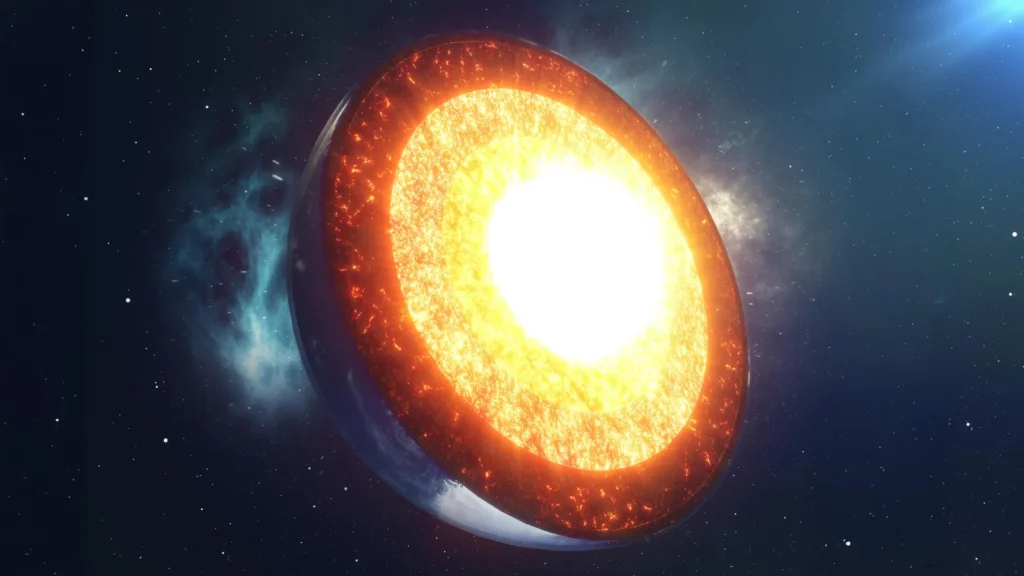
To the average observer, a day is an immutable constant—a reliable 24-hour cycle dictated by the steady rotation of our planet. Yet, beneath the surface of this perceived stability lies a far more chaotic and rhythmic reality. Earth’s rotation is not a perfect, uniform spin; it is a dynamic, shifting process influenced by the complex, churning mechanics of our planet’s deepest interior.
While the fluctuations are measured in mere milliseconds, they are profound enough to capture the attention of physicists and geophysicists alike. New research has finally begun to bridge the gap between the internal movements of Earth’s core and the precision of our clocks, revealing that our planet is far more "alive" than its solid exterior would suggest.
The Main Facts: Why Our Days Are Never Quite the Same
At the heart of the matter is the principle of conservation of angular momentum. Earth is a closed system, and the total rotational momentum of the planet must remain constant. However, that momentum is distributed among the various layers of the planet—the solid inner core, the liquid outer core, and the rocky mantle.
For decades, scientists have observed that the liquid outer core does not rotate in perfect synchronicity with the mantle. When the core speeds up, the mantle must compensate by slowing down to maintain the planet’s total angular momentum. Because the mantle includes the crust—the layer upon which we live—even the most microscopic change in its rotational speed translates into a perceptible change in the length of a day. These variations, though infinitesimal, serve as a heartbeat for the planet, signaling the massive, invisible exchanges occurring thousands of kilometers beneath our feet.
Chronology of a Geophysical Mystery
The study of Earth’s rotation has evolved significantly over the last century.
The Early Observations (1960s–1990s)
In the mid-20th century, the advent of atomic clocks allowed scientists to measure the length of a day with unprecedented precision. By the 1990s, researchers had established a clear link between the Earth’s magnetic field—generated by the liquid outer core—and changes in the length of a day. It became widely accepted that the core and the mantle were engaged in a multi-decadal "dance," with the core speeding up and slowing down in cycles lasting 20 to 30 years.
The Missing Link (2000s–2023)
For years, the mechanism behind this exchange remained a subject of intense academic debate. While the electromagnetic coupling between the core and the mantle was well-documented, it did not entirely explain the magnitude of the observed rotational shifts. Researchers knew that "something" was transferring momentum, but the precise physics of this interaction remained elusive.
The Breakthrough (September 2023)
The mystery reached a potential turning point with the publication of a study in the journal Nature on September 23. University of Alberta PhD student Huifeng Zhang and professor Mathieu Dumberry introduced a groundbreaking hypothesis: that the inner core acts as a gravitational anchor, exerting a "gravitational torque" that influences the rotation of the mantle.
Supporting Data: The Physics of Gravitational Torque
The core of the Earth is a complex engine. At its center lies the solid inner core—a sphere of iron and nickel roughly the size of the Moon. Surrounding it is the liquid outer core, followed by the mantle, a 3,000-kilometer-thick layer of solid rock that behaves like a viscous fluid over geological time.
The Gravitational Tug-of-War
The new study posits that the inner core is not a perfectly smooth sphere. Because it possesses an uneven distribution of mass, its rotation relative to the mantle creates a gravitational interaction. As the inner core rotates, it exerts a force—a "gravitational torque"—on the mantle.
This interaction is not static. The researchers found that the inner core is far more dynamic than previously assumed. By modeling the interactions, Zhang and Dumberry demonstrated that the inner core appears to "deform viscously" over a timescale of roughly 10 years. This deformation allows the inner core to respond to external forces and redistribute mass in a way that directly impacts the mantle’s rotation.
Competing Forces: Friction and Drag
The gravitational torque is not the only force at play. The boundary between the core and the mantle is also subject to "core-mantle boundary torque." This consists of electromagnetic drag and friction, which act as a stabilizing influence, resisting the gravitational pull of the inner core.
The variation in the length of a day, therefore, is the result of a delicate, ongoing battle between these two forces. When the gravitational torque is stronger, the mantle’s rotation shifts accordingly; when the electromagnetic drag is more dominant, the rotation stabilizes.
Official Responses and Scientific Consensus
The findings presented by Zhang and Dumberry have been met with significant interest in the geophysics community. Dr. Mathieu Dumberry, an expert in planetary geodynamics, noted that the research challenges long-held assumptions about the rigidity of the inner core.
"We have long viewed the inner core as a somewhat inert, solid mass," Dumberry stated in a recent briefing. "But this research suggests that it is capable of significant deformation on decadal timescales. It is essentially a gear in a much larger machine that we are only just beginning to understand."
Independent peer reviewers have praised the study for its innovative use of numerical modeling. By simulating the internal dynamics of the Earth, the researchers were able to reproduce the observed variations in day length with a higher degree of accuracy than previous models, which relied solely on electromagnetic coupling.
Implications: A New Window into the Deep Interior
The implications of this discovery extend far beyond the mere adjustment of our clocks by a few milliseconds.
Understanding Planetary Evolution
By confirming that the inner core is viscously deformable, scientists now have a new tool to probe the physical properties of the Earth’s deepest layers. This data helps researchers estimate the temperature and composition of the core-mantle boundary, providing clues about how Earth cools and how its magnetic field has evolved over billions of years.
The Future of Timekeeping
While a few milliseconds may seem negligible to the average person, they are critical for the global infrastructure of GPS and telecommunications. Satellite navigation relies on the extreme precision of Earth’s rotation to maintain accurate positioning data. If geophysicists can better predict these "wobbles" and shifts, they can provide more accurate data to the agencies responsible for maintaining global time standards, such as the International Earth Rotation and Reference Systems Service (IERS).
The Dynamic Earth
Perhaps the most profound takeaway is the philosophical shift in how we view our planet. We often conceptualize the Earth as a static, solid rock—a firm foundation beneath our feet. This study shatters that perception. It reveals a world that is in constant, fluid motion, where the very center of the planet communicates with the surface through gravity and friction.
The "deforming" inner core represents a frontier of science that was once thought to be impossible to study. By looking at the length of a day, we are essentially reading the internal vital signs of the planet. As research continues, we may find that these decadal shifts in Earth’s rotation are connected to other large-scale phenomena, such as shifts in the geomagnetic field or even variations in mantle convection currents.
Conclusion: The Clockwork of the Deep
The realization that our days are modulated by a gravitational tug-of-war 3,000 kilometers beneath our feet is a testament to the sophistication of modern geophysics. What began as a simple observation of clocks falling slightly out of sync has led to a deeper understanding of the Earth’s inner engine.
As Huifeng Zhang and Mathieu Dumberry’s work continues to be scrutinized and expanded upon, one thing is clear: the Earth is far from a simple, spinning rock. It is a complex, responsive, and ever-changing system. Every time we check our watches, we are unknowingly participating in a global measurement of a process that involves the core, the mantle, and the very gravity that holds our world together. The pulse of the planet is subtle, but thanks to the rigors of modern physics, it is a pulse we can finally measure, track, and—eventually—predict.



