The Swiss watchmaking landscape has long been defined by the tension between heritage and innovation. Few brands navigate this delicate balance as adeptly as Zenith, the Le Locle-based manufacture renowned for its high-frequency El Primero movements. This month, the brand has officially unveiled its latest collection: the Zenith Chronomaster Solo Sport.
Stepping away from the complex chronograph architecture that defined the original Chronomaster Sport, this new family of three-hand timepieces marks a strategic pivot for Zenith. It offers a refined, everyday-wearable alternative for the modern collector who demands technical excellence without the clutter of sub-dials. As the brand seeks to capture a larger share of the "luxury sports" segment, the Solo Sport arrives as a "feature-packed" contender that blends historical gravitas with contemporary engineering.
Main Facts: A Technical Overview
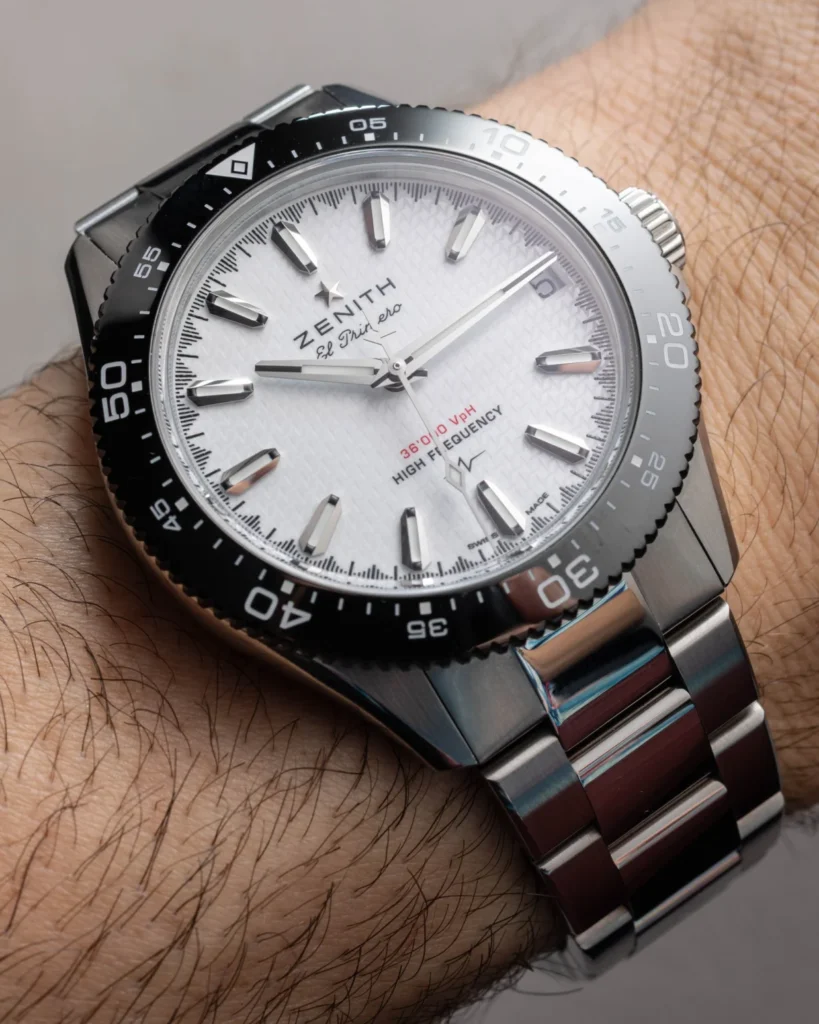
The Chronomaster Solo Sport debuts as a collection of four distinct models, all housed within a 40mm stainless steel case—a slight reduction in size from the 41mm Chronomaster Sport chronograph, offering a more balanced proportion for a wider range of wrists.

The collection is powered by the in-house El Primero caliber 3620, an automatic movement operating at the signature high-frequency rate of 5Hz (36,000 vibrations per hour). This movement ensures superior precision, a hallmark of the El Primero lineage. The power reserve is a robust 60 hours, ensuring the watch remains running through the weekend.
Key Technical Specifications:
- Case Diameter: 40mm.
- Material: Polished Stainless Steel.
- Water Resistance: 200 meters (enhanced from the 100m of the Chronograph).
- Crystal: Flat, anti-reflective sapphire on both the front and the exhibition caseback.
- Bezel: Solid ceramic unidirectional-rotating bezel (available in black or brown).
- Clasp System: The new ZENCLASP micro-adjust system, offering 10mm of extension in 2.5mm increments.
Perhaps the most significant design departure is the use of solid ceramic for the bezel. Unlike many competitors that utilize a ceramic insert set into a steel ring, Zenith has opted for a singular, robust piece of ceramic. This construction significantly increases scratch resistance and long-term durability, protecting the watch against the common "nicks" that typically plague steel bezels.
Chronology: From Chronograph to Solo
The "Chronomaster" name has been synonymous with the legendary El Primero chronograph since the late 20th century. However, the 2021 release of the Chronomaster Sport propelled the brand into a new tier of public consciousness. Despite its success, that watch drew comparisons to the Rolex Cosmograph Daytona, a "compliment" that also served as a critique of its derivative design.

By introducing the "Solo" (three-hand) variant, Zenith is clearly attempting to shed the "Daytona-alternative" label. The development of the Solo Sport began shortly after the success of the Sport Chronograph, with the design team focusing on creating a cleaner, more practical dial layout. The internal development of the ZENCLASP system was a multi-year project, necessitated by the need to create a proprietary, patent-free micro-adjust system that could compete with industry benchmarks like the Rolex Glidelock.
The launch of these models in late 2026 represents the culmination of this transition, moving Zenith away from purely "racing-inspired" watches toward a versatile, diver-adjacent luxury sports category.
Supporting Data: The Value Proposition
Zenith is historically positioned as a "value-for-money" powerhouse, offering in-house, high-frequency movements at prices often lower than competitors with mass-produced ébauches. With the Solo Sport, the brand is testing this perception.

Pricing Structure:
- Reference 03.5000.3620/21.M5000 (No-Date, Black): $9,800 USD.
- Reference 03.5000.3620/22.M5000 (Date, Black): $10,900 USD.
- Reference 03.5000.3620/69.M5000 (Date, White): $10,900 USD.
- Reference 03.5001.3620/72.M5000 (Date, Brown): $10,900 USD.
The introduction of a no-date variant is a significant nod to the enthusiast community, which has long advocated for the aesthetic purity of the "no-date" dial. Pricing the no-date version at an $1,100 discount is an interesting market signal, acknowledging that for many collectors, "less is more."
The inclusion of the ZENCLASP—a mechanism requiring 41 distinct parts and tested for 600,000 cycles—justifies the premium pricing to an extent. By comparison, the standard Chronograph version of the Chronomaster sits less than $3,000 higher in price, forcing potential buyers to weigh the utility of a chronograph against the daily comfort and sleekness of the Solo.
Official Responses and Strategic Vision
Zenith’s leadership has emphasized that the Chronomaster Solo Sport is not intended to replace the existing lineup but to bridge the gap between their high-performance racing tools and their more rugged, outdoor-focused "Defy" collection.

In discussions surrounding the development of the ZENCLASP, company representatives highlighted the difficulty of the engineering process. Because the most effective micro-adjust systems are heavily protected by patents, Zenith spent significant time ensuring their solution was both legally distinct and functionally superior. Their testing protocols—focusing on long-term wear and tear—were designed to convince the market that the Chronomaster Solo Sport is a "lifetime" object, intended to withstand years of daily use without losing the tactile satisfaction of its adjustment mechanism.
Implications: Where Does Zenith Go from Here?
The launch of the Solo Sport has several profound implications for the watch industry and for Zenith specifically:
1. The "Everyday" Luxury Segment
By moving into the 40mm three-hand space, Zenith is positioning itself to compete directly with the "Holy Trinity" of luxury sports watches—the Audemars Piguet Royal Oak, the Patek Philippe Nautilus, and the Vacheron Constantin Overseas—but at a fraction of the price. While Zenith lacks the same historical prestige as these houses, the technical superiority of the El Primero movement provides a compelling counter-argument for the modern, rational collector.

2. The Power of the Ceramic Bezel
Zenith’s decision to use a full-ceramic bezel (as opposed to an insert) is a manufacturing masterstroke. It signals to the consumer that the brand is not cutting corners. If this bezel design proves as durable as advertised, it could set a new industry standard, forcing other luxury brands to abandon the "ceramic insert" method in favor of full-ring construction.
3. Future Expansion
The current quartet is clearly just the beginning. Given the brand’s history, we can expect to see:
- Material Variations: A titanium model is widely anticipated, which would further enhance the wearability of the 40mm case.
- Dial Colors: While we have black, white, and brown, the "El Primero" high-frequency graphic on the dial invites further experimentation with textures and colors.
- Case Materials: The move to 200m water resistance suggests that a precious metal version (rose gold or two-tone) could be in the pipeline for those who want a "luxury diver" that can be worn with a suit.
4. The Price Ceiling
The most contentious point remains the $10,000+ price tag. Zenith must now rely on its brand equity to justify a cost that, while technically sound, enters the territory of brands with significantly higher market recognition. The success of the Chronomaster Solo Sport will depend on the brand’s ability to communicate the "superlative" nature of the ZENCLASP and the high-beat movement to a broader audience who might otherwise opt for a Rolex or an Omega.

Conclusion
The Zenith Chronomaster Solo Sport is a confident, mature release. It avoids the temptation of gimmicks, opting instead for a "feature-packing" strategy that prioritizes durability, precision, and comfort. Whether it succeeds in fully distancing itself from the "Daytona shadow" remains to be seen, but as a standalone timepiece, it is arguably one of the most compelling luxury sport watches to hit the market in 2026. For the enthusiast who values engineering over marketing, the Solo Sport offers a compelling, high-frequency reason to take a closer look at the Le Locle manufacture.