

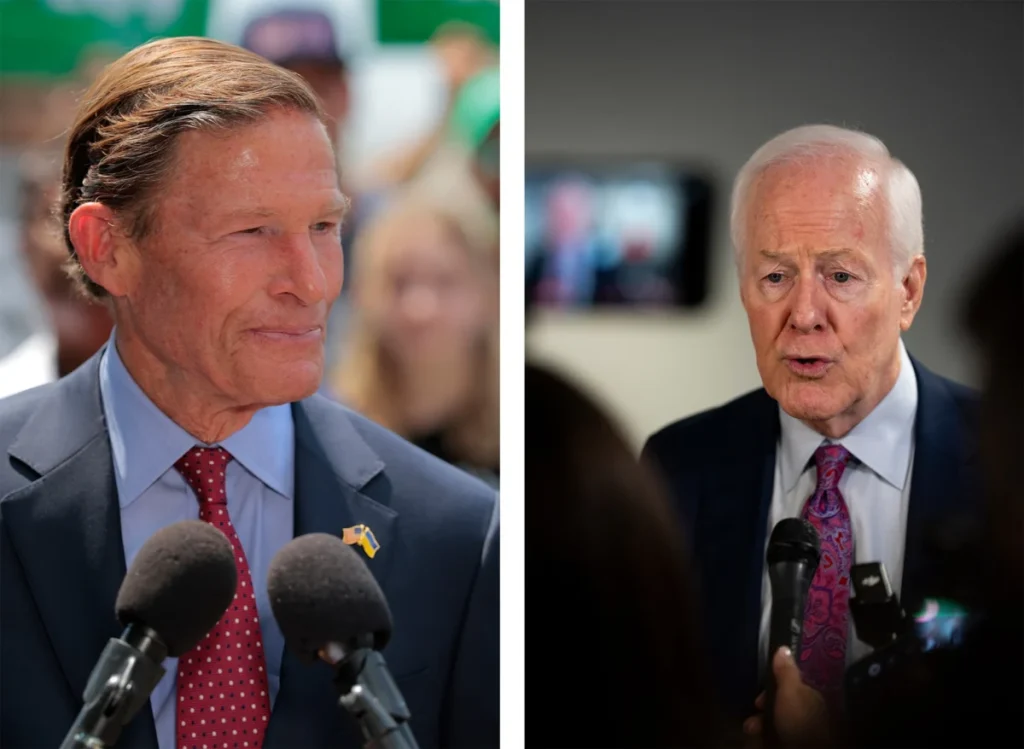
In a rare and significant display of bipartisan unity, U.S. Senators Richard Blumenthal (D-CT) and John Cornyn (R-TX) have stepped into the federal court system to defend the constitutionality of the Holocaust Expropriated Art Recovery (HEAR) Act. Their intervention, filed as an amicus curiae (“friend of the court”) brief on September 18 in the Southern District of New York, represents a major escalation in the ongoing legal saga Reif v. Republic of Austria.
The case, which centers on the recovery of twelve priceless works by Austrian Expressionist master Egon Schiele, has become a lightning rod for broader debates regarding federal authority, international law, and the moral imperative of redressing the systemic theft of cultural property during the Third Reich.
The Core Conflict: Reif v. Republic of Austria
The litigation is spearheaded by Timothy Reif, a descendant of the renowned Austrian Jewish cabaret performer and art collector Fritz Grünbaum. Grünbaum, a victim of the Holocaust, was arrested by the Nazis and ultimately murdered at the Dachau concentration camp in 1941. Prior to his death, his vast collection—comprising over 440 works of art—was systematically seized by the Nazi regime following the Anschluss, the annexation of Austria by Germany on March 13, 1938.
In December 2022, Reif, alongside fellow heirs David Fraenkel and Milos Vavra, initiated a lawsuit against the Republic of Austria, the Albertina Museum, and the Leopold Museum in Vienna. The plaintiffs contend that these institutions have effectively become "havens for traffickers in Nazi-looted art," alleging that the Austrian state has weaponized "impossible financial barriers" and procedural obfuscation to prevent the rightful return of the stolen pieces.
The defendants, however, have mounted a vigorous defense, challenging the very legality of the HEAR Act—the federal legislation intended to simplify the recovery process for victims of Nazi looting.
A Legislative Timeline: The Evolution of the HEAR Act
To understand the current legal friction, one must look at the legislative history of the HEAR Act, a bipartisan achievement that sought to rectify decades of procedural injustice.
The 2016 Foundation
The HEAR Act was signed into law in 2016, designed to provide a uniform, federal standard for statutes of limitations in cases involving art looted by the Nazis. For years, survivors and their heirs were frequently blocked from recovering their heritage due to state-level statutes of limitations that had long since expired, often before the victims even knew the location of their property.
Frustration and the 2025 Amendments
Despite the noble intent of the 2016 law, the legislative record suggests that the initial implementation was less than perfect. Senators Blumenthal and Cornyn noted in their recent filing that, in the years following the law’s passage, courts had frequently "frustrated" the congressional intent by relying on overly technical, procedural dismissals.
In response, the law was significantly amended in 2025. These revisions were transformative:
- Removal of Expiration Dates: The 2026 expiration date originally baked into the 2016 act was eliminated, ensuring the law remains a permanent tool for justice.
- Streamlined Limitations: The new standard requires plaintiffs to file suit within six years of discovering the identity and location of the work in which they hold an ownership interest, clearing away the dense fog of conflicting state laws.
- Jurisdictional Expansion: The amendments strengthened the federal government’s ability to reach foreign states, explicitly granting jurisdiction to U.S. courts in cases where looted art is at the center of the dispute.
Constitutional Challenges: The Austrian Defense
The Austrian defendants have challenged the legitimacy of the HEAR Act, arguing that the federal government overstepped its bounds. Their argument rests on two primary pillars of constitutional law:
The Tenth Amendment Argument
The defendants assert that the HEAR Act violates the Tenth Amendment, which reserves powers not delegated to the federal government to the states or the people. They argue that property law and the regulation of ownership are traditionally state-level responsibilities, and that Congress lacks the authority to dictate how these claims should be adjudicated when they involve foreign entities.
The Article III Challenge
Furthermore, the defendants invoke Article III of the U.S. Constitution, which defines the judicial power of the United States. They contend that by mandating how courts should handle these specific types of claims, Congress has infringed upon the separation of powers, effectively dictating judicial outcomes and encroaching upon the independence of the federal judiciary.
The Senators’ Defense: Enumerated Powers and Moral Authority
In their amicus brief, Senators Blumenthal and Cornyn offered a robust rebuttal, grounding their argument in the foundational powers of the federal government.
"The HEAR Act is a valid exercise of Congress’s enumerated powers," the senators wrote. They specifically cited the government’s authority regarding "war" and the "regulation of foreign and interstate commerce." Their argument is that the systemic looting of art was not merely a local property dispute, but a core component of the Nazi war effort and a disruption of the international art market that continues to reverberate through global commerce today.
By intervening, the senators are signaling to the court that the HEAR Act was never intended to be a mere suggestion. It is a deliberate legislative exercise of the United States’ power to regulate its foreign affairs and ensure that its courts remain a venue for fundamental justice. They maintain that the law "neither violates the Tenth Amendment nor offends separation-of-powers principles."
Implications for International Restitution
The outcome of Reif v. Republic of Austria will likely serve as a landmark precedent for the future of Holocaust restitution. If the HEAR Act is upheld against this constitutional challenge, it will solidify the ability of heirs to pursue stolen cultural property in U.S. courts, regardless of the museum’s prestige or the defendant’s nationality.
The Role of Museums
The case has placed the Albertina and Leopold Museums under intense international scrutiny. Historically, these institutions have argued that their acquisitions were legal under the laws of the time—a defense that ignores the coerced nature of Nazi-era sales. By shielding these institutions, the Republic of Austria risks further reputational damage in the global art community.
Future Litigation
Should the court find the HEAR Act unconstitutional, it could lead to a "chilling effect," where survivors are once again forced to navigate a labyrinth of state-level statutes, effectively ending their chances of recovery. Conversely, a victory for the plaintiffs would reinforce the idea that the "commerce" of stolen art cannot be protected by procedural shields, no matter how much time has passed.
Conclusion: A Moral and Legal Imperative
The involvement of Senators Blumenthal and Cornyn highlights the extraordinary nature of this case. It is rare for the architects of a law to appear before a court to defend its constitutionality, but as the senators suggest, the stakes transcend standard legal interpretation.
The HEAR Act was created to provide a remedy for a specific, historical wrong that the world promised would "never happen again." By fighting for the law’s survival, the plaintiffs and the senators are attempting to ensure that the promise of justice is not merely a slogan, but a functioning component of the American legal system. As the Southern District of New York deliberates, the world watches—not just for the sake of the twelve Egon Schiele works, but for the principle that the theft of history cannot be made legitimate by the passage of time.



