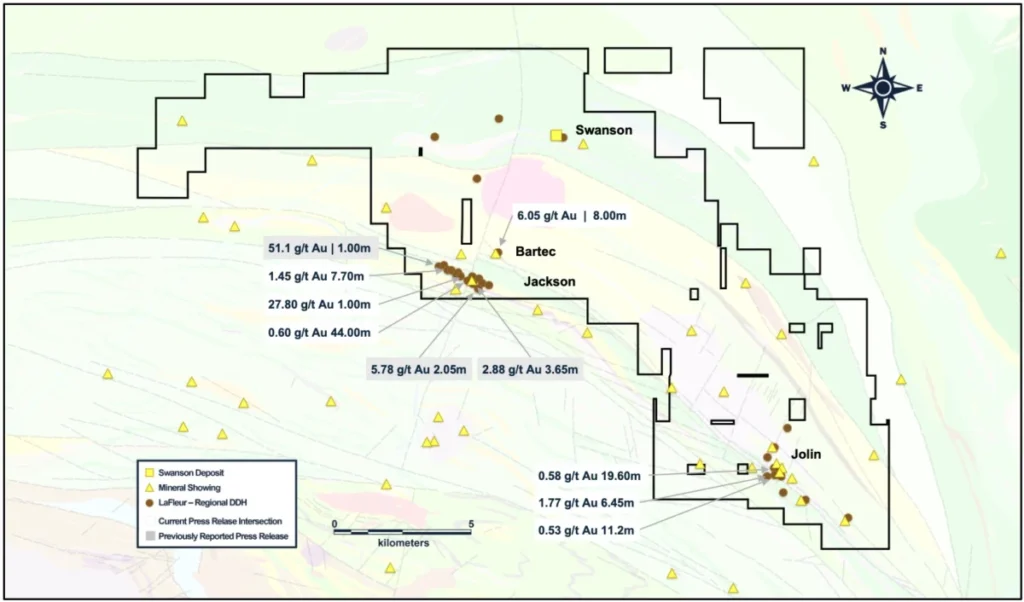
VAL-D’OR, QUÉBEC — LaFleur Minerals Inc. (CSE: LFLR) (OTCQB: LFLRF) (FSE: 3WK0) has unveiled a series of compelling assay results from its latest regional drilling campaign at the Swanson Gold Project. The results, which highlight high-grade intercepts and the discovery of multiple mineralized zones, signal a significant expansion in the company’s understanding of the project’s district-scale potential.
As the company works to advance its flagship PEA-stage Swanson Gold Deposit, these regional exploration efforts—specifically at the historical Bartec, Jackson, and Jolin showings—provide a roadmap for future resource growth. The most striking development, however, is the successful validation of the Bartec target, where modern drilling has confirmed significant gold mineralization in a zone that had remained largely untouched for nearly four decades.
The Bartec Breakthrough: A New Priority Target
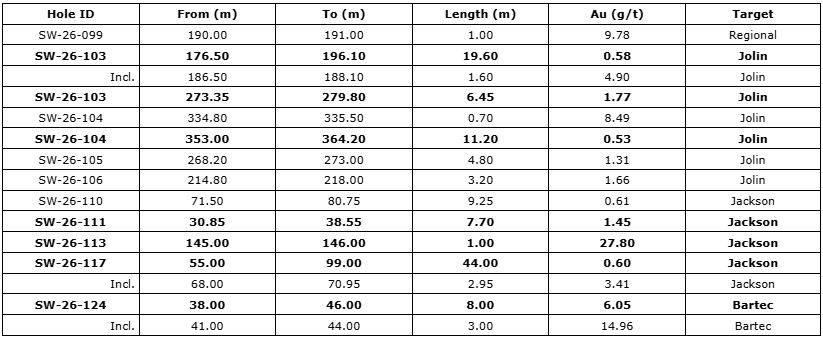
The crown jewel of the recent announcement is the performance of drill hole SW-26-124 at the Bartec showing. The hole returned an impressive 6.05 g/t Au over 8.00 metres, which includes a high-grade core of 14.96 g/t Au over 3.00 metres. Notably, this mineralization begins just 38 metres downhole, marking it as a shallow, high-priority target for future development.
Bartec has long been recognized as a gold-silver occurrence associated with the northwest-trending Bartec shear zone. Situated at the contact between felsic volcanic rocks—such as rhyolite, dacite, and felsic tuff—and porphyritic andesite, the mineralization is characterized by the presence of pyrite, native gold, chalcopyrite, and native silver. The system, interpreted as an orogenic, shear-hosted quartz-carbonate vein system, shows extensive carbonate, sericite, and silica alteration.
Before LaFleur’s intervention, the Bartec showing was defined by limited, antiquated data. Historical records from the SIGÉOM database indicated 20 diamond drill holes were completed between 1957 and 1987, testing approximately 700 metres of strike. While some historical intersections showed promise, they lacked the systematic, modern analysis required to move the project toward a resource estimate. By acting as the first entity to conduct modern-day drilling at the site since 1987, LaFleur has effectively "rediscovered" the zone, elevating it to a primary focus for upcoming exploration phases.
Jackson and Jolin: Extending the Mineralized Footprint
Beyond the excitement at Bartec, the regional drilling program has successfully extended the gold-bearing corridor at the Jackson and Jolin targets.
At the Jackson showing, the company has traced gold mineralization for approximately 1,500 metres along strike. This success is attributed to the integration of high-resolution airborne magnetic and VLF-EM surveys with aggressive diamond drilling. Recent results have been particularly encouraging:
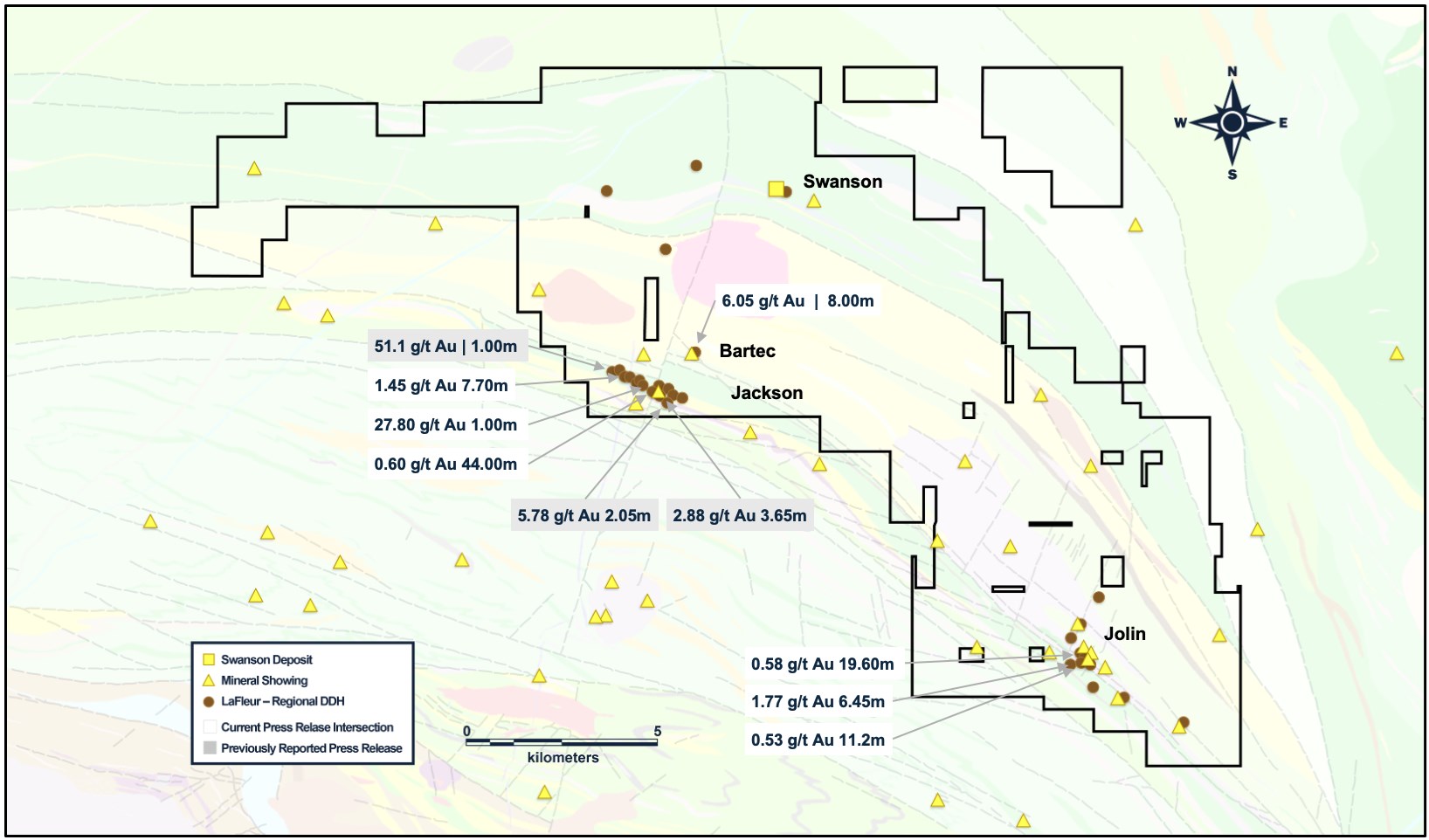
- Hole SW-26-111 intersected 1.45 g/t Au over 7.70 metres, including a sub-interval of 3.17 g/t Au over 1.15 metres.
- Hole SW-26-113 delivered a high-grade hit of 27.8 g/t Au over 1.0 metre.
- Hole SW-26-117 encountered a broad mineralized zone of 0.60 g/t Au over 44.0 metres, reinforcing the theory that the area hosts significant structural continuity.
These results follow previously reported high-grade intercepts in the area, such as the 51.1 g/t Au over 1.0 metre found in hole SW-25-067, which was drilled 1,200 metres west-northwest of the original historical Jackson showing.
At the Jolin target, the focus has shifted to the structural complexity of the area. Drilling has identified multiple, stacked mineralized zones within individual holes. For instance, hole SW-26-103 intersected nine distinct zones, including a 19.6-metre section grading 0.58 g/t Au and a deeper 6.45-metre section grading 1.77 g/t Au. These findings suggest a robust, multi-layered mineral system that warrants further testing to map its full orientation and extent.
Chronology of the Exploration Program
The current results represent the final 35 holes (9,429 metres) of a comprehensive 25,570.5-metre, 93-hole drilling campaign at the Swanson Gold Project. The regional component of this program involved 64 holes totalling 16,331 metres.
The company provided its initial report on this program on February 4, 2026, which covered the first 29 holes. By combining geological interpretation with cutting-edge geophysical surveys—including ground IP and soil sampling—LaFleur has successfully transitioned from "grassroots" prospecting to defining high-priority, drill-ready targets. This systematic approach has allowed the company to move rapidly from identifying historical showings to testing their depth and strike continuity.
Official Commentary: Leadership Perspective
The leadership at LaFleur Minerals remains optimistic about the project’s trajectory. CEO Andrew Elinesky emphasized the transformative nature of the Bartec results. "We are very pleased with these regional drilling results, and Bartec is the standout," Elinesky stated. "Hole SW-26-124 intersected 6.05 g/t Au over 8.00 metres, including 14.96 g/t Au over 3.00 metres, just 30 metres below surface, on a showing that had not seen modern drilling. Bartec moves straight to the top of our follow-up drilling list."
Marc Ducharme, VP of Exploration, provided a more technical outlook on the broader implications of the findings. "We are very encouraged with these latest regional drilling results," Ducharme noted. "Our objective is to explore and expand the potential for large-scale gold mineralized systems through focused exploration drilling programs at the district scale. We are convinced that the Swanson Gold Project has the potential to host several large-scale gold deposits."
Operational Context and Financing
The exploration success at Swanson is occurring in parallel with the company’s efforts to secure its financial future. LaFleur is currently in advanced discussions with Trafigura regarding a potential prepayment and gold doré offtake financing agreement. Following a successful site visit to the Swanson Gold Project and the company’s Beacon Gold Mill in August 2026, both parties are working to finalize the terms of a definitive agreement.
The Beacon Gold Mill, capable of processing over 750 tonnes per day, remains a cornerstone of the company’s strategy. As outlined in the March 3, 2026, Preliminary Economic Assessment (PEA), the mill is viewed as a vital component for the potential restart of operations at Swanson, offering a clear development pathway to gold production.
Implications for the Abitibi Gold Belt
The Swanson Gold Project spans approximately 20,642 hectares within the Abitibi Greenstone Belt—a region globally renowned for its prolific gold endowment. By consolidating a massive land package that includes the Swanson, Bartec, and Jolin targets, LaFleur is effectively positioning itself as a key player in the Val-d’Or mining district.
The implications of these drill results are two-fold. First, they validate the company’s regional exploration model, proving that high-grade mineralization is not isolated to the main Swanson deposit but is instead a recurring feature of the structural breaks across the property. Second, the shallow depth of the new intercepts at Bartec significantly lowers the barrier to potential future extraction, should the resource be proven sufficient in size and continuity.
As the company prepares for its next phase of drilling, the focus will undoubtedly be on establishing the geometry and depth potential of these newly defined zones. With a clear technical strategy, a refurbished mill, and ongoing financing discussions, LaFleur Minerals is demonstrating the maturity of a company ready to transition from exploration to development in one of the world’s most stable and productive mining jurisdictions.
Technical Note on Quality Control
All core logging and sampling were conducted under a rigorous Quality Assurance and Quality Control (QAQC) protocol. This includes the regular insertion of certified reference materials, blanks, and field duplicates. Samples were processed by AGAT Laboratories Ltd., with gold analysis conducted via 50-gram fire assay with an atomic absorption finish. The procedures align with ISO/IEC 17025 standards and NI 43-101 best practices, ensuring that the data released is both accurate and reliable for stakeholders.