In a breakthrough that bridges the gap between 19th-century exploration and 21st-century archaeological precision, a joint Spanish-Egyptian mission has unveiled a remarkably well-preserved tomb dating back to the Fifth Dynasty of Egypt’s Old Kingdom (c. 2494–2345 BCE). The discovery, announced by the Egyptian Ministry of Tourism and Antiquities, was made during the 2026 excavation season within the storied Mariette Necropolis, located just north of the sprawling Saqqara archaeological complex.
This find serves as a poignant reminder that even within the most scrutinized regions of the Egyptian desert, the sands still hold secrets that provide vital context to the administrative and social hierarchy of one of history’s most influential civilizations.
A Legacy Revealed: The Structure and Inhabitants
The newly documented structure is a mastaba—a flat-roofed, rectangular tomb with inward-sloping sides, typical of high-ranking officials during the Old Kingdom. The interior of the mastaba is divided into two distinct funerary chapels, each providing a window into the lives of the father-son duo interred within.
The primary chapel belongs to Yunmen, a high-ranking official who served under the Pharaoh Djedkare Isesi, who ruled during the late 25th to mid-24th century BCE. Yunmen’s titles were extensive and suggest a man of significant influence within the royal court; he served as a judge, a court administrator, and a chief scribe. His role as the official responsible for reviewing petitions and complaints indicates that he functioned as a crucial intermediary between the common citizenry and the pharaonic bureaucracy.
Adjacent to Yunmen’s resting place is the chapel of his father, Iti. While Yunmen’s titles suggest a life spent in the corridors of power, Iti’s career was rooted in the logistical backbone of the Egyptian state. He held various clerical positions centered on the administration of agricultural lands and the management of temple and funerary offerings. Together, these two chapels illustrate the generational transmission of status and the importance of administrative service in maintaining the stability of the Old Kingdom.
Artistic Splendor: A Glimpse into Ancient Daily Life
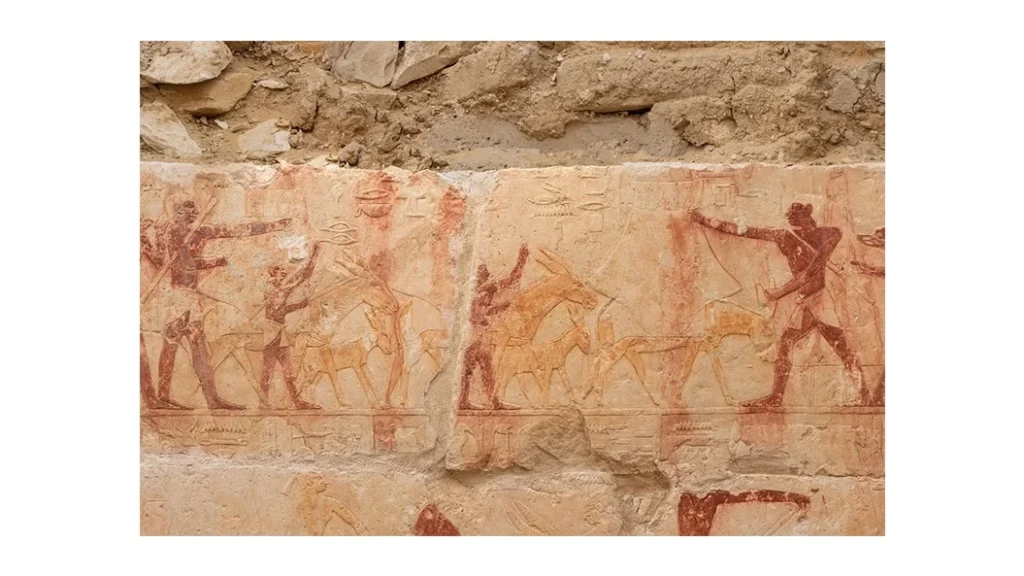
The archaeological significance of the site is heightened by the preservation of its interior artistry. Yunmen’s chapel is adorned with intricate painted reliefs. Remarkably, some of these panels have retained their original vibrant pigments, offering researchers a rare look at the color palette favored by Fifth Dynasty artisans.
The iconography depicted on the walls is both decorative and functional. Scenes capture the rhythmic cycle of agricultural activities—sowing, harvesting, and processing—which formed the basis of the Egyptian economy. Furthermore, the walls feature detailed processions of bearers carrying offerings, a standard but essential element of funerary art meant to sustain the deceased in the afterlife through the perpetual provision of food and drink.
In contrast, Iti’s chapel, while architecturally significant, has suffered more from the ravages of time. It features a traditional "false door"—a structural element designed to allow the Ka, or spirit of the deceased, to move between the worlds of the living and the dead. While much of the decorative relief work in this section has been lost to environmental degradation, the presence of the false door remains a centerpiece of the ritual space.
The Chronology of Exploration: From Mariette to Modernity
The discovery of this mastaba is as much a story about the history of archaeology as it is about the ancient world. The site is located within the Mariette Necropolis, named after the legendary French archaeologist Auguste Mariette, who pioneered large-scale excavations in Saqqara during the mid-19th century.
Mariette, the founder of the Egyptian Antiquities Service, was instrumental in identifying the location of this tomb over 150 years ago. However, in the frantic pace of 19th-century archaeology, the tomb was identified but never subjected to rigorous, systematic scientific documentation. It effectively "disappeared" into the annals of history, its contents and structural nuances left uncatalogued by modern standards.
The current mission, a collaboration between the Autonomous University of Barcelona (UAB) and Egypt’s Supreme Council of Antiquities (SCA), has finally rectified this oversight. Under the leadership of Dr. Josep Cervelló Autuori, a lecturer in the Department of Ancient and Medieval Sciences at UAB, the team utilized modern stratigraphic methods, photogrammetry, and chemical analysis of the pigments to document the site. This effort highlights a shift in modern Egyptian archaeology: moving away from the "treasure hunting" mentality of the colonial era toward a focus on long-term preservation and contextual analysis.
Official Perspectives and Academic Impact
The Egyptian Ministry of Tourism and Antiquities has lauded the discovery as a milestone in our understanding of the late Fifth Dynasty. Hisham El-Leithy, secretary-general of the SCA, emphasized the dual importance of the site.
"This is not merely about finding another tomb," El-Leithy stated. "This is about filling in the gaps of our administrative records. The Fifth Dynasty was a pivotal moment in Old Kingdom religion and politics, marked by the rising power of the priesthood and an increasingly complex bureaucracy. Yunmen’s records of petitions and complaints provide us with a rare, tangible link to the actual legal processes of the time."
For the UAB team, the project represents a multi-year commitment to the Saqqara region. By documenting a site that had been known since the 1800s but never properly studied, the mission has proven that "re-excavating" old sites with new technology can yield results just as profound as the discovery of a completely virgin tomb.
Implications for Old Kingdom Studies
The discovery of the tomb of Yunmen and Iti carries several broad implications for our understanding of Egypt’s past:
- Administrative Complexity: By studying the titles held by Yunmen, historians can better map the career trajectories of Old Kingdom elites. His role in processing petitions suggests a level of civil justice that was perhaps more nuanced than previously assumed.
- The Evolution of Funerary Art: The presence of partially preserved colors allows for advanced chemical analysis, which can tell researchers about the trade routes used to acquire pigments—such as lapis lazuli, malachite, or ochre—further illuminating the economic reach of the Fifth Dynasty.
- The "Mariette" Context: The successful study of this tomb encourages a broader re-evaluation of the sites discovered by 19th-century explorers. Many sites mapped by Mariette and his contemporaries were left unexcavated or were buried again by shifting sands. This project serves as a blueprint for how international teams can return to these areas to perform the "due diligence" that earlier generations of archaeologists lacked the tools to provide.
Conclusion: A Window into the Past
As the excavation continues, the mission plans to further stabilize the reliefs and consolidate the structure of the mastaba to ensure its longevity. The discovery of Yunmen and Iti is more than a recovery of antiquities; it is an act of historical restoration.
The Fifth Dynasty was a period of transition, setting the stage for the societal changes that would define the later Old Kingdom. Through the work of Dr. Cervelló Autuori and his colleagues, we are granted a fleeting, intimate look at the men who kept the gears of the Egyptian state turning nearly 4,500 years ago. In the quiet, dusty silence of the Saqqara desert, the voice of a judge and the labor of an agricultural administrator have finally been given their due, proving once again that in Egypt, the past is never truly buried.