

The world of high fashion has always thrived on the intersection of the primal and the polished, but this season, Mugler took that dialectic to a visceral, biological extreme. Under the creative direction of Miguel Castro Freitas, the house’s latest runway presentation, titled "Naturalia X," served as a sensory exploration of the birds, the bees, and the inherent savagery of the natural world. In a season where romance—or perhaps, raw carnal desire—seems to have infected the creative consciousness of the industry, Mugler stood out not just for its craftsmanship, but for its uncompromising, slightly unsettling commitment to the concept of “savage beauty.”
A Season of Intimacy: The Romantic Zeitgeist
It is a curious phenomenon when the collective output of designers begins to echo a singular, unspoken mood. This season, love—in all its messy, tactile, and breathing glory—has been the prevailing wind. From the uninhibited public displays of affection captured on the runway at Diesel to the heavy, rhythmic breathing that provided the chilling soundtrack for Tom Ford, the fashion elite appear to be in the throes of a romantic obsession.
Freitas tapped into this zeitgeist, though he chose to look beneath the surface of romance to the biological imperative that drives it. The trailer for the show, released on Instagram, was a stark manifesto of this intent: high-definition footage of mating snails, juxtaposed against the intimate, saliva-swapping closeness of human lovers. It was a provocation—a reminder that beneath the couture and the glitter, humanity is merely another species driven by the same ancient, feral urges as the flora and fauna of the wild.
The Legacy of the Insect: A Chronology of Inspiration
"Naturalia X" marks the third installment in a conceptual trilogy that seeks to reconcile the house’s futuristic reputation with its historical roots. Specifically, the collection serves as a direct homage to the seminal Spring 1997 haute couture show, "Les Insectes," orchestrated by the house founder, Manfred Thierry Mugler.
Manfred was, by all accounts, a visionary who understood that the human body is merely a canvas for architectural intervention. By revisiting the motifs of 1997, Freitas wasn’t merely engaging in archival nostalgia; he was conducting a clinical study. The collection manifested this through a series of striking garments:
- The Butterfly Wing: A feather tunic that captured the fragile, iridescent precision of a lepidopteran.
- Arachnid Elegance: A spider-web dress that blurred the line between clothing and externalized nervous system.
- Reptilian Armor: Croc-embossed leather trousers and a snakeskin hourglass dress that featured, with typical Mugler audacity, a cut-out exposing the lower back, or “bum cleavage.”
"It’s looking into the feral aspect of nature versus the ethereal aspect of nature—the fragility versus the danger," Freitas explained backstage, his voice grounded in the technical challenge of balancing these opposing forces.
Technical Prowess: Crafting the Feral
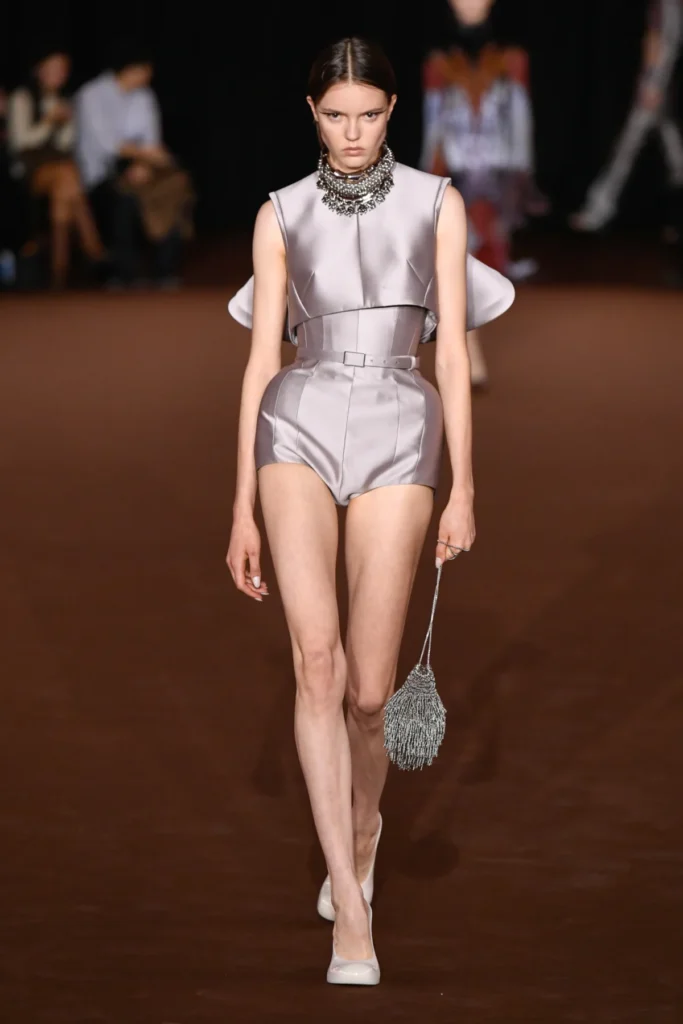
Since his appointment at the house last year, Miguel Castro Freitas has been tasked with the monumental challenge of modernizing the Mugler silhouette while retaining its signature “hard-edged glamour.” This season, he succeeded by leaning heavily into a futuristic sheen, utilizing sculptural tailoring in gleaming Mikado silk.
However, the collection’s true brilliance lay in its textural contradictions. The rigidity of silk and molded leather was consistently interrupted by the earthiness of faux fur and the fluidity of latex. To achieve this, Freitas enlisted a cadre of specialized artisans. The result was a collection that felt both manufactured and grown: shaggy hair tunics featuring flame-colored motifs, sweeping latex fringe gowns that seemed to ripple like water, and leather dresses that sprouted alien, molded-latex flora.
The runway itself became a secondary organism. Models navigated an immersive video installation by artist Casper Sejersen, while the room vibrated under an ear-splitting, industrial-grade soundtrack by Teho Teardo. The inclusion of a track by Björk—who further cemented her alignment with the collection by wearing a custom piece during a DJ set in Poland that same day—provided the final, avant-garde seal of approval.
The Ghost in the Machine: The Alexis Stone Incident
No discussion of the "Naturalia X" show would be complete without addressing the moment that threatened to overshadow the craftsmanship: the presence of performance artist Alexis Stone. In a move that was, depending on one’s perspective, either a brilliant piece of theater or a jarring lapse in taste, Stone appeared in the front row wearing full prosthetic makeup to replicate the visage of the late Manfred Thierry Mugler.
The visual was haunting. Seated next to Manfred’s husband, Krzysztof Leon Dziemaszkiewicz, the “reincarnated” designer provided an unsettling centerpiece to an already surreal atmosphere. For many in the industry, the stunt felt like a bridge too far—a commercialization of grief that distracted from the collection’s standalone merit.
Freitas, however, maintained a different perspective. "It’s quite surreal," he conceded during the post-show press rounds. "We approached his husband to get his blessing. It was very important to know that he would be comfortable with seeing the image of the man that he shared his life with, sharing the same venue. He was very entertained by the idea. He said that Manfred would have loved that."
Implications: The Future of the House
The reaction to the Stone appearance was, predictably, polarized. Online discourse centered on the ethics of digital and prosthetic resurrection, often drowning out the more nuanced conversation regarding Freitas’s design trajectory. This presents a unique challenge for the brand: how to honor a legacy as gargantuan as Manfred’s without being consumed by it?
The implication for Mugler as a house is clear: it remains a destination for those who view fashion as a theatrical, almost aggressive, form of expression. By anchoring the collection in the "feral vs. ethereal" dichotomy, Freitas has successfully established his own voice—one that respects the house’s archival “savage beauty” while acknowledging the technological and biological complexities of the current era.
The collection, stripped of the viral stunts, is a triumph of construction. It proves that the Mugler DNA—defined by its hourglass silhouettes, architectural rigidity, and unapologetic display of the body—is as relevant today as it was in the late 90s. The challenge moving forward will be to maintain this high level of technical rigor while ensuring that the brand’s identity is defined by its future creations, rather than its historical ghosts.
Conclusion: The Persistence of Nature
As the lights dimmed and the guests departed, the prevailing feeling was one of sensory overload. "Naturalia X" was not a collection meant to be worn in the quiet corners of daily life; it was a performance piece designed to challenge the observer.
In attempting to reconcile the "birds and the bees" with the "hard-edged glamour" of the house, Miguel Castro Freitas has managed to tap into something deeper. He has highlighted that fashion, at its most potent, is a biological signal. Whether through the predatory grace of a leather dress or the ethereal flutter of a feather tunic, Mugler continues to remind us that we are all, at our core, creatures of nature—and that the clothes we wear are merely the most sophisticated armor we possess in the fight to survive and stand out.
The controversy surrounding the front row will fade, as all viral moments do. What will remain are the silhouettes—the sculptural tailoring, the latex, and the relentless, feral beauty that has become the hallmark of this new chapter for Mugler. In the end, the snails and the lovers were just the beginning of a much larger, more complex conversation about what it means to be alive in the age of the spectacle.



