Six months after first encountering Karla Diaz’s Uncle’s Crossing (2022) at the Buffalo AKG Art Museum, the image remains etched in my mind. The painting is modest—measuring just 40 by 30 inches—and easily missed by the casual observer. Rendered in thinned-out acrylic, it depicts two mustachioed Latino men, one hoisted upon the other’s shoulders. The work’s outward appearance of joyful casualness acts as a veil for a more somber reality; clues to the narrative lie in the subtle inclusion of a coyote on one of the men’s shirts and the weight of the title.
The painting serves as a poignant, deeply personal portrait of Diaz’s late uncle, a man who worked as a "coyote"—a facilitator for undocumented individuals crossing into the United States. Within Latinx communities, the role of the coyote is a fraught subject, often viewed as a "necessary evil": a lifeline for some, and a source of exploitation for others. For Diaz, the subject was a childhood taboo. "He would whisper, ‘Okay, I’m leaving for work,’ and I was like, ‘Okay, why are you whispering? You’re just going to work,’" she recalls. It was only years later that she understood the true nature of his labor.

The Genesis of a Curatorial Vision
The exhibition currently housing this work, Let Us Gather in a Flourishing Way, stands as a landmark intervention in the history of contemporary art. Curated by Andrea Alvarez, the exhibition is not merely a display of objects; it is an ambitious attempt to reshape the discourse around Latinx art and the discipline of painting itself.
Alvarez, who joined the Buffalo AKG as a curatorial fellow in 2018, began her journey toward this exhibition with a simple question: How can a museum bridge the gap between its historical collection and the contemporary, multifaceted reality of Latinx creative output? By the time she was promoted to assistant curator in 2021, the project had evolved from an idea into a massive, cross-country research endeavor. Studio visits took her from the barrios of Los Angeles to the galleries of Miami, Chicago, Puerto Rico, and beyond.

"That’s when I started homing in on the discipline of painting," Alvarez says. She recognized that the museum’s deep holdings in 20th-century painting provided a perfect pedagogical hook, allowing visitors to engage with contemporary Latinx artists through a familiar medium, before being challenged by the subversion of that medium’s traditional boundaries.
Chronology: From Concept to National Tour
The timeline of Let Us Gather in a Flourishing Way reflects a deliberate, slow-burn approach to institutional curation. Following years of research and studio visits, the final checklist was solidified in the summer of 2024. Alvarez broke from traditional curatorial hierarchies by involving the artists in the selection process. Recognizing that artists from disparate regions were being brought into a shared space, she wanted to ensure that the works on display were not just "curated" but were resonant for the creators themselves.

The exhibition opened in March 2026 at the Buffalo AKG Art Museum and is currently preparing for a national tour, with stops in Iowa, Phoenix, and Seattle. This movement is significant; it ensures that the "richness and complexity" of the Latinx diaspora is not siloed within a single New York institution but is instead disseminated across the American landscape.
Challenging the Materiality of Painting
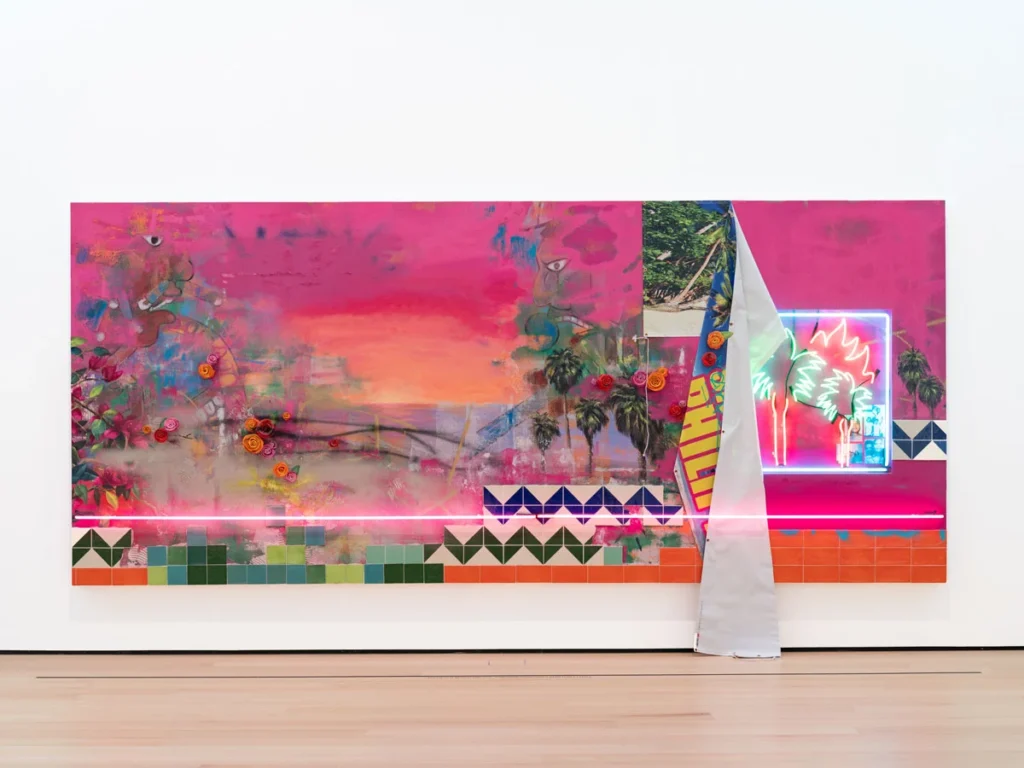
One of the most striking aspects of the exhibition is its refusal to accept a narrow definition of "painting." While traditionalists might define the medium strictly as oil or acrylic on canvas, Alvarez has curated a selection that pushes the boundaries of materiality.

The exhibition features works like Moises Salazar Tlatenchi’s Cruising Queens (2024), which frames a queer re-imagining of Washington Crossing the Delaware with crocheted materials. Similarly, Manuela Gonzalez’s Inanna (2024) utilizes painted textiles sewn into a diamond shape, a direct nod to the history of hard-edge abstraction, while Nery Gabriel Lemus’s Querida Niña Migrante consists of 15 painted floor mats installed directly on the ground.
These choices are intentional. As artist Sarah Zapata noted during a panel discussion, "an important part of the lineage of painting is thinking about how textiles are largely the reason that painting exists." By highlighting these intersections, the exhibition forces a confrontation with the "what" of art history—questioning why certain materials were historically elevated as "fine art" while others were relegated to the realm of craft.

Thematic Microcosms: A Diverse Diaspora
The exhibition is organized into seven themes, including "Identity/Place" and "Pinturx," a gender-neutral term for "painter." This structure allows for a nuanced exploration of subjects that are often flattened by broader societal narratives.
In the "Community" section, artists such as Aliza Nisenbaum and Shizu Saldamando treat community as both a noun and a verb. They examine the essential nature of chosen and blood families for marginalized groups—a theme that resonates with the exhibition’s title, borrowed from U.S. Poet Laureate Juan Felipe Herrera’s 2008 poem.

"I started to understand the poem as a celebration of abundance," Alvarez explains. "As I was trying to figure out the title of the exhibition, I realized that was exactly what I was doing: inviting these artists to be present in their fullest expression in the galleries."
Official Responses and Artistic Agency
The artists involved have responded to this invitation with profound intellectual and emotional labor. rafa esparza’s Tratos: Después de Pedro Valtierra Entre Redadas (2025–26) is perhaps the most visceral example. This adobe installation, inspired by a 1998 photograph of the Acteal Massacre, incorporates a coiled U.S. flag and imagery of ICE raids. By forcing the viewer to physically walk through the installation, esparza bridges the gap between historical colonial oppression and the contemporary reality of mass deportations.

Justin Favela’s contribution, St. Maarten (1972), After Marisol, utilizes his signature "piñata mural" style to subvert the expectation that Latinx art must be "folkloric." Having started the series as a tongue-in-cheek response to a professor who asked him to "make something about being Mexican," Favela has turned a potentially reductive request into a sophisticated, 20-year-long artistic critique.
Implications for the Future of Museums
The implications of Let Us Gather in a Flourishing Way extend far beyond the duration of the show. The Buffalo AKG has taken the rare and commendable step of aggressively acquiring works from the exhibition for its permanent collection. Since 2022, pieces by Patrick Martinez, Guadalupe Maravilla, and Alfonso Gonzalez Jr. have been added to the museum’s holdings, signaling a long-term commitment to correcting the historical exclusion of Latinx voices from the American art canon.

Alvarez herself is quick to temper expectations of "comprehensiveness." She intentionally resists the word "survey," noting that it carries the connotation of a "complete story." Instead, she views this exhibition as "the tip of the iceberg."
As the exhibition prepares to travel, it leaves behind a blueprint for how institutions can engage with marginalized histories without falling into the trap of tokenism. It offers a vision of Latinx art that is not defined by the "colorful" or "folkloric" stereotypes imposed by outsiders, but by the "infinitely complex" reality of the diaspora itself. In a political climate that is increasingly fraught, the call to "gather in a flourishing way" serves as both a celebration of survival and a necessary, urgent act of visibility. The exhibition is not just a study of what painting was, but a manifesto for what it—and the museums that house it—can become.