For billions of years, the Moon has served as a silent, cratered witness to the relentless fury of the solar wind. A constant stream of charged particles emanating from the Sun, the solar wind typically bombards any planetary body lacking an atmosphere or a global magnetic field. For decades, lunar scientists operated under the assumption that this bombardment was uniform, treating the Moon as a monolithic target for solar radiation. However, groundbreaking analysis of material returned by China’s Chang’e 6 mission has shattered that assumption, revealing that the Moon’s near and far sides have endured vastly different solar experiences.
The findings, recently published in the journal Nature Geoscience, demonstrate that the Moon is not merely a passive target; rather, its interaction with the solar wind is heavily moderated by the invisible, protective bubble of Earth’s own magnetosphere.
The Celestial Laboratory: Why the Far Side Matters
To understand the significance of these findings, one must first understand the Moon’s regolith—the fine, powdery layer of dust and rock covering its surface. This soil is not just debris; it is a natural, high-fidelity archive. Because noble gases like helium, neon, argon, krypton, and xenon do not react chemically with other materials, they remain trapped in the lunar soil in the exact state they arrived in, billions of years ago.
For the entirety of the space age, researchers were limited to samples collected from the Moon’s near side—the face perpetually turned toward Earth. Missions like Apollo and the recent Chang’e 5 provided a wealth of data, but they left a gaping hole in our understanding: the far side. Without physical samples from the hemisphere shielded by the Moon’s own bulk, scientists could only theorize about how the lunar environment might vary globally.
This changed when the Chang’e 6 mission touched down in the South Pole-Aitken basin on the far side of the Moon. By successfully returning 1.935 grams of pristine regolith, the mission provided the "missing piece of the puzzle," allowing for the first direct, side-by-side comparison of solar wind implantation between the two hemispheres.
A Chronology of Discovery
The investigation was led by a team from the Institute of Geology and Geophysics (IGG) of the Chinese Academy of Sciences (CAS), spearheaded by postdoctoral researcher Xuhang Zhang and Professor HE Huaiyu.
The Analytical Phase
The team began by subjecting the Chang’e 6 samples to rigorous mass spectrometry, measuring the concentrations and isotopic compositions of noble gases. The team, which included collaborators from the University of Science and Technology of China and the Chang’e 7 volatile payload team, looked for subtle signatures of "fractionation"—the process by which solar wind particles are sorted by mass as they collide with and settle into the lunar surface.
The Turning Point: Neon Isotopes
The first major clue emerged from the neon isotopes. The Chang’e 6 samples displayed an average $^20$Ne/$^22$Ne ratio of 11.34 ± 0.22. This value was notably lower than any reading taken from near-side samples. In the world of planetary science, a lower ratio is a "smoking gun" for intense solar wind fractionation. It suggested that the far side had been subjected to a more aggressive, high-energy environment, causing the heavier isotopes to settle differently than those on the near side.
The Depth Gauge: Krypton and Xenon
The researchers then moved to "stepwise heating" experiments, a process where they gradually heat the lunar soil to release trapped gases at different temperatures. Xenon, in particular, acted as a deep-crust thermometer. In near-side samples, xenon was released at both low and high temperatures, indicating a broad range of implantation depths. In the Chang’e 6 samples, however, the xenon was released almost exclusively at high temperatures. This confirmed that the solar wind particles on the far side had penetrated significantly deeper into the regolith—a physical reality that only occurs when particles strike the surface with significantly higher kinetic energy.
The "Speed-Governing" Effect of the Magnetosphere
The central question remained: Why would the far side receive higher-energy particles than the near side? The answer, according to the IGG researchers, lies in the Earth’s magnetosphere.
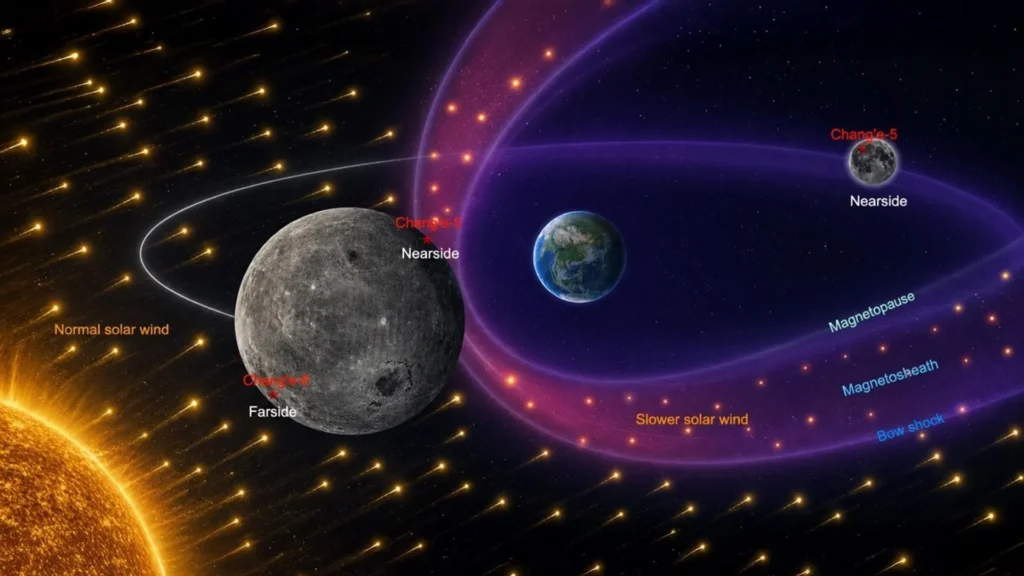
As the Moon orbits our planet, it periodically passes through the magnetosheath—the turbulent buffer zone that surrounds the Earth’s protective magnetic field. This region acts as a cosmic "speed bump." Outside of this zone, the solar wind travels at a blistering 400 kilometers per second. However, within the magnetosheath, the solar wind is decelerated to approximately 200 kilometers per second.
Because the near side of the Moon faces Earth, it spends significant time passing through this protective "shadow." The slower, lower-energy particles that reach the near side lack the momentum to penetrate deep into the regolith, resulting in shallow implantation. The far side, conversely, is perpetually shielded from the Earth’s magnetosphere by the Moon’s own mass. It remains exposed to the "raw," unhindered solar wind, allowing high-velocity particles to slam into the surface with maximum force.
The researchers estimate that approximately 25% of the total solar wind exposure recorded at the near-side Chang’e 5 landing site was moderated by this magnetic slowing effect, a phenomenon entirely absent from the far-side records.
Official Perspectives and Academic Context
The implications of this study have rippled through the global planetary science community. Dr. Zhang noted in the project’s summary that these samples represent the first direct physical evidence of Earth’s magnetosphere acting as a long-term, large-scale regulator of the lunar environment.
"We are essentially looking at a permanent, recorded history of the Sun-Earth-Moon interaction," the IGG research team stated. By analyzing these trapped noble gases, the team is advocating for a shift in how we view the Moon. It is no longer just a geological satellite; it is a massive, planetary-scale data storage device for the history of our solar system’s plasma environment.
Independent experts have lauded the methodology, noting that the combination of isotope ratios and heating experiments provides a robust, multi-layered argument that is difficult to dispute. The inclusion of the Chang’e 7 volatile payload team suggests that this research will be foundational for upcoming missions, which aim to further characterize the lunar surface as a repository of solar history.
Broader Implications: A Fossil Record of Earth’s Past
Perhaps the most profound implication of the study is the potential to use the Moon as a "fossil record" of Earth’s magnetic history.
Earth’s magnetosphere has not always been the same. Over millions and billions of years, the strength, shape, and orientation of the Earth’s magnetic field have shifted due to the churning of our planet’s iron-rich core. Until now, tracking these changes over deep time was restricted to terrestrial paleomagnetic data, which can be fragmented or obscured by geological activity.
The lunar regolith, however, is geologically stable. If the noble gases in the lunar soil indeed record the interaction between the solar wind and the magnetosphere, then researchers may be able to "read" the gases like a tape recorder. By correlating the isotopic signatures in different layers of the lunar regolith with known periods of Earth’s magnetic evolution, scientists could theoretically map the history of our planet’s magnetic shield across eons.
Conclusion: A New Era of Lunar Exploration
The Chang’e 6 mission has fundamentally altered our understanding of the Moon’s relationship with its cosmic neighborhood. We now know that the two hemispheres of our satellite tell different stories—stories that are deeply intertwined with the life-sustaining magnetic field of our own home planet.
As we look toward future missions, the Moon stands as an increasingly vital witness to the history of the Sun-Earth connection. Whether through understanding the origins of water, the nature of solar flares, or the long-term stability of the magnetosphere, the dust of the far side has proven that the Moon has much more to teach us. We are only just beginning to turn the pages of this ancient, dusty, and infinitely revealing archive.