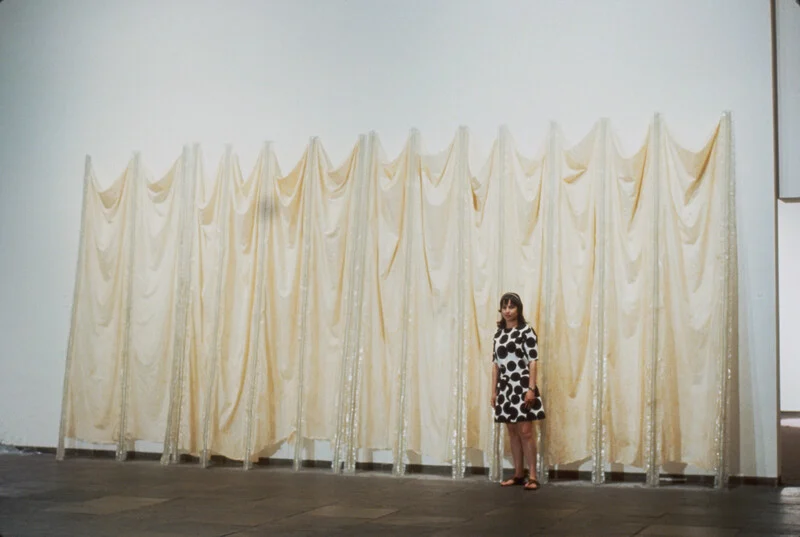
In the opening pages of Foam, the latest literary endeavor from Kate Zambreno—arriving via Semiotext(e) on September 15—the author grapples with a spectral subject: the life and legacy of the late, boundary-pushing sculptor Eva Hesse. "I’m writing a novella about Eva Hesse," the narrator tells acquaintances. Yet, like the delicate, degradable materials Hesse often employed in her own work, the subject keeps slipping away. Hesse, who famously declared that "art and life are inseparable," becomes a lens through which the narrator observes their own fragmented reality, only to find the figure of the artist subsumed by the relentless pressures of the mundane.
Zambreno’s Foam is a work that defies easy classification. Its publisher labels it a "speculative new fiction," while the author, in various interviews, has described it as a hybrid space where "spooky fictions and art essays" collide. It is a book that discovers its own architecture as it unfolds—a characteristic fluidity that has defined Zambreno’s career since their 2009 debut.
A Chronology of Emergence: From "Heroines" to "Foam"
To understand Foam, one must view it as the latest iteration in a long-standing project of "searching for form." Zambreno has spent over a decade interrogating the limits of the book as a container for human experience.
- 2009–2012: The Early Formative Years: Zambreno first gained significant critical attention—and a reputation for provocation—with Heroines (2012), a book that challenged the patriarchal structures of literary history. It was here that the "love-hate" relationship with critics began, establishing a pattern where the author’s refusal to adhere to generic conventions sparked intense debate.
- 2020: The Pivot of "Drifts": With the publication of Drifts, Zambreno solidified an autobiographical, process-oriented voice that prioritized the "act of writing" over traditional plot mechanics.
- 2023: "The Light Room": A memoir that further refined the intimate, diaristic, and analytical blend that characterizes their current work.
- 2025: The Arrival of "Foam": As their 13th published work, Foam arrives with the weight of expectation. It continues the trajectory of exploring how a writer balances the "labor of family" with the "labor of art," all while navigating the precarious economic realities of contemporary academia and the gig economy.
The Tension of the Prolific: Critical Reception and the "Blockage" Narrative
Zambreno occupies a unique space in modern letters. Despite being primarily platformed by small, independent presses, their work consistently triggers polarized responses from mainstream critics. Much of this friction stems from the author’s self-reflexive commentary on their own creative process.
Critics have frequently noted the irony of a writer who documents "creative blockage" while being remarkably prolific. In a profile for The New Yorker, the author’s frequent documentation of inaction was flagged as "disingenuous." Similarly, Bookforum critics have historically questioned whether the "stakes" are truly as high for the reader as they are for the narrator.

This tension reached a fever pitch with the reception of Drifts. Catherine Lacey, writing for The New York Times, argued that the book’s conclusion—marked by childbirth—suggested a "necessary redemption" from the narrator’s existential woes. Zambreno’s supporters, however, view this interpretation as a misunderstanding of the author’s intent. Where some see "resolution," others see the brutal, unvarnished reality of a writer attempting to reclaim their desk amidst the overwhelming demands of early motherhood.
Supporting Data: The Precarity of the Modern Writer
Foam is not merely an aesthetic experiment; it is a sociological document. It captures the granular texture of life as a perpetual adjunct, a renter with no safety net, and a parent operating without the cushion of institutional stability.
The Economics of the "Mother’s Helper"
A central thread in Foam involves the narrator’s attempt to manage childcare through a series of "mother’s helpers"—often former students. This dynamic highlights the uncomfortable intersection of power and poverty. The narrator holds the "power" of the teacher and the employer, yet they lack the financial resources to offer their employees a living wage. Conversely, the students—also named "Eva"—often possess a generational privilege that allows them to treat the work as a flexible, temporary commitment. This proliferation of "Evas"—from the historical artist to the young, aspiring students—serves as a structural mirror for the narrator’s own splintered identity.
The Metaphor of the Physical
The title itself, Foam, emerges from the domestic and the medical. It is the texture of the placenta following a traumatic birth; it is the spray foam used to patch the holes in a failing apartment wall; it is the physical manifestation of "softness" and "non-form." By juxtaposing these visceral images with the intellectual legacy of Eva Hesse, Zambreno creates a dialogue between the "fragile sturdiness" of art and the "fragile sturdiness" of a life lived on the brink of economic collapse.
Official Perspectives and Intentions
In discussions surrounding the book, Zambreno emphasizes that Foam is an exploration of "nervous systems and hostilities." Referencing the philosopher Peter Sloterdijk, the book posits that foam is "almost nothing, yet not nothing."

The author’s intent is to move beyond the binary of success and failure. By refusing to offer an "outside analysis"—maintaining instead a position of being "too inside" the conditions they describe—Zambreno forces the reader to confront the textures of class striation without the comfort of objective distance.
Implications: The Future of the Hybrid Narrative
The implications of Foam for the literary landscape are significant. By successfully integrating the "spooky" elements of speculative fiction with the rigorous, essayistic inquiries of art criticism, Zambreno is suggesting a new way forward for writers who feel stifled by the traditional novel.
- Genre Fluidity: Foam serves as a proof-of-concept that a work does not need to choose between being a memoir, a novel, or a theoretical treatise.
- The "Precarity" Canon: The book legitimizes the inclusion of the "unglamorous" aspects of creative life—adjuncting, rent strikes, lead-poisoned walls, and childcare—into the high-art conversation.
- The Ethics of Labor: By making the financial strain of the writer the primary engine of the plot, Zambreno challenges the romanticized notion of the "starving artist," revealing it instead to be a calculated and often exhausting endurance test.
Ultimately, Foam stands as a testament to the resilience of the creative spirit. It is a work that acknowledges the "gaps" in one’s life—the time lost to contract labor, the exhaustion of domestic duty—and finds a way to fill them not with concrete, but with the expansive, porous, and endlessly shifting substance of foam. As the narrator navigates the loss of an apartment and the weight of their own history, the reader is invited into a space that is as challenging as it is revelatory, proving that even when one feels they have "completely exited" themselves, the act of writing remains a tether to the world.