In an era where artificial intelligence has rapidly transitioned from a novelty to a necessity, the boundaries between productivity tool and personal companion have become increasingly blurred. With over 400 million users interacting with ChatGPT on a weekly basis, the platform has become a fixture in the modern digital landscape. However, as users lean on the software for more than just code snippets or email drafts—often seeking guidance on life-altering personal decisions—OpenAI has introduced a new "Trusted Contact" feature. This development serves as both a functional safety mechanism and a stark reminder of the profound, and potentially unsettling, emotional reliance society is placing on generative AI.
The Evolution of the AI "Life OS"
The rise of ChatGPT as an "operating system for life" was perhaps best summarized by OpenAI CEO Sam Altman during an address at Sequoia Capital’s AI Ascent event last May. Altman noted a distinct behavioral shift among younger demographics, who are increasingly treating the chatbot not merely as an assistant, but as an advisor for the most significant moments of their lives.
"They don’t really make life decisions without asking ChatGPT what they should do," Altman remarked. While he acknowledged the technical impressiveness of such capability, the admission highlights a broader, deeper trend: for many, the AI is becoming a surrogate for human counsel, peer feedback, and even therapeutic support. This shift necessitates a new framework for safety, one that recognizes that AI systems are now embedded in the emotional health of their users.
How the "Trusted Contact" Feature Functions
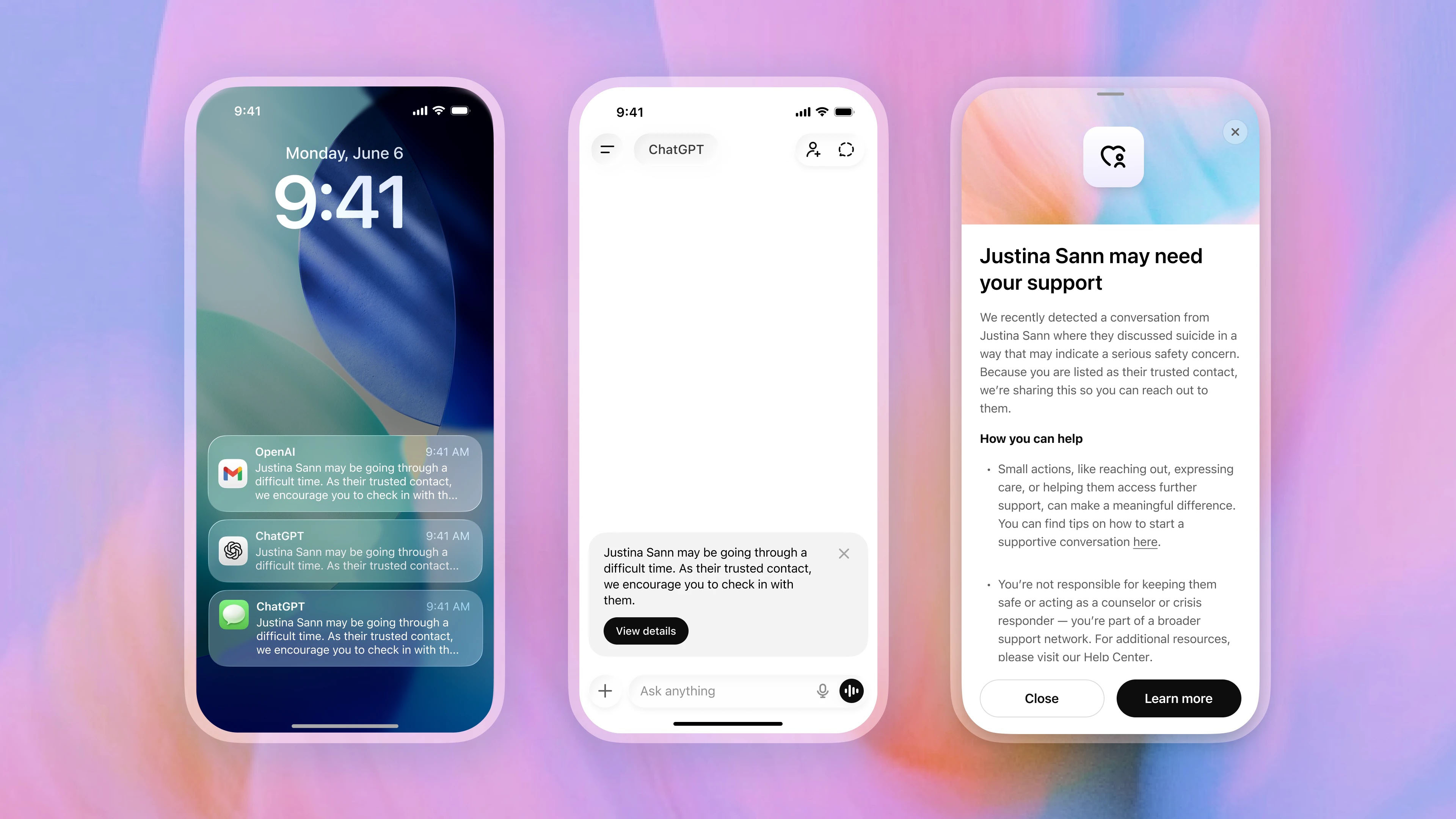
The "Trusted Contact" feature is designed to act as a fail-safe. While the rollout is gradual and not yet available to every user, those who have access can navigate to their account settings to nominate a specific individual—usually a friend, family member, or trusted adult—to be alerted in the event of an emergency.

The mechanism is multi-layered:
- Detection: ChatGPT’s automated safety systems scan interactions for indicators of a serious risk of self-harm.
- Proactive Warning: If a concern is flagged, the user is warned that their designated Trusted Contact may be notified. The system encourages the user to reach out to that contact independently before an alert is triggered.
- Human Oversight: Crucially, the system does not immediately alert the contact. A specially trained team of human reviewers assesses the flagged interaction to determine if there is a genuine, imminent safety concern.
- Notification: If the reviewers confirm the risk, the Trusted Contact is notified via email, text, or in-app messaging, providing a bridge for real-world intervention.
To protect user privacy, OpenAI has confirmed that these alerts do not include transcripts or the specific context of the conversation. Furthermore, users retain the right to modify or remove their Trusted Contact at any time, maintaining a degree of control over their digital privacy.
A Chronology of AI Safety Integration
The introduction of Trusted Contact did not happen in a vacuum. It is the latest in a series of strategic moves by OpenAI to mitigate the risks associated with its platforms.
- Initial Guardrails: Following the initial explosion of ChatGPT in late 2022, OpenAI faced intense scrutiny regarding the potential for harmful, biased, or dangerous content. Early efforts focused on "refusal" training—teaching the model to decline requests for illegal activities or self-harm instructions.
- Parental Controls: As ChatGPT entered the classroom, OpenAI introduced robust parental controls, allowing guardians to monitor and restrict access for younger users.
- Global Collaboration: In the lead-up to the Trusted Contact feature, OpenAI engaged in a massive, collaborative effort. The company consulted with mental health professionals, suicide-prevention experts, and a global network of over 260 doctors across 60 countries. This consultative phase was intended to ensure that the feature was not just technologically sound, but ethically grounded.
- The Shift to Professionalism: While the company has recently pivoted marketing materials to emphasize productivity—particularly with tools like the "Codex" coding assistant—the underlying software remains deeply psychological. The Trusted Contact feature acknowledges that no matter how much a company emphasizes "workplace utility," the user experience remains fundamentally human and emotional.
Supporting Data: The Rising Tide of AI Interaction
The reliance on AI for personal well-being is backed by a surge in data regarding how users interact with large language models. Recent studies suggest that users often find it easier to "open up" to an AI than to a human. This phenomenon, often referred to as the "disinhibition effect," allows individuals to express anxieties, fears, and vulnerabilities without the perceived judgment of a human peer.

However, this convenience comes with risks. As noted in recent industry investigations, including work by TechRadar’s own team, the introduction of monitoring tools—even those meant for safety—can create a "chilling effect." When a user knows their conversations are being monitored for mental health indicators, they may begin to censor themselves.
Official Responses and Ethical Implications
OpenAI’s position is that the Trusted Contact feature is a necessary evolution. They argue that as AI becomes a ubiquitous part of daily life, the platforms have a moral obligation to provide safety nets. By involving a human element (the Trusted Contact), OpenAI is attempting to bridge the gap between digital interaction and real-world care.
However, the industry response is mixed. Critics argue that we are effectively outsourcing our social responsibilities to algorithms. Amy Sutton, a representative from Freedom Counselling, has previously raised concerns regarding the use of AI in workplace mental health monitoring. She notes that if users feel they are being "watched" by an AI, they are less likely to seek help and more likely to hide their struggles.
"With mental health stigmas still rife, AI observation would likely lead to greater efforts to hide evidence of struggles," Sutton stated. "This could create a dangerous spiral, where the greater our efforts to hide low mood or anxiety, the worse it becomes."
The Psychological Implications: Reassurance or Surveillance?
The core question facing users today is whether they view this feature as a life-saving safety net or an intrusion into their private thoughts. For a user in distress, the notification of a loved one could be the difference between life and death. For others, the knowledge that a "human review team" might read their most private, vulnerable thoughts for the purpose of safety assessment is a deeply uncomfortable prospect.
The duality of AI is perfectly captured here: it is a tool that can provide the perfect, non-judgmental answer to a technical problem, while simultaneously serving as a mirror to our own mental states. As these models become more capable of human-like conversation, the risk of "parasocial" attachment—where a user develops a deep, one-sided emotional bond with the AI—increases.
Future Outlook: Where Do We Draw the Line?
As we look toward the future of generative AI, the Trusted Contact feature serves as a benchmark for the industry. Other companies, from Google with its Gemini platform to Anthropic with Claude, will likely face pressure to implement similar safety protocols.
The challenge lies in balancing safety with the fundamental human right to privacy. Can we create a system that catches genuine crises without turning every chatbot into a surveillance tool? The answer may lie in transparency. OpenAI’s commitment to not sharing chat logs with the Trusted Contact is a positive step, but it remains to be seen if that will be enough to quell concerns about the normalization of "AI-assisted mental health monitoring."

Ultimately, the Trusted Contact feature confirms a transition in how we view technology. We are no longer just using computers to calculate or catalog; we are using them to navigate the complexities of our human existence. As OpenAI, Microsoft, and others continue to push the boundaries of what AI can do, the focus must remain on the human at the other end of the screen. Whether or not these tools successfully provide comfort, they have permanently altered the nature of our digital solitude, proving that in the age of AI, we are never truly talking to ourselves.