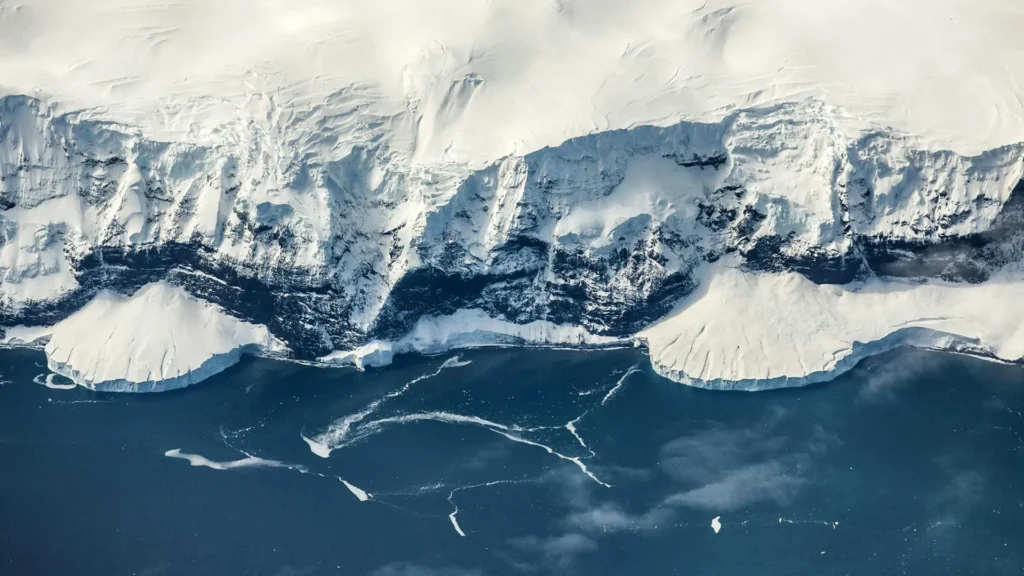
For decades, paleoclimatologists have grappled with a significant anomaly in Earth’s history: the sudden and massive glaciation of Antarctica approximately 34 million years ago. At the time, the planet was roughly 5°C warmer than today, with atmospheric carbon dioxide levels significantly higher than the pre-industrial baseline. Standard climate models, which rely heavily on greenhouse gas fluctuations, have long struggled to explain how a continent could transform into a frozen wasteland while the rest of the globe remained in a relatively temperate state.
A groundbreaking international study published in the journal Science has finally provided the missing piece of the puzzle. By mapping the deep-time geological evolution of the Antarctic continent, researchers have determined that the secret to the polar freeze lies not just in the atmosphere, but deep within the Earth’s mantle.
The Geological Foundation: Unearthing a Deep-Time Mystery
The research, led by Professor Thomas Gernon of the University of Southampton, suggests that the glaciation of Antarctica was a process "preconditioned" by the movement of tectonic plates and the slow, rhythmic pulses of the Earth’s interior. While atmospheric CO2 levels certainly played a role in the global climate, they were not the sole arbiter of the polar freeze.
The study posits that the gradual formation of high terrain in East Antarctica—specifically the rise of an expansive escarpment, a massive plateau, and the enigmatic Gamburtsev Mountain range—created the necessary elevations for snow and ice to persist throughout the year. Once these geographic thresholds were met, the cooling process became self-sustaining, fundamentally altering the trajectory of the planet’s climate.
Chronology of a Frozen Continent
To reconstruct 100 million years of Antarctic history, the research team utilized advanced computational models. Their findings reveal a fascinating, slow-motion geological transformation that set the stage for the Cenozoic Ice Age.
1. The Jurassic Departure (201–143 Million Years Ago)
The story begins with the breakup of the supercontinent Gondwana. As Antarctica and Africa began their slow drift apart, the tectonic architecture of the southern polar region was fundamentally altered. This separation initiated powerful deep-Earth forces that would reshape the continent’s surface for over a century of millions of years.
2. The Era of Mantle Waves (100 Million Years Ago to Present)
The most critical revelation of the study is the role of "mantle waves." Recently identified by Prof. Gernon’s team, these are slow-moving, long-wavelength disturbances that travel beneath continents following the breakup of tectonic plates. These waves are responsible for profound changes in topography, previously linked to the eruption of diamond-bearing volcanoes and mysterious uplift events across various continents. As these waves passed beneath East Antarctica, they acted as a geologic lift, gradually raising a vast plateau and thrusting the Gamburtsev Mountains toward the sky.
3. The Critical Threshold (45 Million Years Ago)
By approximately 45 million years ago, the simulations show that large sections of East Antarctica had reached a critical elevation: 2 kilometers above sea level. At this altitude, the "lapse rate"—the phenomenon where air temperature drops by roughly 1°C for every 100 meters of altitude—made the mountain peaks cold enough for glaciers to develop, even when the surrounding oceans remained warm.
4. The Great Freeze (34 Million Years Ago)
By 34 million years ago, nearly half of the Gamburtsev range had risen above the 2-kilometer threshold. Small, isolated glaciers began to coalesce, eventually expanding into a unified ice sheet. This marked the definitive beginning of the Antarctic glaciation, millions of years before the Northern Hemisphere would see any comparable ice cover.
Supporting Data: Why the Poles Responded Differently
One of the most striking questions addressed by the study is the asymmetry between the poles. While Antarctica became heavily glaciated 34 million years ago, the Arctic did not follow suit until roughly five million years ago.
The researchers argue that if atmospheric CO2 were the only driver, the poles should have responded symmetrically. Instead, Antarctica gained a significant "head start" due to its elevated topography. In contrast, Arctic landmasses remained largely at lower elevations during that period, preventing the accumulation of permanent ice.
The Feedback Loops of Cooling
Once the initial ice sheets formed, the process of expansion was accelerated by two powerful climate feedback loops:
- The Ice-Albedo Effect: As the ice sheet expanded, its bright white surface acted as a giant mirror, reflecting more sunlight back into space. The researchers estimate this cooling effect reduced global temperatures by an additional 1°C.
- The Atmospheric Drying Effect: As the region cooled, the air became drier. Because water vapor acts as a natural greenhouse gas—an "insulating blanket" for the planet—a drier atmosphere allowed more heat to escape into space, further driving down local temperatures.
Official Perspectives and Expert Analysis
The interdisciplinary team behind the study—comprising experts from the University of Southampton, Durham University, GFZ Helmholtz Centre for Geosciences, the University of Potsdam, Utrecht University, and the University of Florence—emphasizes that topography is a fundamental, often overlooked component of climate science.
"Antarctica’s land surface was gradually lifted to the point where ice could gain a permanent foothold, even while the surrounding polar oceans as well as global temperatures remained surprisingly warm," noted Professor Thomas Gernon.
Dr. Thea Hincks, co-lead of the study, highlighted the success of the computational modeling: "We found that our models can realistically capture the evolution of the two-kilometer-high coastal escarpment, elevated plateau and inland mountains, eventually seeding the East Antarctic Ice Sheet."
Dr. Guy Paxman of Durham University reinforced the importance of elevation: "Topography is fundamentally important for glaciation. Air temperatures can drop by up to 1°C for every 100 meters of altitude gained. That shift is the difference between seasonal snow that melts in summer and permanent ice that accumulates for eons."
Implications: A New Lens on Climate Tipping Points
The implications of this study extend far beyond the history of Antarctica. By demonstrating that Earth’s interior "preconditions" the surface for climate change, the research forces a re-evaluation of how scientists define and predict major climate transitions.
1. Reinterpreting Ice Ages
The study suggests that major ice ages are not exclusively the result of atmospheric or solar forcing. Instead, geological forces deep inside the Earth may be the primary architects, preparing the landscape by raising it to elevations where permanent ice is physically possible.
2. Future Climate Modeling
Understanding these "tipping points" is critical for modern climate science. As we look toward the future, the study reminds us that the Earth’s climate system is an interconnected web of geological, atmospheric, and radiative processes. The East Antarctic Ice Sheet, currently the largest on the planet, holds enough frozen water to raise global sea levels by approximately 52 meters. Understanding its origin provides a better baseline for predicting its future stability.
3. A Shift in Methodology
By integrating geophysical data regarding mantle waves with climate modeling, the research provides a new blueprint for future studies. It invites climate scientists to collaborate more closely with geophysicists, acknowledging that the "solid Earth" is not a static stage, but an active participant in the climate drama.
In conclusion, the freezing of Antarctica was not merely an accident of chemistry or greenhouse gas concentration. It was a slow, deliberate performance of tectonic forces, a geological "preconditioning" that eventually pushed a continent over the edge into a permanent state of ice. As humanity works to understand the climate of the future, this study serves as a humbling reminder: the answers to our most pressing environmental questions may be hidden deep beneath our feet.