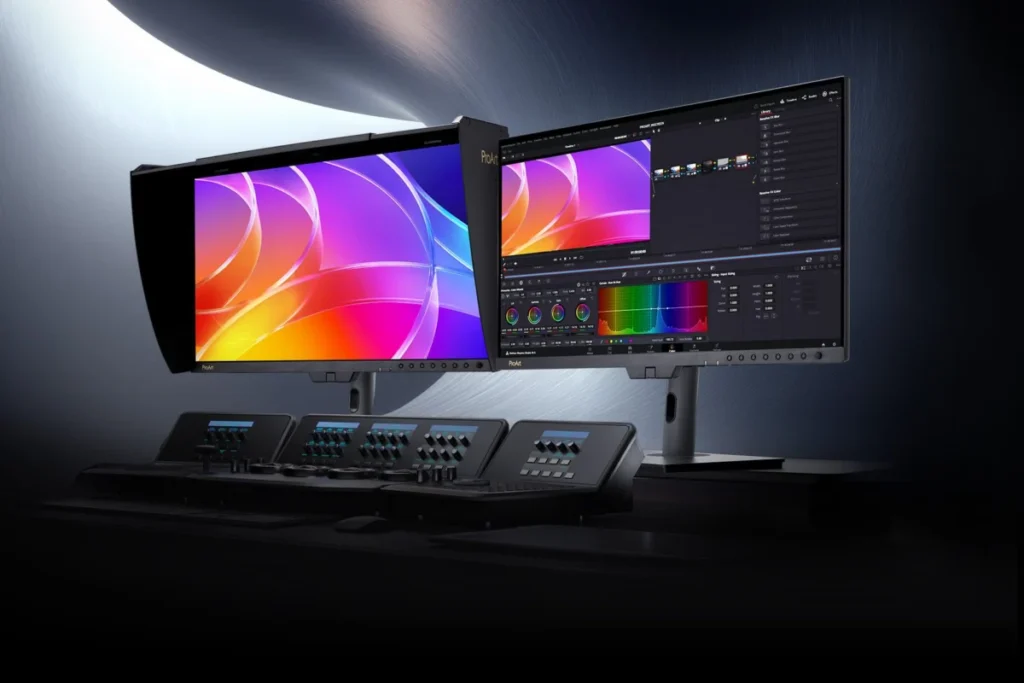
In an industry where visual fidelity can mean the difference between a masterwork and a costly re-edit, ASUS has once again raised the bar for North American post-production professionals. The company has officially unveiled its latest flagship entries into the high-end display market: the ProArt Display OLED PA27USD and its larger counterpart, the PA32USD. These monitors represent a convergence of gaming-grade fluidity and clinical color accuracy, specifically engineered for the rigorous demands of 4K video editing, color grading, and high-stakes visual effects (VFX).
Main Facts: The New Frontier of Professional Displays
The launch of the ProArt PA27USD (26.5-inch) and PA32USD (31.5-inch) marks a significant shift in how ASUS approaches the creative workspace. By integrating cutting-edge QD-OLED (Quantum Dot OLED) technology, these monitors are designed to solve the perennial struggle of balancing true-to-life color representation with deep, infinite contrast ratios.
Both models feature native 4K resolution, ensuring that every pixel of a high-resolution timeline is rendered with uncompromising clarity. Perhaps most impressive is the peak brightness capability of 1,000 nits, a figure that typically eluded OLED technology in the past, allowing for a high dynamic range (HDR) experience that is both vibrant and precise. With a 10-bit color depth capable of displaying over 1.07 billion colors and a 99% coverage of the DCI-P3 color gamut, these monitors provide the wide color space required for cinema-standard output.
Chronology of Development: From Concept to Creative Studio
The development of the PA27USD and PA32USD follows a multi-year trend in the display industry toward moving away from traditional IPS panels in favor of self-emissive OLED technology. ASUS began telegraphing its intent to dominate the creative OLED space nearly two years ago, following the positive reception of its smaller, specialized ProArt OLED offerings.
- Q3 2024: ASUS internal research identifies a gap in the market for a "hybrid" display that offers both high-speed performance for motion graphics and the absolute color calibration needed for color grading.
- Q1 2025: Prototype units are circulated among select colorists and film editors in the Los Angeles and New York markets to gather feedback on peak brightness and auto-calibration consistency.
- May 2026: The official announcement of the PA27USD, with a retail debut set for the end of the month.
- June 2026: Scheduled release of the larger-format PA32USD, completing the flagship lineup for North American studios.
Supporting Data: Engineering Precision
For the professional creative, marketing specs often fall short of reality. ASUS addresses this skepticism by focusing on the "science of accuracy." Both the PA27USD and PA32USD arrive factory-calibrated to a Delta E < 1. In the world of color science, a Delta E value below 1 is effectively imperceptible to the human eye, meaning the color displayed on the screen is indistinguishable from the color data in the source file.
The Motorized Advantage
The most innovative feature of this series is the integrated, motorized colorimeter. In traditional workflows, colorists must manually attach and run a third-party calibrator once a month, a process that is prone to human error and inconsistency. ASUS has embedded this hardware directly into the monitor bezel. Users can schedule auto-calibration to occur during off-hours, ensuring the display maintains its accuracy over its lifespan. Because the calibration profiles are saved directly to the monitor’s internal hardware chip (LUT), the display remains perfectly calibrated regardless of which workstation or operating system is connected to it.

Motion and HDR Performance
Historically, OLED monitors were criticized for slow response times or "burn-in" risks. ASUS counters this with a 240Hz refresh rate—a specification usually reserved for high-end gaming monitors. This fluidity allows motion graphic designers to view their work with zero ghosting. Furthermore, the inclusion of comprehensive HDR support, including Dolby Vision, HLG, and HDR10, ensures that content creators can master their work for any streaming platform or cinema requirement.
Official Responses and Strategic Vision
In a statement accompanying the product launch, ASUS executives highlighted that the move to QD-OLED was driven by the changing nature of the "creative studio." Modern creators are no longer confined to static imagery; they are working with high-frame-rate video, complex 3D composites, and interactive media.
"We designed the PA27USD and PA32USD not just as screens, but as essential creative partners," said an ASUS representative. "By merging the color depth required for professional cinema with the high-speed refresh rates demanded by modern motion design, we are removing the compromise that has historically forced professionals to choose between two different types of monitors."
The decision to include a three-month subscription to Adobe Creative Cloud with every unit is a strategic move to integrate ASUS hardware into the foundational software stack of the modern creative. By providing the tools to create and the medium to view, ASUS is positioning its ProArt line as the "all-in-one" solution for the high-end U.S. market.
Implications for the Creative Industry
The introduction of these monitors at the $2,199 and $2,699 price points indicates that ASUS is aiming squarely at the "prosumer" and professional studio segments. This is a crowded space, currently occupied by established players like Eizo, Dell’s UltraSharp PremierColor line, and Apple’s Pro Display XDR.
A New Standard for Workflow Efficiency
The primary implication of this launch is the democratization of high-end calibration. By automating the maintenance of color accuracy, ASUS is effectively reducing the "technical debt" of creative studios. Small boutique firms that may not have the budget for a dedicated IT/calibration staff can now rely on the monitor’s internal system to ensure that the content they produce for clients is consistent, accurate, and professional.

The "Bundle" Ecosystem
The inclusion of the Italian Panaro MAX transport case for the PA27USD is a significant indicator that ASUS recognizes the mobility of modern editors. The rise of "digital nomad" creatives and on-set editors, who need to bring studio-quality equipment to location shoots, is a growing demographic. By providing a rugged, professional-grade transport solution, ASUS is signaling that their flagship monitors are built to move, not just to sit on a desk in a climate-controlled office.
Economic and Environmental Impact
While these monitors carry a premium price tag, their longevity—backed by robust internal calibration and high-quality QD-OLED panels—could lower the total cost of ownership (TCO) for production houses. By reducing the need for external calibration services and mitigating the degradation of color accuracy over time, these displays are built to last through several years of intense production cycles.
Technical Specifications Summary
| Feature | ProArt PA27USD | ProArt PA32USD |
|---|---|---|
| Panel Size | 26.5-inch | 31.5-inch |
| Resolution | 4K (3840 x 2160) | 4K (3840 x 2160) |
| Panel Tech | QD-OLED | QD-OLED |
| Refresh Rate | 240Hz | 240Hz |
| Color Accuracy | Delta E < 1 | Delta E < 1 |
| Color Coverage | 99% DCI-P3 | 99% DCI-P3 |
| Peak Brightness | 1,000 nits | 1,000 nits |
| Calibration | Motorized Auto-Calibration | Motorized Auto-Calibration |
Conclusion: A Future-Proof Investment
As the boundaries between gaming, cinematography, and interactive digital art continue to blur, the hardware required to produce these mediums must evolve. ASUS, through its ProArt series, is demonstrating a clear understanding of this convergence.
The ProArt Display OLED PA27USD and PA32USD are not merely iterative upgrades; they are a response to the specific pain points of modern content creators. By addressing the critical needs of auto-calibration, high-speed fluid motion, and universal HDR compatibility, ASUS has provided a roadmap for what the professional monitor of the next five years should look like. For the creative professional in the United States, these monitors offer a rare combination of reliability, performance, and technical sophistication that justifies their place at the center of the modern creative workflow. Whether you are cutting a feature-length film or rendering complex 3D assets, the ProArt series ensures that your vision is the only thing that matters—and that your vision is exactly what the world will see.