In the modern corporate landscape, the "open-plan" office has long been hailed as the engine of collaboration and spontaneous innovation. Yet, as the lines between collective synergy and individual productivity blur, a silent crisis has emerged: the noise epidemic. Constant auditory interruptions—ranging from the rhythmic clatter of keyboards and the buzz of HVAC systems to the overlapping chatter of open-office dynamics—are no longer just minor nuisances. They are significant barriers to professional efficacy, mental clarity, and employee well-being.
As businesses strive to balance the collaborative spirit with the need for deep work, acoustic management has shifted from an architectural afterthought to a critical component of human-centric office design. Creating a high-performance workspace does not require total silence; rather, it demands a sophisticated orchestration of sound.
The Anatomy of Office Noise: A New Challenge for Management
Recent workplace surveys indicate that noise is one of the top three complaints from office-based employees. When conversations, ringing phones, and office machinery collide, cognitive load increases. The brain struggles to filter out irrelevant information, leading to what researchers call "attention residue," where the mind remains tethered to a distraction long after the noise has ceased.
For business leaders and facility managers, the challenge is twofold: identifying the specific acoustic signature of their workspace and implementing a layered, evidence-based strategy to mitigate unwanted reverberation.
1. Identifying the Acoustic Profile
Before investing in expensive hardware, management must perform a diagnostic assessment of the environment. Every office has a unique acoustic footprint. An office dominated by glass partitions, concrete ceilings, and exposed ductwork will behave like a reverberation chamber, whereas a space filled with soft textures may suffer from "dead" sound that feels equally unnatural.
Common Noise Culprits:
- Reflective Surfaces: Glass, steel, and polished stone act as mirrors for sound waves, causing them to bounce repeatedly, increasing the ambient noise floor.
- Point-Source Distractions: High-traffic areas such as breakrooms, reception desks, and printer stations located adjacent to "quiet zones."
- Technology & Infrastructure: Inefficient HVAC units and poorly dampened office equipment create low-frequency hums that induce fatigue over time.
Once these sources are mapped, the strategy shifts from mere suppression to intelligent sound management.
2. The Science of Sound-Absorbing Materials
Acoustics is governed by the principles of absorption and diffusion. When sound hits a hard surface, it reflects; when it hits a porous, fibrous material, it is trapped and converted into a negligible amount of heat energy.
The Role of Premium Acoustic Wall Panels
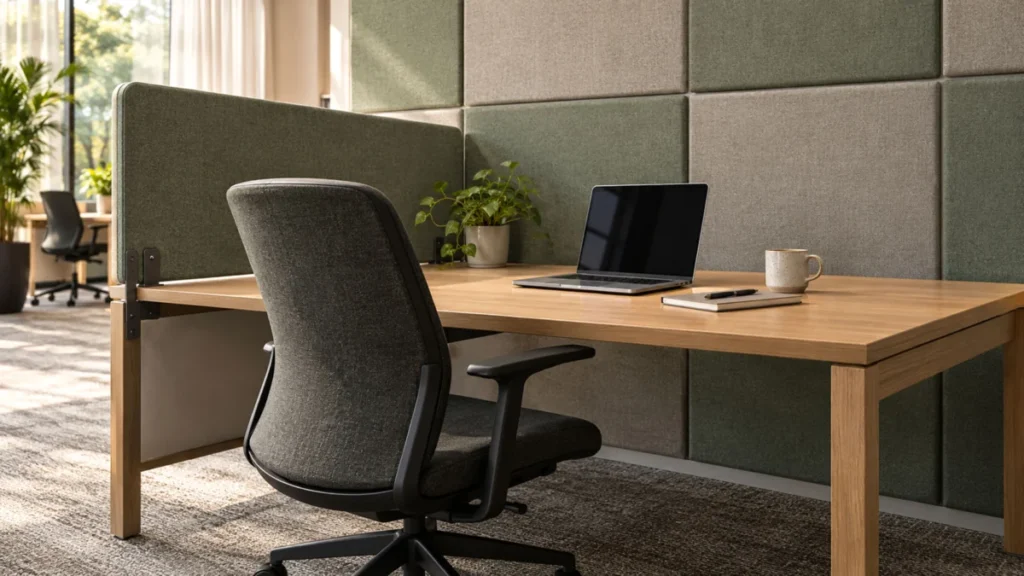
Walls represent the largest surface area in any office. In modern minimalist designs, these are often vast expanses of drywall or glass. By installing premium acoustic wall panels, businesses can significantly reduce the "reverberation time"—the length of time sound persists in a room.
These panels are not merely functional; they have evolved into aesthetic design elements. Fabric-wrapped panels offer a dual-purpose solution: they provide a high Noise Reduction Coefficient (NRC) while serving as a canvas for brand identity, utilizing corporate color palettes to enhance the office’s visual appeal while muffling the chaos of a busy floor.
3. Engineering the Open-Plan Office
The open-office layout is not inherently flawed, but it is often poorly executed. The key to successful open-plan design is the creation of "acoustic islands."
Zonal Planning: A Chronology of Implementation
- Assessment Phase: Map the floor plan based on noise intensity. High-collaboration zones (team hubs) should be physically segregated from low-intensity zones (deep-work pods).
- Implementation of Physical Barriers: Use desk dividers, freestanding acoustic screens, and "huddle booths" to interrupt the line-of-sight and the line-of-sound.
- Soft Furnishing Integration: Introduce rugs, upholstered seating, and thick curtains to dampen high-frequency sounds that bypass rigid dividers.
By allowing employees to choose their environment based on the task at hand—a concept known as Activity-Based Working (ABW)—organizations grant staff the autonomy to escape noise when the task requires intense concentration.
4. Ceiling Acoustics: The Hidden Frontier
In many commercial buildings, the ceiling is the largest unobstructed plane, making it the most significant factor in sound reflection. In older, high-ceilinged buildings or modern industrial offices with exposed services, sound travels effortlessly across the room, disrupting workers who are dozens of feet away.
Modern Ceiling Solutions:
- Acoustic Baffles: Suspended vertically, these panels are highly effective at breaking up sound waves before they can travel horizontally across a ceiling.
- Acoustic Clouds: These horizontal suspended panels are perfect for "taming" the noise above meeting tables or communal break areas.
- Integrated Tiles: For more traditional offices, high-density mineral fiber tiles offer a uniform and cost-effective approach to drop-ceiling noise control.
5. Strategic Selection and Customization
Selecting the right panel is not a "one-size-fits-all" endeavor. An office in a high-density financial district will have different acoustic requirements than a creative studio.
Key considerations include:
- NRC Rating: Look for products with a high NRC (Noise Reduction Coefficient), ideally ranging from 0.7 to 0.9.
- Durability and Maintenance: Ensure that the materials chosen can withstand the wear and tear of a commercial environment, including regular cleaning and potential impact.
- Customization: For companies with strong visual identities, bespoke fabric-wrapped panels provide a custom fit that integrates seamlessly with interior branding, turning acoustic mitigation into a design feature.
6. Cultural Implementation: Workplace Noise Policies
Physical infrastructure is only half the battle. The most effective acoustic strategy is backed by a corporate culture that respects the auditory space of others.
Recommended Workplace Protocols:
- The "Headphone Rule": Establishing a protocol where wearing headphones signals a period of deep work, discouraging unnecessary interruptions.
- Defined Huddle Areas: Prohibiting impromptu meetings at desks and instead requiring the use of designated "collaboration corners."
- Digital Etiquette: Encouraging the use of chat platforms for non-urgent communication, reducing the need for constant phone calls.
7. Common Pitfalls and Mitigation Strategies
Even the best-laid plans can fail if common pitfalls are not addressed.
- The Appearance Trap: Managers often prioritize aesthetics over performance. Always verify the acoustic laboratory data provided by the manufacturer. If a panel looks great but lacks the density to absorb sound, it is merely wall art.
- Confusing Absorption with Soundproofing: This is the most frequent technical error. Absorption manages sound within a room; soundproofing (or sound insulation) prevents sound from entering or leaving a room through walls and doors. For soundproofing, one must address structural integrity, gaps, and mass.
- The "Set and Forget" Mentality: Office noise is dynamic. As teams grow or layouts change, the acoustic needs of the room change. Conduct quarterly "sound audits" and gather feedback from the workforce.
8. Implications: The ROI of Quiet
The implications of investing in professional office acoustics are profound. Data suggests that productivity gains resulting from reduced distraction can pay for the cost of acoustic treatments within months. Beyond the bottom line, the human impact is measurable through reduced stress levels, lower employee turnover, and increased job satisfaction.
Conclusion: Orchestrating the Future of Work
Creating a productive office environment is an ongoing commitment to the comfort and cognitive health of employees. By identifying the primary sources of noise, utilizing high-performance acoustic materials like fabric-wrapped wall panels and ceiling baffles, and fostering a culture of respectful communication, businesses can transform their workplaces.
A well-designed office is not one that is silent, but one that is quiet enough to allow for thought, clear enough to allow for communication, and comfortable enough to allow for peak performance. As the future of work continues to evolve, the organizations that prioritize their acoustic environment will undoubtedly hold a competitive advantage, attracting the best talent and fostering a culture of sustained focus and innovation.