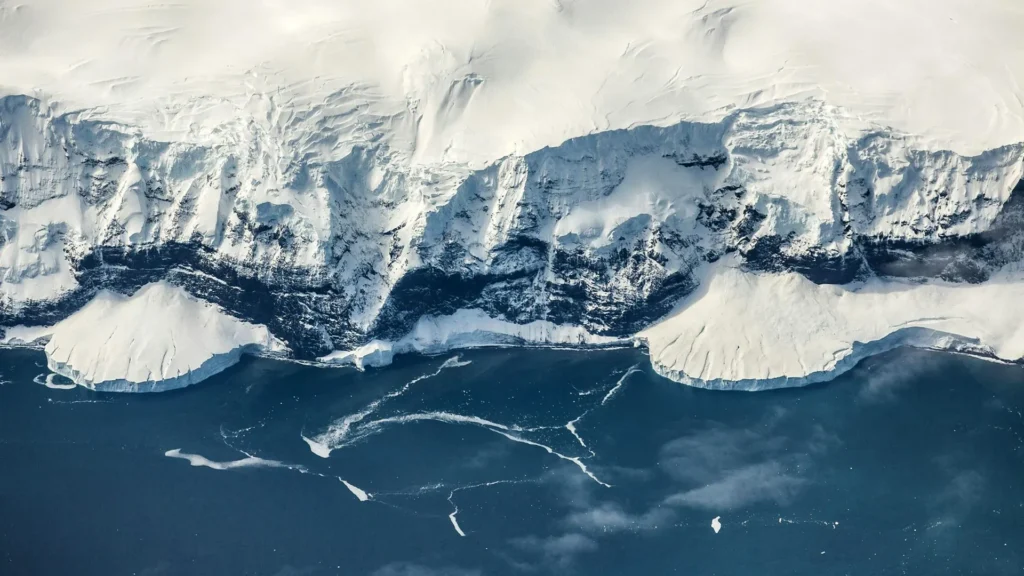
For decades, climate scientists have wrestled with a profound planetary paradox: how did Antarctica become shrouded in a massive, permanent ice sheet 34 million years ago, at a time when Earth’s global temperatures were a staggering 5°C warmer than today? While atmospheric carbon dioxide levels are typically cited as the primary dial for Earth’s thermostat, new research suggests that the answer lies not just in the sky, but deep beneath our feet.
In a landmark study published in the journal Science, an international team of researchers has unveiled evidence that the "deep-earth" architecture of the Antarctic continent—specifically the gradual uplift of its landmass—acted as the essential catalyst for global glaciation. This discovery challenges the traditional climate-centric view of ice ages, suggesting that geological forces must "precondition" a landscape before atmospheric changes can take hold.
The Core Findings: A Tale of Two Poles
The discrepancy between the two poles has long puzzled researchers. While Antarctica began its transformation into an ice-covered fortress nearly 34 million years ago, the Northern Hemisphere’s major ice sheets did not form until a mere five million years ago. If falling CO2 levels were the sole driver of glaciation, one would expect a more symmetrical, simultaneous response across both polar regions.
Instead, Antarctica gained a massive head start. The study, led by the University of Southampton, posits that the geological elevation of East Antarctica created the "cold trap" necessary for snow to persist through the summer. By raising the continent’s surface, Earth’s interior essentially created the high-altitude conditions required to initiate the cooling cycle that would eventually dominate the planet.
Chronology of a Frozen Continent
To reconstruct the timeline of Antarctica’s ascent, researchers utilized complex computational models covering the last 100 million years of geological history.
1. The Jurassic Departure (201–143 Million Years Ago)
The story begins with the breakup of the supercontinent Gondwana. As Antarctica and Africa began their slow, tectonic divorce during the Jurassic Period, the continent was subjected to immense internal stresses. These forces set the stage for a transformation that would take over 100 million years to complete.
2. The Era of Mantle Waves (100 Million Years Ago–Present)
The researchers identified a phenomenon known as "mantle waves"—slow-moving, seismic ripples that travel beneath continental plates after they begin to fragment. These waves, previously linked to the formation of diamond-bearing volcanoes, acted as a subterranean conveyor belt, gradually lifting the East Antarctic landmass. As these waves pulsed beneath the continent, they elevated the vast plateau and the Gamburtsev Mountain range.
3. Reaching the Critical Threshold (45–34 Million Years Ago)
By approximately 45 million years ago, the geological lifting had pushed large portions of East Antarctica above a critical elevation of 2 kilometers. According to the study, this altitude was the "tipping point." At 2,000 meters above sea level, air temperatures are significantly lower—a drop of roughly 1°C for every 100 meters gained. This allowed mountain glaciers to form and eventually coalesce, covering the continent by 34 million years ago.
Supporting Data: Topography as a Climate Engine
The study highlights that topography is not merely a passive feature of the landscape; it is a fundamental driver of climate. The elevation of the Gamburtsev Mountains serves as a primary example. Prior to 50 million years ago, the range was largely below the 1.5-km mark. By the 34-million-year milestone, nearly half of the range had breached the 2-km elevation barrier.
The Ice-Albedo Feedback Loop
Once the ice began to accumulate, a powerful reinforcement mechanism—the "ice-albedo effect"—kicked in. The bright, white surface of the ice reflected a greater portion of incoming solar radiation back into space. The researchers estimate this single feedback reduced global temperatures by approximately 1°C.
The Atmospheric Drying Effect
Furthermore, as the region cooled, the atmosphere’s capacity to hold water vapor diminished. Because water vapor acts as a potent greenhouse gas, its removal from the air acted like the removal of an insulating blanket. This drier, colder atmosphere allowed the ice sheets to expand from the mountain peaks down to the coastline, eventually engulfing the continent.
Official Perspectives from the Research Team
The collaboration, involving experts from the University of Southampton, Durham University, the GFZ Helmholtz Centre for Geosciences, the University of Potsdam, Utrecht University, and the University of Florence, underscores the necessity of interdisciplinary science.
Professor Thomas Gernon, lead author and Professor of Earth Science at the University of Southampton, noted:
"Antarctica’s land surface was gradually lifted to the point where ice could gain a permanent foothold, even while the surrounding polar oceans as well as global temperatures remained surprisingly warm. If falling levels of CO2 acted alone, you would expect the poles to respond more symmetrically. Instead, Antarctica gained a major head start because geological processes had raised land to higher elevations, making it colder."
Dr. Thea Hincks, who co-led the study, emphasized the accuracy of the computational models:
"We found that our models can realistically capture the evolution of the two-kilometer-high coastal escarpment, elevated plateau, and inland mountains, eventually seeding the East Antarctic Ice Sheet."
Dr. Guy Paxman of Durham University reiterated the importance of altitude:
"Topography is fundamentally important for glaciation. Air temperatures can drop by up to 1°C for every 100 meters of altitude gained. This was the difference between snow that melts in summer and snow that stays for a millennium."
Dr. Philip Goodwin, a climate physicist at the University of Southampton, concluded the team’s findings:
"As the ice sheet expanded, its bright surface reflected more sunlight back into space, cooling the region further. Together, these feedbacks allowed the Antarctic ice sheet to spread from the mountains across the continent, eventually reaching the coast."
Implications: Rethinking Climate Tipping Points
The implications of this research extend far beyond historical geology. The East Antarctic Ice Sheet currently holds enough frozen water to raise global sea levels by approximately 52 meters. Understanding the conditions that led to its birth—and the conditions that sustain it—is critical in the era of anthropogenic climate change.
The "Preconditioning" Theory
The most significant shift in scientific thinking proposed by this study is the concept of "preconditioning." Scientists have traditionally looked for climate triggers—such as volcanic eruptions or sudden shifts in carbon cycles—to explain transitions into ice ages. This study suggests that, while those triggers are important, they cannot act in a vacuum. Earth’s interior must first "prepare" the landscape by creating the physical conditions—such as high elevation—that make large-scale cooling possible.
Future Climate Modeling
By proving that geological processes dictate the viability of ice sheets, the study provides a new framework for modeling future climate scenarios. It suggests that our understanding of "tipping points" must be expanded to include geological stability.
"Our findings reveal that the Earth’s interior preconditions landscapes to glaciation, determining when and where major climate transitions like the glaciation of Antarctica become possible," Professor Gernon concluded. "That’s incredibly important for understanding Earth’s ancient ice ages as well as future tipping points in the climate system."
As the scientific community continues to map the intricate dance between the Earth’s mantle and its atmosphere, the tale of Antarctica stands as a stark reminder of the complexity of our planet. The ice that defines the modern Antarctic landscape was not merely a product of the sky; it was a collaborative work of art, sculpted by the slow, grinding pulse of the Earth from deep within.
This research was supported by the WoodNext Foundation, a fund of a donor-advised fund program.