For the seasoned watch collector, Rolex often occupies a paradoxical space. It is simultaneously the most recognized horological brand on the planet and, for many, the most polarizing. For those of us who pride ourselves on a contrarian streak or a preference for the obscure, the "Crown" can feel like an inevitable—and perhaps overly safe—destination. I have spent fifteen years as a journalist and collector cultivating a taste for the unconventional, frequently shrugging off the mass appeal of the Rolex catalog.
However, horology is a discipline of constant re-evaluation. A recent encounter with a 1974-serial Rolex Oysterdate Precision Reference 6694 has forced a rare, humbling confrontation with my own biases. This is not merely a review of a vintage timepiece; it is an examination of why, in an era of hyper-engineered ceramic behemoths, the most modest watch in the Rolex archives remains a masterclass in design.
The Main Facts: A Study in Restraint
The Rolex Oysterdate Precision Ref. 6694 represents the brand in its most elemental, unadulterated form. Unlike the high-beat chronographs or the professional-grade diving tools that define the modern brand’s identity, the 6694 was designed for utility and accessibility.

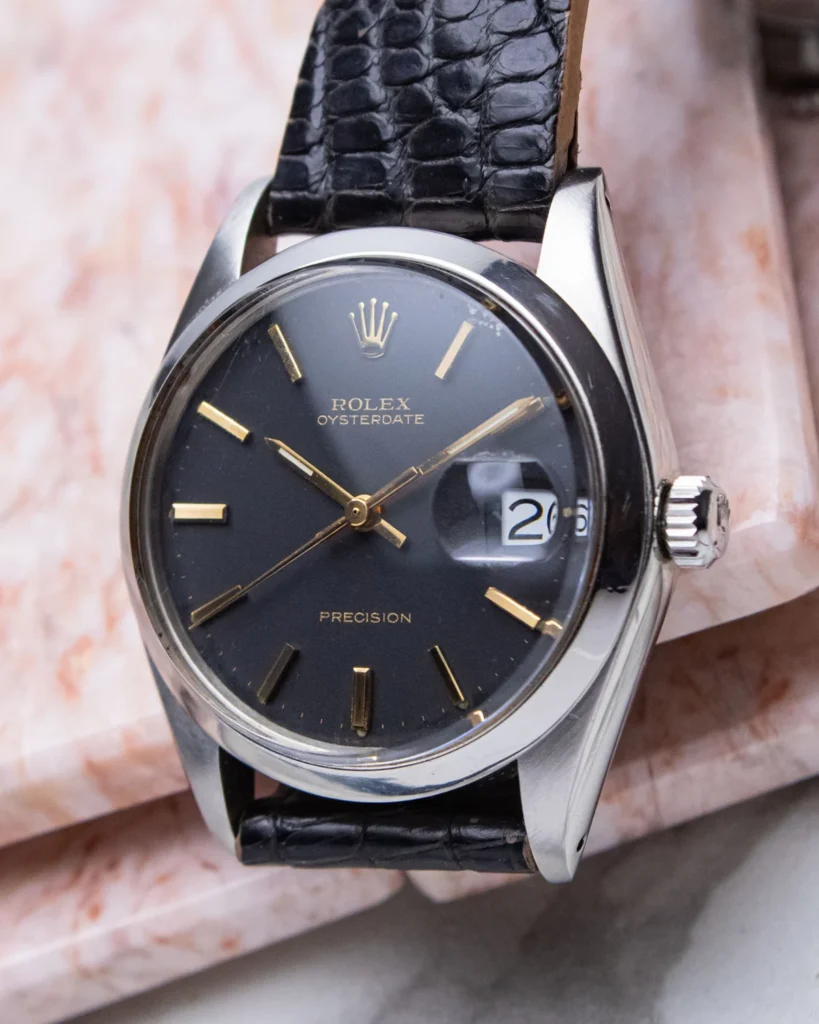
At 34mm, the case size is, by contemporary standards, remarkably restrained. Yet, it serves as a testament to the fact that proportions matter more than dimensions. The long, tapering lugs and the tall acrylic box crystal create a silhouette that commands more visual presence than a millimeter-ruler would suggest. It is a watch that avoids the "slab-sided" thickness of modern sport models, favoring a sophisticated, rounded curvature that hugs the wrist with an elegance rarely seen in today’s market.
The dial is equally minimalist. The 1974 model I evaluated featured a stunning matte charcoal gray surface adorned with gilt text and gold hardware. It is a design that relies on negative space and balanced typography rather than aggressive branding. It is, quite simply, the essential Rolex: a time-telling instrument that prioritizes legibility and timelessness over flash.
Chronology: The Last of Its Kind
The historical significance of the Ref. 6694 is often overlooked by those who fixate on the "Big Three" professional lines. Produced from the early 1960s until 1989, the 6694 enjoyed a production run that spanned nearly three decades.

Its most vital claim to fame is its status as the final manually-wound watch offered by Rolex. When the reference was discontinued in 1989, it marked the end of an era, beating the final hand-wound Daytona by a mere year. For over twenty-five years, the 6694 served as the "gateway" for aspiring collectors. It was the entry point into the world of Oyster cases, providing a tactile, intimate connection to the movement that automatic rotors often mask.
To wear a 6694 is to participate in a ritual: the daily morning winding of the crown. It is a practice that binds the wearer to the watch, transforming it from a static accessory into an active partner in the measurement of time.
Supporting Data: The Caliber 1225
Inside the 6694 beats the Caliber 1225, a movement that serves as a perfect microcosm for the philosophy of the watch itself. Introduced in 1967, this caliber is not a record-breaking piece of mechanical engineering. It does not possess a silicon hairspring, a co-axial escapement, or an 80-hour power reserve.

- Frequency: 21,600 vibrations per hour (vph).
- Power Reserve: Approximately 58 hours.
- Hairspring: Breguet overcoil.
- Serviceability: Exceptional, due to the relative simplicity of its construction.
While the movement is not a COSC-certified chronometer, its real-world performance remains surprisingly robust. It is a workhorse engine designed for longevity. The primary "complaint" regarding the 1225 is the absence of a quickset date feature. To adjust the date, one must cycle the hands through 24-hour periods—a laborious task that highlights the age of the movement. However, in an era of over-engineered complications, there is a certain romanticism in the absence of a quickset; it is one fewer gear to fail, one fewer point of stress, and a daily reminder that this watch exists in a different mechanical epoch.
The Debate: Form vs. Function
The aesthetic choices of the 6694 continue to stir debate among enthusiasts. The "Cyclops" date magnifier is the most prominent point of contention. Purists often argue that it disrupts the symmetry of the dial. Yet, from a design perspective, it is a functional necessity that has become an iconic brand signature.
Furthermore, the choice of a white date wheel against a dark dial is often mocked by modern collectors who demand color-matched displays. However, viewing the 6694 through the lens of 1974, this was not a "failure" of design, but a standard practice. The "open six" typeface found on the date wheel adds a layer of vintage warmth that modern, perfectly color-matched displays simply cannot replicate.

The strap choice is another avenue for personal expression. While this specific piece has lost its original Oyster bracelet, it currently resides on a lizard-pattern leather strap. The glossy black texture of the strap complements the matte charcoal dial, elevating the piece from a casual sport watch to something far more versatile and dressy. It proves that the 6694 is a chameleon—it looks as natural with a field jacket as it does with a tailored blazer.
Implications: The Collector’s Horizon
Why does this watch, a humble 34mm manual-wind relic, have the power to challenge a decade and a half of ingrained bias? The answer lies in the concept of "soul."
Modern luxury watchmaking is often defined by specs: water resistance, power reserve, material hardness, and movement accuracy. We have become a culture of enthusiasts who judge watches by their brochures. The 6694 ignores this race. It does not try to be the most accurate or the most rugged. It is content to be a watch that you wind, you wear, and you enjoy.

The implications for the wider market are clear: there is a growing fatigue with the "hype" surrounding modern, steel-sport Rolex models. Collectors are increasingly looking backward, seeking out watches that possess character, history, and a manageable price point. The 6694 offers a bridge between the unattainable modern secondary market and the rich, storied history of the 20th-century watch industry.
Final Reflections
My experience with the 1974 Rolex Oysterdate Precision 6694 has been a lesson in intellectual flexibility. I have spent years constructing a persona built on the rejection of the mainstream, only to realize that the mainstream often becomes mainstream for a reason.
This watch is not going to replace a complicated chronograph or a high-end GMT in a collection, nor will it satisfy the thirst for technical innovation. But it succeeds where so many other watches fail: it is completely comfortable in its own skin. It doesn’t need to be 40mm, it doesn’t need a chronometer certification, and it certainly doesn’t need a quickset date to justify its existence.

For the collector who feels they have seen it all, or for the enthusiast who believes they are "above" the Crown, I invite you to spend a week with an Oysterdate Precision. You might find, as I did, that the most rewarding discoveries are not the ones that challenge your technical expectations, but the ones that remind you why you started collecting in the first place: the simple, quiet, and enduring pleasure of a well-made machine on the wrist.