

Main Facts: The Unveiling of the Victoria Falls High Jewelry Suite
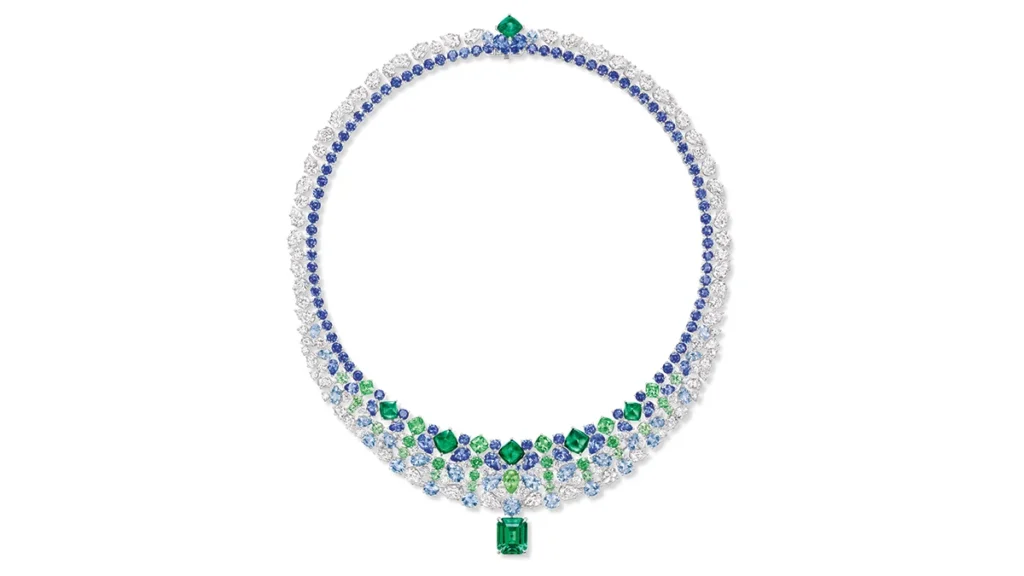
The House of Harry Winston has unveiled its latest high jewelry triumph: the Victoria Falls suite, an ambitious, chromatic tribute to one of the natural world’s most dramatic hydrological wonders. Rendered in platinum and commanded by a vivid, detachable 5.9-carat emerald pendant, the centerpiece necklace forms the nucleus of an extraordinary suite that cascades with approximately 89 carats of hand-selected gemstones. Paired with coordinating chandelier earrings, the complete suite comprises 285 individually matched gems totaling nearly 100 carats.
+--------------------------------------------------------------------------+
|                     VICTORIA FALLS SUITE: AT A GLANCE                    |
+--------------------------------------------------------------------------+
| Total Gemstone Count  : 285 individual stones                            |
| Total Carat Weight    : Approximately 100 carats (suite combined)        |
| Centerpiece Stone     : 5.9-carat detachable emerald pendant             |
| Dominant Materials    : Emeralds, sapphires, tsavorites, aquamarines,    |
|                         mint tourmalines, brilliant-cut diamonds         |
| Mounting Metal        : Hand-articulated Platinum                        |
| Design Inspiration    : Victoria Falls (Mosi-oa-Tunya), Zambezi River    |
| Pricing Structure     : Private acquisition / Price upon request         |
+--------------------------------------------------------------------------+
Modeled after the geological precipice along the border of Zambia and Zimbabwe where the Zambezi River surges over a basalt chasm, the collection departs from the house’s monochromatic diamond traditions to embrace a dynamic, polychromatic palette. The necklace’s architecture is engineered around an interior ribbon of calibrated round sapphires that sits flush against the neck, anchoring a kinetic fall of tsavorites, mint tourmalines, aquamarines, and brilliant-cut white diamonds designed to mirror churning hydraulic spray.
Offered exclusively through private salon presentation with price upon request, the Victoria Falls suite represents a major technical feat for the Fifth Avenue jeweler. It serves as both an aesthetic study in fluid mechanics and a testament to the founder’s foundational—yet often overlooked—fascination with world-class colored gemstones.
Chronological Trajectory: From Pawn-Shop Phenomenon to Architectural Mastery
While Harry Winston built an indelible mid-century reputation as the undisputed "King of Diamonds," the jeweler’s origin story was catalyzed not by carbon crystals, but by beryl. The timeline of the house’s gemstone mastery stretches across more than a century of acquisition, lapidary innovation, and structural engineering.
A CENTURY OF GEMOLOGICAL MASTERY
========================================================================================
1908          1920          1932          1940s         1958          2020s
 |             |             |             |             |             |
 +-- 25-Cent   +-- Premier   +-- Eponymous +-- "Winston   +-- Donates   +-- Victoria
     Emerald       Diamond       House of      Cluster"       Hope          Falls Suite
     Discovery     Company       Harry         Technique      Diamond to    Debuts
     in NYC        Formed        Winston       Pioneered      Smithsonian   Globally
                                 Founded
========================================================================================
The 1908 Discovery and Early Foundations
The maison’s historical narrative began on Manhattan’s West Side in 1908. At twelve years old, Harry Winston was browsing the trays of an unpretentious pawnshop when a green stone caught his eye, tagged at twenty-five cents. Having absorbed the fundamentals of lapidary identification in his father Jacob Winston’s modest jewelry shop, the young prodigy recognized the gem’s specific gravity, pleochroism, and mineral inclusions as those of an authentic two-carat emerald. He purchased the stone and sold it forty-eight hours later for $800—a return on capital that crystallized his career trajectory.
By age fifteen, Winston had discontinued his formal schooling to become a full-time partner in his father’s workshop, mastering trade routes, gem evaluation, and estate auctions.
The Mid-Century Transformation: The Cluster Technique
In 1920, Winston established The Premier Diamond Company, followed in 1932 by the launch of Harry Winston Inc. at 599 Fifth Avenue. While the firm quickly monopolized high-profile historic diamond estates—later handling iconic rarities such as the Jonker, the Vargas, and the Hope Diamond (which Winston donated to the Smithsonian Institution in 1958)—its ateliers spent the 1940s revolutionizing high jewelry fabrication.

Working alongside master designer Nevdon Koumrouyan, Winston pioneered the "clustering" technique. This philosophy dictated that the innate geometry and fiery refraction of gemstones, rather than heavy platinum mountings, should govern the structural integrity of a piece.
Contemporary Evolution: The Colored Stone Resurgence
Throughout the late 20th and early 21st centuries, the house continuously returned to this design language. The debut of the Victoria Falls suite marks the culmination of decades spent refining this kinetic philosophy, utilizing near-invisible metal armatures to capture the ephemeral movement of natural landmarks through complex colored stone pairings.
Supporting Data and Technical Gemology: Anatomy of a Cascading Suite
To capture the atmospheric conditions of the Zambezi River’s descent, Harry Winston’s master gemologists and master jewelers spent hundreds of bench hours compiling, calibrating, and hand-setting the suite’s 285 gems.
+--------------------------------------------------------------------------+
|                  GEMOLOGICAL & CHROMATIC PALETTE MAPPING                 |
+----------------------+--------------------+------------------------------+
| Gemstone Variety     | Chromatic Function | Hydrodynamic Analogue        |
+----------------------+--------------------+------------------------------+
| Fine Beryl (Emerald) | Deep forest green  | Riverbank rain-forest canopy |
| Corundum (Sapphire)  | Deep/light cobalt  | Subsurface currents & plunge |
| Tsavorite Garnet     | Vivid neon-green   | Verdant spray & flora fringe |
| Mint Tourmaline      | Translucent mint   | Aerated foam & water crests  |
| Beryl (Aquamarine)   | Crystalline cyan   | Suspended mist particles     |
| Diamond (D-F, VS+)   | Blinding white     | Breaking water & white caps  |
+----------------------+--------------------+------------------------------+
Carat Distribution and Dimensional Balance
The suite’s weight distribution follows rigorous hydrodynamic proportions:
- The Collar Foundation: An interior collar of deep-blue round sapphires contours closely against the clavicle, grounding the composition.
- The Centerpiece: Suspended from the nexus of the collar hangs the detachable 5.9-carat emerald pendant, cut to maximize depth of color without extinguishing internal brilliance. The stone’s detachable mechanism allows the wearer to convert the suite from a formal gala piece to a sleeker collar arrangement.
- The Waterfall Strands: Radiating outward and downward, approximately 89 carats of mixed-cut gems create an asymmetrical cascade across the decolletage.
- The Suite Earrings: The accompanying earrings add roughly 11 carats of matched gems, engineered with flexible hinge joins to deliver articulated motion in tandem with the wearer’s movement.
Lapidary Calibration and Metallurgical Architecture
The creation of the Victoria Falls suite presented considerable technical hurdles:
- Differential Hardness Balancing: Setting diverse mineral species within a unified platinum framework demands bespoke seat preparation. Tsavorite garnets (Mohs hardness 7–7.5), tourmalines (7–7.5), and emeralds (7.5–8 with characteristic jardin fissures) react disparately to pressure compared to sapphires (Mohs 9) and diamonds (Mohs 10). The maison’s artisans hand-tailored individual prong angles to prevent lattice stress across the softer stones.
- Chromatic Transitions: The gemological team rejected thousands of carats of candidate stones to find specimens whose color saturation transitioned naturally from deep river-bed blues to airy seafoam hues, ensuring the visual progression felt organic rather than banded.
- Micro-Articulated Platinum Lattice: Below the visual plane of the gems, the underlying platinum mounting is carved into thousands of miniature gallery windows. This openwork structure maximizes light return while granting the rigid metal the liquid drape of silk fabric.
Official Perspectives and Design Philosophy: Translating the ‘Smoke That Thunders’
Designers at the maison drew inspiration from the indigenous Kololo name for Victoria Falls: Mosi-oa-Tunya ("The Smoke That Thunders"). The geological marvel features a continuous sheet of falling water dropping 354 feet across a width of 5,604 feet, generating a localized rain-forest microclimate and plumes of rising mist that soar over 1,600 feet into the atmosphere.
"The essence of the Winston design philosophy has never been
 about decorating platinum with stones; it is about liberating
 gems from metal entirely so that nature's architecture speaks
 without interruption."
 — Atelier Curatorial Note, Harry Winston Design Studio
According to curatorial statements from the house’s creative leadership, the suite’s primary design challenge lay in translating dynamic velocity into mineral permanence. The design team resolved this by playing with varied stone cuts: marquise-cut diamonds, pear-shaped tourmalines, and oval-cut sapphires were assembled at divergent angles to scatter reflected light in multiple directions, mimicking the chaotic refractions of turbulent water.

The inclusion of the 5.9-carat detachable emerald serves as a direct historical bridge to Harry Winston himself. Company historians emphasize that while Winston acquired historical marvels like the Hope Diamond, his first intuitive commercial win was an emerald. The inclusion of an exceptional beryl at the physical heart of the Victoria Falls suite is intended as a self-referential tribute to that 1908 West Side epiphany.
Strategic and Market Implications: The Ascendance of High-Carat Colored Gemstones
The launch of the Victoria Falls suite underscores broader commercial and aesthetic currents in the ultra-luxury jewelry landscape, with implications rippling across international auction houses, investment portfolios, and high-jewelry ateliers.
MACRO-TRENDS IN HIGH JEWELRY CONNOISSEURSHIP
┌────────────────────────────────────────────────────────────────────────┐
│                                                                        │
│  [1] CHROMATIC DIVERSIFICATION                                         │
│      Collector shift from strictly white diamonds to high-contrast,    │
│      multi-gemstone compositions with distinct visual narratives.       │
│                                                                        │
│  [2] MULTI-FUNCTIONAL MODULARITY                                       │
│      Rising demand for detachable pendants and convertible             │
│      mechanisms, bridging grand gala wear with intimate private salon  │
│      aesthetics.                                                       │
│                                                                        │
│  [3] HERITAGE-DRIVEN VALUE PRESERVATION                                │
│      Institutional capital favoring historically rooted maisons that   │
│      pair certified origin provenance with proprietary setting craft.  │
│                                                                        │
└────────────────────────────────────────────────────────────────────────┘
The Shifting High-Jewelry Portfolio
While untreated Type IIa white diamonds maintain their role as reliable stores of wealth, the contemporary ultra-high-net-worth (UHNW) demographic has increasingly diversified into museum-grade colored gemstones. Recent auction cycles at Sotheby’s and Christie’s in Geneva and Hong Kong have logged record prices-per-carat for unheated sapphires, exceptional Colombian and Zambian emeralds, and fine cuprian tourmalines. By producing a suite that blends emeralds, tourmalines, and tsavorites with diamonds, Harry Winston positions the set directly at this growing appetite for chromatic complexity.
Transformable Jewelry as an Investment Requirement
The inclusion of a detachable mechanism for the central 5.9-carat emerald aligns with a distinct structural shift in the high-jewelry market: transformability. Contemporary collectors routinely seek convertible functionality in eight-figure suites. A transformable piece provides stylistic flexibility, allowing an owner to convert high-profile exhibition jewels into understated jewelry for less formal engagements, all without sacrificing structural safety.
Provenance and Historical Mythmaking
In the competitive upper tier of haute joaillerie, technical execution alone is no longer enough to command top-of-market premiums; pieces must embody a compelling corporate and design legacy. By directly linking the Victoria Falls suite to Harry Winston’s 1908 pawnshop discovery, the maison reinforces its century-old heritage. The suite celebrates the rare stones extracted from the Earth, the natural majesty of Mosi-oa-Tunya, and the enduring instinct of a twelve-year-old boy who recognized the unmistakable fire of an emerald when no one else did.



