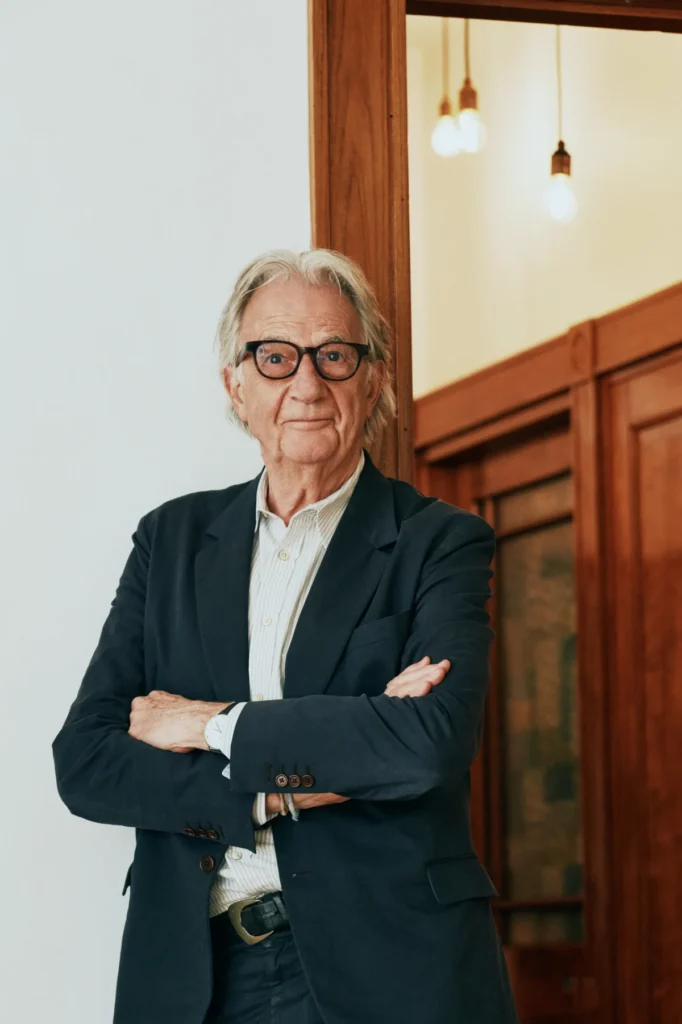
At 80 years old, most titans of industry have long since retreated to the quietude of a country estate, content to let their legacy be managed by boardrooms and branding consultants. Sir Paul Smith, however, is not most people. On any given Saturday, you are as likely to find him on the shop floor of his Albemarle Street boutique in London, engaging in lively repartee with customers, as you are to find him in a boardroom.
Recently, he recalled a particularly memorable encounter: a customer wandered into the store dressed entirely as a rabbit. Without missing a beat—and perhaps channeling the same playful spirit that has defined his career—Smith greeted her with the casual warmth of a lifelong friend. "I said, ‘Can I help you? Do you need a new tail or anything?’" he recounts with a chuckle. It is this unique blend of professional excellence and irrepressible zaniness that has cemented Sir Paul Smith not just as a fashion icon, but as the industry’s permanent "head of happiness."
The Architecture of an Icon: A Chronology of Success
Sir Paul Smith’s journey is a testament to the power of curiosity and the triumph of the unconventional. Born in Nottingham, Smith left school at 15 with undiagnosed dyslexia and a singular, unrefined passion for photography and design. He did not attend a prestigious fashion academy, nor did he have a family fortune to bankroll his ambitions. Instead, he relied on his father’s encouragement and an innate sense of style.
In the late 1960s, he met his wife and lifelong mentor, Pauline Denyer, a designer and Royal College of Art graduate. Together, they opened a tiny, 12-foot-by-12-foot shop in Nottingham. The store, which was only open on Fridays and Saturdays, was "managed" by their Afghan hound, Homer. It was within this claustrophobic, humble space that Smith learned the fundamentals of retail: how to market a product, how to listen to a customer, and, perhaps most importantly, how to build a brand through personal connection.
By the 1970s, Smith was already making waves in the industry. While his contemporaries were sticking to the rigid, austere lines of traditional tailoring, Smith was loosening the silhouette. He introduced softer shoulders, dropped lapels, and a daring color palette—lavender, lemon, and bold checks—that challenged the masculinity of the era. Working in parallel with Giorgio Armani, Smith helped redefine the modern suit, transforming it from a uniform of conformity into a canvas for individual expression.
Over the last 56 years, his career has seen him dress everyone from rock royalty like David Bowie and Paul McCartney to the cycling champion Bradley Wiggins. He has navigated the volatile waters of the fashion industry to become Britain’s most successful independent designer, boasting a net worth exceeding £240 million. In 2000, he was knighted, and two decades later, he became the first fashion designer to be named a Companion of Honour to the British monarch, placing him in an elite cohort of high-achievers including Dame Judi Dench and architect David Chipperfield.
The Curiosity Shop: A Philosophy of Design
To understand Paul Smith, one must look at his office. It is less a workspace and more a "curiosity shop" of the highest order. It is packed with the inexplicable gifts sent by his anonymous admirers: a 20-foot-long yellow pencil, carved fish, vintage bicycles, and stacks of fruit-crate wrappers.
In September, he recreated this chaotic, vibrant environment at the Selfridges Corner Shop, filling the space with 400 cycle jerseys, old televisions, and a classic Paul Smith Mini. The display was a perfect distillation of his worldview: it was messy, joyous, and profoundly human. Pointing to a pair of nautical-themed objects during an interview, he quipped, "Look—fish… and ships!" It is this ability to find the pun in the profound that keeps him perpetually young.
His aesthetic—the "wacky" polka-dot boxer shorts and the "wonky" stripes—has become a global shorthand for a very British brand of optimism. It is design that does not take itself too seriously, yet is crafted with the rigorous attention to detail expected of a master tailor.
Supporting Data and Business Acumen
While his demeanor is whimsical, Smith’s business strategy is grounded in hard, cold reality. He remains the majority owner of his company, a rarity in an era of massive luxury conglomerates. He credits his longevity to a combination of stamina, lateral thinking, and a disciplined approach to property and retail.
"When people say I was ‘lucky’ in Japan, Pauline always responds that luck equals hard work and a lot of lateral thinking," he notes. Japan, in particular, has been a pillar of his success, bolstered by his long-standing relationship with minority shareholder Itochu Corp. Smith travels there regularly, maintaining a hands-on approach that keeps him connected to his largest markets.
His eponymous foundation, the Paul Smith Foundation, serves as an extension of this work ethic, offering studio space and business mentoring to the next generation. He is deeply invested in demystifying the industry for young creatives, warning them that "there is no magic wand."
"So many of the young people and fashion students I meet think getting ahead is about networking, becoming well-known and starting your own company," Smith observes. "But so many of them eventually close down. You have to pay the rent."
Official Reflections: "Threads: My Life in Style"
In his new memoir, Threads: My Life in Style (published by Macmillan), Smith reflects on the path that led him from a Nottingham shopkeeper to a global fashion statesman. The book is not merely a biography; it is a guidebook for those who wish to navigate the creative industries without losing their humanity.
Throughout the text, Smith emphasizes that professional success is meaningless if it comes at the expense of life’s simple pleasures. He speaks with deep admiration for his contemporaries, including the late Giorgio Armani, and discusses the resilience required to survive six decades of shifting trends.
He is an advocate for the "human approach" to business. "Life is about friendship, camaraderie, love, health," he writes. "It’s about pacing yourself and enjoying everyday things." Even at 80, he maintains his physique through swimming and Pilates, drives his own electric Mini Cooper to his Covent Garden headquarters, and remains the primary engine of his company’s creative output.
Implications for the Future of Fashion
What does the enduring success of Paul Smith mean for the fashion industry at large? His career provides a compelling argument for independence and, more importantly, for the longevity of the "human-first" brand.
In a digital age where many designers are obsessed with metrics, algorithms, and rapid-fire collection cycles, Smith represents a slower, more deliberate, and more joyful path. He proves that a brand can be global and commercially dominant without sacrificing its soul. His ability to maintain his status as an "establishment pillar" while remaining a contrarian at heart is a rare feat.
For emerging designers, Smith’s legacy is a reminder that the most durable businesses are built on relationships, not just trends. By prioritizing "the journey" over the destination, and by maintaining a sense of curiosity that doesn’t fade with age, Smith has created a blueprint that is as relevant today as it was when he first opened his doors in the 1970s.
As he looks toward the future, Smith shows no sign of slowing down. He continues to travel, to mentor, and to design. His advice remains simple: "There’s always a new way to look at the world." With that, he places his hands on his head to form bunny ears, laughs, and walks off—a man who has spent 80 years proving that the most serious work is often done with a smile.