The Arctic, once considered a vast, unchanging vault of frozen history, is undergoing a seismic transformation. As global temperatures climb at a rate significantly outpacing the rest of the planet, the frozen ground known as permafrost is thawing. This process is not merely a localized environmental shift; it is a critical variable in the global climate equation. Buried within this icy substrate are enormous, ancient stores of organic carbon—a legacy of millennia of plant and animal life.
For years, scientists have grappled with a haunting question: What happens when this carbon is released? As coastlines crumble into the sea and rivers carve through thawing soil, this carbon is flushed into the Arctic Ocean. A landmark study recently published in Nature Geoscience by researchers from the Alfred Wegener Institute (AWI) and MARUM—the Centre for Marine Environmental Sciences at the University of Bremen—has finally begun to provide a clear answer. By analyzing sediment cores from the coast of Qikiqtaruk (Herschel Island) in Canada, the team has discovered that the ocean’s microbial life acts as a surprising, selective filter, potentially altering our understanding of how permafrost thaw contributes to climate change.
The Magnitude of the Carbon Vault
To grasp the stakes of this research, one must understand the sheer scale of the Arctic’s carbon reserves. Arctic land ecosystems hold approximately 1,300 gigatonnes of organic carbon, largely comprised of ancient plant remains preserved in a state of suspended animation. Furthermore, an additional 400 gigatonnes are locked away in subsea permafrost and river deltas.
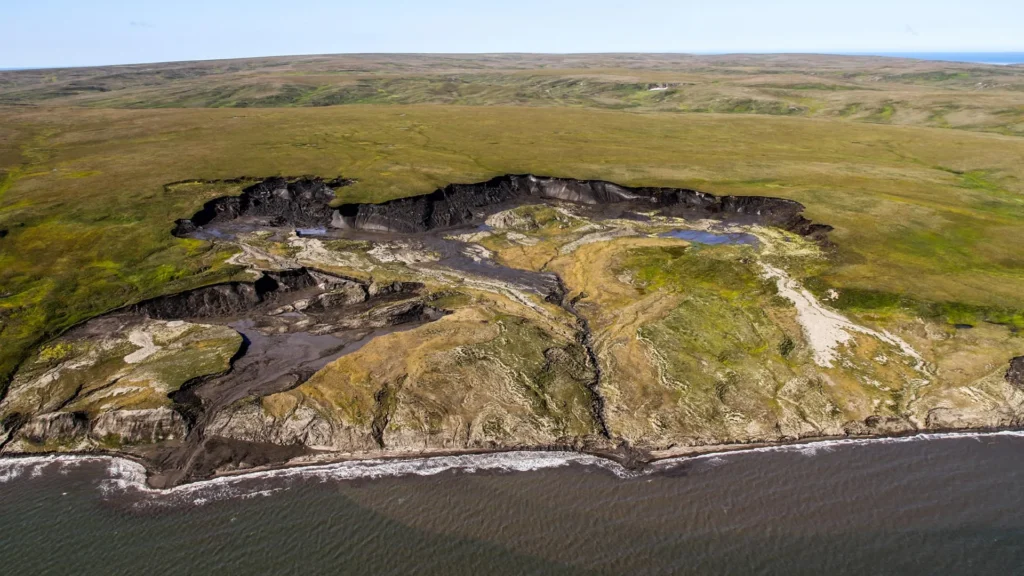
As the climate warms, the integrity of these deposits is failing. Coastal erosion and riverine transport act as a conveyor belt, moving this carbon from terrestrial storage into the marine environment. Dr. Manuel Ruben, the study’s lead author from the Alfred Wegener Institute, Helmholtz Centre for Polar and Marine Research (AWI), notes the urgency of the situation: "Up to 0.02 gigatonnes of carbon are entering the sea each year, and according to forecasts, this outflow could rise by 70 to 150 percent by the year 2100."
Until now, the critical "missing link" in climate modeling was the destination of this carbon. Did it remain inert on the seafloor, or was it rapidly processed by marine bacteria into carbon dioxide and methane—the very gases that accelerate the warming cycle?
Chronology of a Disappearing Coastline
The research team’s investigation centered on the waters surrounding Herschel Island. By extracting sediment cores, the scientists were able to read a chronological record of the seafloor spanning approximately 50 years. This provided a window into how the coastal carbon cycle has responded to recent climatic changes.
The process of carbon transfer is complex and multi-staged:
- Release: As permafrost thaws, the soil loses its structural stability, leading to rapid coastal retreat and the slumping of organic material into the Arctic Ocean.
- Transport: Rivers and coastal currents distribute this terrestrial material across the continental shelf.
- Deposition: Much of this sediment settles on the seafloor, creating a stratified record of carbon input.
- Microbial Processing: Bacteria and other microorganisms inhabiting the sediment pore water interact with the organic carbon, attempting to break it down for energy.
By analyzing these layers, the team was able to distinguish between material deposited decades ago and carbon that had only recently arrived, providing a longitudinal view of how the ecosystem manages this influx.
Data-Driven Insights: The "Gourmet" Microbe Theory
The most compelling aspect of the study lies in the discovery of how marine microorganisms "choose" their food sources. Through the analysis of carbon isotopes—specifically the 13C and 14C variants—the researchers could trace the origin and age of the material consumed by microbial life.
The findings were unexpected. While the ocean floor is saturated with organic carbon from terrestrial permafrost, the resident bacteria are surprisingly picky. They act as "gourmet" eaters, consistently bypassing the older, tougher organic carbon from permafrost in favor of fresh, high-quality carbon derived from modern algal remains and marine biomass.
"The 13C isotope tells us whether they have consumed carbon from land or from the sea," explains Prof. Gesine Mollenhauer, a geochemist at the AWI and co-spokesperson for the ‘The Ocean Floor – Earth’s Unexplored Interface’ cluster of Excellence. "By way of the 14C isotope, we were able to determine whether the single-celled organisms preferred old organic carbon from permafrost or fresh organic carbon from algae remains."
The data indicates that only about ten percent of the organic carbon deposited in the seabed is converted into greenhouse gases. The vast majority remains sequestered in the seafloor, effectively "locked away" from the atmosphere for the time being. This suggests that the immediate climate impact of eroding permafrost, while significant, may be less explosive than some worst-case scenarios previously predicted.
Official Perspectives and Scientific Caution
While the findings offer a glimmer of optimism regarding the sequestration capacity of the Arctic seafloor, the researchers are careful to temper this with scientific rigor. Dr. Ruben and Prof. Mollenhauer emphasize that the "gourmet" behavior of bacteria is only one part of a much larger, more volatile puzzle.
"We do need further research here," Dr. Ruben cautioned. "Some of the organic carbon from the permafrost may already have been broken down before it reaches the seabed." The journey from the crumbling coastline to the deep seafloor is long and physically abrasive, and the chemical transformation might begin in the water column before the sediment ever touches the bottom.
Furthermore, the study highlights that while the atmospheric impact might be moderated by microbial preference, the ecological impact on the Arctic ocean is far more direct and potentially devastating.
The Broader Implications: Reshaping the Arctic
The influx of terrestrial carbon and sediment is not just a climate issue; it is an ecological one. As massive amounts of eroded material wash into the coastal waters, they change the fundamental physical characteristics of the marine environment.
Light Limitation and the Food Web
The presence of organic material and suspended sediment makes the coastal waters turbid and dark. This "clouding" effect limits the penetration of sunlight, which is essential for primary producers like phytoplankton and algae. Because these organisms form the foundation of the Arctic food web, their decline has a cascading effect. Crustaceans, fish, and marine mammals, such as seals, rely on a healthy, productive ocean to survive. If the light-starved base of the food chain falters, the entire regional biodiversity is at risk.
Local Community Impacts
For local communities in the Arctic, the ocean is a primary source of sustenance and cultural identity. Changes in the water’s chemistry and light levels directly impact the migratory patterns and population health of the species they rely upon for food security. The erosion of the coastline also threatens infrastructure, further compounding the challenges faced by these populations.
Future Horizons: The 2027 Arctic Pulse Campaign
To build upon the foundation laid by this study, the scientific community is preparing for a massive, coordinated effort: the 2027 "Arctic Pulse" campaign. This international initiative aims to observe the Arctic’s transformation in real-time using a multi-modal approach.
The campaign will deploy the Polarstern research icebreaker, utilize advanced AWI research aircraft for aerial surveys, and establish permanent observation sites on land. The goal is to move from localized studies to a pan-Arctic understanding of how these ecological and climate-driven changes intersect.
By integrating this new data into global climate models, researchers hope to provide more accurate predictions regarding the feedback loops between thawing permafrost and the global climate. "Our study shows, more precisely than ever before, how much carbon is safely stored in the seabed," says Dr. Ruben. "This provides an important foundation for climate models that can predict the consequences of permafrost thawing for the global climate."
In conclusion, while the Arctic’s microbial communities may be providing a temporary buffer against the worst effects of carbon release, the rapid, systemic changes occurring in the north are a clarion call. The Arctic is not just a passive repository of our climate past; it is an active, evolving participant in our climate future. As we look toward 2027 and beyond, the focus remains on understanding these delicate, microscopic choices in the sediment to protect the macroscopic future of our planet.