

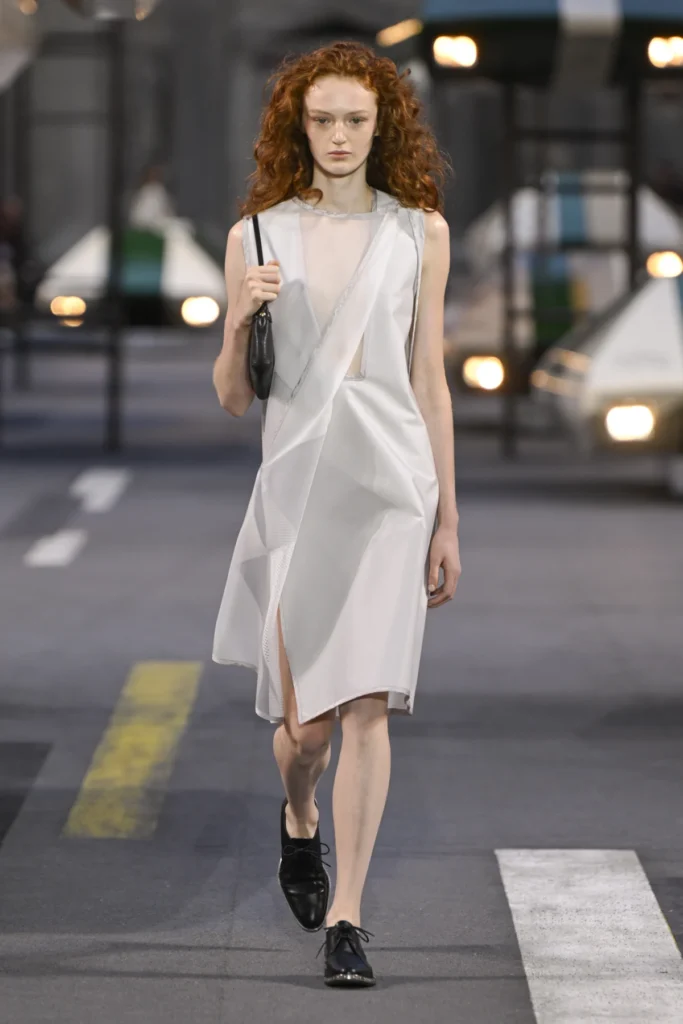
For the fashion elite gridlocked in the perennial, snarling traffic of Paris Fashion Week, the promise of flying taxis—summoned via a simple smartphone tap—is less of a science-fiction fantasy and more of a desperate, long-overdue necessity. It was this intersection of urban frustration and futuristic aspiration that served as the backdrop for Nicolas Ghesquière’s latest outing for Louis Vuitton, a collection that managed to marry the heavy machinery of tomorrow with a whisper-light aesthetic of today.
A Cinematic Vision: The Cour Carrée Transformed
The setting was nothing short of monumental. Within the vast, historic expanse of the Louvre’s Cour Carrée, Ghesquière constructed an immersive environment that felt like a bridge between eras. Dozens of windowless, wedge-shaped vehicles were suspended high above the asphalt catwalk, their 1970s-inspired headlights and brake lights glowing with a retro-futuristic charm. Along the perimeter of these vertical traffic lanes, navigation antennas blinked with a rhythmic, pulsing red light—a visual homage to the dystopian aesthetics of Blade Runner.
This was not merely a set; it was a narrative device. By placing the audience in a reimagined, congested metropolis, Ghesquière established a clear thematic tension: how does one remain free, mobile, and unencumbered in a world that is increasingly turbulent and literally overheating? The answer, according to the designer, lies in the architecture of the clothes themselves.
Chronology of a Collection: From Armor to Air
Nicolas Ghesquière has long been recognized as the high priest of structural fashion. Throughout his tenure at Louis Vuitton, he has challenged the body with "robot leggings," "Lego" footwear, industrial-grade neoprene tops, and stiff, regal capes inspired by traditional kepenek. He is a designer who has mastered the art of the silhouette through rigidity.
"I’m a specialist in armor for a long time," Ghesquière remarked with a knowing chuckle during a pre-show preview, acknowledging the radical shift in his design philosophy for this season.
This collection marked a pivot—a deliberate departure from the protective, heavy-duty aesthetic that defined his previous work. Instead of imposing structure, Ghesquière sought to facilitate movement. The show began with a series of looks that seemed to drift down the runway rather than march, signaling a new chapter for the house that values fluidity over fortification.
The Engineering of Lightness
While the collection presented an air of breezy, almost effortless minimalism, Ghesquière was quick to dispel the notion that "simple" meant "easy."
"I wanted to express a sensation of simplicity—a quest for purity somehow," the designer explained. "The idea of lightness, of fluidity is very important with this collection."
To achieve this, the Louis Vuitton atelier engaged in an exhaustive period of research into fabric science and technical engineering. During the preview, Ghesquière produced a fabric card from a simple sheet protector, revealing a scarf-weight, checkered cashmere. This material, which possesses the tactile qualities of a cloud, was utilized for double-face coats that defied standard industry logic.
The technical data behind the collection is staggering: many of the outer layers and double-face garments were constructed from fabrics thinner than traditional chiffon. According to Ghesquière, several of the coats presented on the runway weighed less than a standard cotton T-shirt. This is not merely a design choice; it is a profound engineering feat that requires the precise fusion of high-performance textiles and traditional couture construction.
The Aesthetic Shift: Approachability and Fluidity
The collection was undeniably one of the most approachable, wearable, and undeniably pretty collections to emerge from the Louis Vuitton atelier in recent memory. By leaning into familiar garment archetypes—the classic three-hole dress, the oversized cardigan, the blouson, and the reefer coat—Ghesquière grounded the collection in reality before elevating it with his signature technical rigor.
The color palette was intentionally restrained, dominated by faint, washed-out tones. Prints were kept small, blurred, or obscured, ensuring that the focus remained on the movement of the fabric rather than the pattern. For the observant attendee, the true mastery was found in the details:
- Textural Innovation: Leather blousons featured dimpled, tactile surfaces that invited touch.
- Subtle Geometry: Tailoring was largely executed in jersey and knit fabrics, allowing the garments to bounce, shudder, and sway with the model’s stride.
- Integrated Utility: Closer inspection revealed that many of the gauzy shift dresses and slinky trousers incorporated fine mesh panels, providing both aesthetic interest and thermal regulation—a nod to the "overheating world" referenced in the show’s concept.
Implications for the Future of Luxury
The implications of this collection are twofold: they speak to both the immediate needs of the fashion consumer and the long-term trajectory of the Louis Vuitton brand.
1. The Death of the "Heavy" Luxury Aesthetic
Historically, luxury has been associated with weight—thick wools, heavy leathers, and elaborate, cumbersome embellishments. Ghesquière’s pivot suggests that the future of luxury lies in the "invisible" performance of the garment. In an era where consumers are increasingly conscious of comfort and versatility, the ability to create a garment that offers the prestige of a heritage house while maintaining the weightlessness of a second skin is the new gold standard.
2. Sustainability and Technical Progress
While the show leaned heavily on the imagery of urban congestion, the message was one of liberation. By focusing on lightweight fabrics and complex construction that reduces material mass, Ghesquière is subtly nodding toward a more sustainable future—one where less is significantly more. The "quest for purity" he spoke of is a direct challenge to the excess that has defined fashion for decades.
3. The Designer as an Urban Planner
By using the Louvre as a space to interrogate the problems of the modern city, Ghesquière has solidified his role not just as a couturier, but as a cultural commentator. His clothes are no longer just armor; they are tools for navigation. As we look toward a future where our cities may indeed be filled with flying vehicles and autonomous systems, Ghesquière’s vision suggests that our fashion must evolve to match the speed and fluidity of our environment.
Final Reflections: Defying Gravity
As the final model exited the Cour Carrée, the juxtaposition remained: the brutalist, wedge-shaped vehicles hovering in the air above, and the ethereal, paper-thin clothes drifting across the pavement below. The show was a masterclass in balance.
Nicolas Ghesquière has managed to do the impossible: he has evolved his signature architectural style without abandoning it. He has taken the "armor" he is so famous for and stripped away the weight, proving that one can remain protected and poised even in a world that feels increasingly unmanageable.
This collection was not just a parade of garments; it was an act of defiance against the gravity of the modern condition. By prioritizing the sensation of lightness, Ghesquière has provided a blueprint for a future where fashion—and perhaps the city itself—can move with the grace and agility that our complex world demands. In the end, Louis Vuitton has not only captured the zeitgeist of a shifting urban landscape but has also reminded us that, even when the world feels heavy, true luxury is the ability to float.



