Introduction: The Invisible Shield of Global Trade
The global economy relies on a fragile, invisible web of maritime supply chains. With over 80% of global trade volume transported by sea, the safety of shipping lanes is not merely a logistical concern—it is a cornerstone of geopolitical stability. However, lurking in the shadows of major shipping corridors, the threat of maritime piracy and armed robbery remains a persistent, evolving danger.
Since its inception in 1991, the International Chamber of Commerce (ICC) International Maritime Bureau’s (IMB) Piracy Reporting Centre (PRC) has functioned as the industry’s primary sentinel. Operating as a 24-hour nerve center, the PRC provides a critical safety net for mariners, serving as a clearinghouse for threat intelligence and a catalyst for international response. As modern piracy shifts in tactics and geographical focus, the role of the PRC has never been more consequential.
The Genesis and Evolution of the IMB Piracy Reporting Centre
The establishment of the PRC in 1991 was a reactionary necessity to a surge in violent maritime crime that threatened the safety of crew members and the viability of international commerce. Before the center’s existence, reporting mechanisms were fragmented, leading to delayed responses and a lack of consolidated data.
H3: A 24-Hour Sentinel
The PRC operates on the principle that information is the most potent weapon against piracy. By maintaining a constant, 24-hour watch, the center ensures that when a ship comes under threat, the distress signal is not lost in a bureaucratic void. The PRC’s primary mandate is twofold:
- Immediate Support: Coordinating with regional response agencies, navies, and coast guards to dispatch assistance to vessels in distress.
- Intelligence Dissemination: Broadcasting real-time warnings to ships in high-risk zones, allowing captains to adjust routes and implement "Best Management Practices" (BMP) to mitigate risks.
Chronology: Thirty Years of Maritime Defense
To understand the current landscape of piracy, one must look at the evolution of the threat over the past three decades.
- The 1990s: The Rise of the PRC: Founded in the wake of escalating incidents in Southeast Asia, the PRC quickly became the gold standard for incident tracking. It provided the first comprehensive, reliable data set that governments could no longer ignore.
- The 2000s: The Somali Crisis: This decade witnessed the most dramatic spike in piracy in modern history. The PRC played a pivotal role during the peak of Somali piracy (2008–2012), acting as the primary hub for coordinating between private owners and international naval coalitions.
- The 2010s: The Gulf of Guinea and Southeast Asian Complexity: As Somali piracy waned due to increased naval presence, the focus shifted to the Gulf of Guinea, where kidnapping for ransom became a lethal business model. The PRC’s data collection during this period highlighted the shift from hijacking ships for cargo to kidnapping crew members for profit.
- 2020–Present: Technological Adaptation and Current Threats: Today, the PRC is at the forefront of tracking how modern pirates use technology—ranging from sophisticated communication jamming to the utilization of faster, more agile craft—to target unsuspecting vessels.
Supporting Data: Why Reporting is the First Line of Defense
The IMB’s data is not merely a record of crime; it is a tactical map for the maritime industry. The PRC urges all shipmasters and owners to report every incident—whether it is a successful hijacking, a failed attempt, or even a suspicious sighting.
H3: The Data-Driven Approach to Security
When a captain reports an incident, that data point enters a global matrix. The PRC uses this information to:
- Allocate Resources: By identifying "hotspots," the PRC provides evidence-based recommendations to national authorities, encouraging them to increase patrols in specific zones.
- Identify Trends: Is the piracy occurring at anchor or while underway? Are the attackers armed with knives or automatic weapons? This granular data allows the shipping industry to tailor its defensive measures.
- Public Awareness: By publishing the "Piracy and Armed Robbery Against Ships" report, the PRC holds coastal states accountable, ensuring that the international community is aware of where maritime law enforcement is failing.
Key Insight: The IMB emphasizes that under-reporting is the pirate’s best friend. When shipowners fear that reporting will lead to increased insurance premiums or delays, the lack of data emboldens criminals to target the same routes repeatedly.
Official Responses and Strategic Collaboration
The IMB does not work in isolation. The PRC serves as a bridge between the private sector and intergovernmental organizations.
H3: Bridging the Gap Between Industry and State
The PRC works closely with the International Maritime Organization (IMO) and regional maritime security centers. When the PRC issues an alert, it is often the precursor to a coordinated naval response. Director Michael Howlett has consistently emphasized that the PRC’s success is built upon the voluntary cooperation of the global merchant fleet.
"The reporting center is only as effective as the information it receives," notes the IMB. "Every master who takes the time to report an incident is helping to protect the next ship that passes through those waters."
Implications: The Future of Maritime Security
As we look toward 2025 and beyond, the maritime environment is becoming increasingly complex. The rise of autonomous shipping and the digitization of maritime logistics present new vulnerabilities that pirates may eventually look to exploit.
H3: The Human Cost of Piracy
Beyond the financial losses, the primary concern of the IMB is the human element. The psychological trauma experienced by crew members held hostage, the physical injuries sustained in boardings, and the fear of operating in high-risk zones are the true costs of maritime insecurity. The PRC’s advocacy for the safety of seafarers remains the guiding principle of all its operations.
H3: Maintaining Global Trade Integrity
If piracy is left unchecked, the implications are immediate:
- Supply Chain Inflation: Increased insurance premiums and the need for private armed security teams raise the cost of shipping, which is ultimately passed on to consumers.
- Environmental Risk: An unmanned, drifting ship (the result of a hijacking) poses an catastrophic environmental threat to coastlines if it runs aground or suffers a cargo spill.
- Geopolitical Instability: Piracy often thrives in states with weak governance. By documenting these incidents, the IMB assists the international community in identifying regions that require maritime capacity-building assistance.
Call to Action: The Responsibility of the Maritime Community
The fight against piracy is not a battle that can be won by a single entity. It requires a unified front involving shipowners, flag states, naval forces, and international regulators.
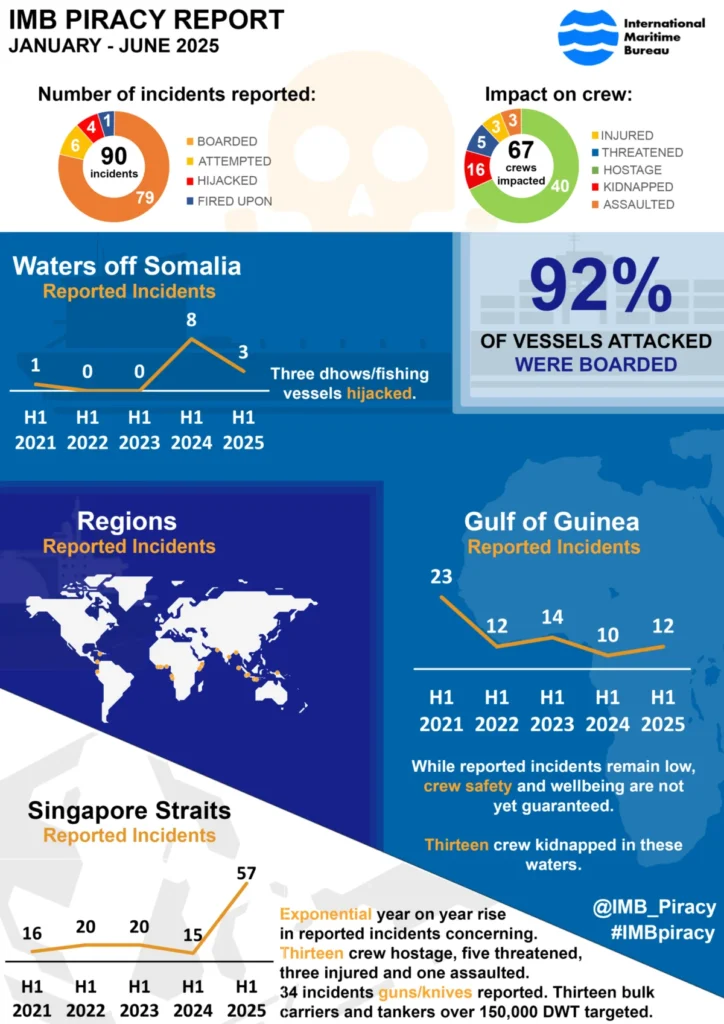
The recent 2025 Jan – June Piracy and Armed Robbery Against Ships report is a testament to the ongoing nature of this struggle. By reviewing the data contained in these reports, stakeholders can gain a clearer understanding of the threats currently posed to their fleets.
How to Contribute:
- Report: Ensure your bridge teams are trained to contact the IMB PRC immediately upon any suspicious activity or incident.
- Stay Informed: Regularly review the IMB’s quarterly reports to update your Vessel Security Plan (VSP).
- Engage: Reach out to the IMB for specific guidance on high-risk routes.
For those looking to deepen their understanding of current trends, the IMB invites all interested parties to request a copy of the 2025 Jan – June Piracy and Armed Robbery Against Ships report here.
Conclusion: A Vigilant Future
The IMB Piracy Reporting Centre stands as a beacon of resilience in an often-unforgiving maritime environment. For over three decades, it has evolved from a simple reporting hub into an essential component of the global security architecture. By facilitating real-time communication, providing expert analysis, and acting as a persistent voice for the safety of seafarers, the PRC ensures that the high seas remain a viable conduit for the world’s prosperity.
As maritime threats evolve, so too will the IMB. But the core mission remains unchanged: to protect the ships, the crews, and the trade that keep the world moving.
For more information, please contact:
Michael Howlett
Director, ICC International Maritime Bureau
Tel: +44 207 423 6960
Email: [email protected]
Website: icc-ccs.org