In a stunning revelation that challenges our understanding of West African marine biodiversity, an underwater ecosystem long considered a relic of the past has been found thriving off the coast of Benin. For over 60 years, the scientific community operated under the assumption that a deep-water coral reef, first documented in the 1960s, was a dead, barren structure. Modern exploration, however, has proven that the reef is not only alive but serves as a vibrant, functioning hub for marine life.
This discovery, detailed in the journal Frontiers in Marine Science, marks a significant milestone in oceanography, suggesting that the Gulf of Guinea may hold far more biological treasures than previously documented.
A Chronology of Rediscovery: From 1960s Surveys to Modern Tech
The story of this reef began in the mid-20th century, during a period when West African coastal waters were being mapped primarily to identify productive fishing grounds. Researchers at the time identified anomalous, hard-bottom structures deep below the surface. Based on the limited technology of the era, the consensus was grim: the reef was likely a "dead" formation, a skeletal remnant of a past ecosystem that had succumbed to changing environmental conditions.
For six decades, that conclusion remained unchallenged in the literature. It wasn’t until a modern team, led by Gérard Zinzindohoué of the Institut de Recherches Halieutiques et Océanologiques du Bénin, decided to re-examine these historical data points that the narrative shifted.
The Modern Expedition
The mission was fraught with the typical rigors of deep-sea exploration. The team faced technical hurdles, unpredictable weather, and the inherent anxiety of searching for a needle in a haystack of oceanic data. Utilizing advanced sonar, the researchers began by scanning 11.5 kilometers of the seafloor, tracing the coordinates provided by the 1960s surveys.
"It was a mix of long days at sea, technical problems, and a lot of uncertainty," Zinzindohoué recalled. "But then we saw structures on the sonar that looked like they could be reef signatures, which gave us hope that we were close."
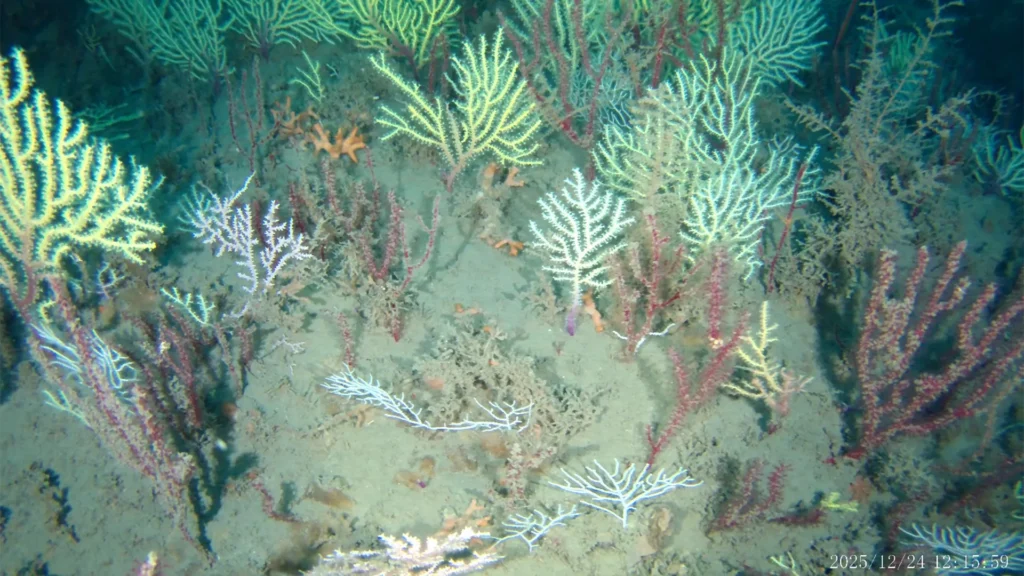
The breakthrough came when the team deployed an underwater drone equipped with the National Geographic Exploration Technology Lab’s Deep Sea Camera System. As the high-definition footage flickered to life on the monitors, the team witnessed what they had long suspected but dared not assume: a living, breathing coral community.
Supporting Data: The Mesophotic Marvel
The discovery challenges the traditional binary view of "dead vs. alive" reefs. Zinzindohoué and his colleagues suggest that the site is actually a mesophotic coral ecosystem (MCE). Unlike shallow-water reefs that rely heavily on direct sunlight for photosynthesis, mesophotic reefs exist in "twilight zones"—deeper waters where light is limited.
Characteristics of the Ecosystem
- Patchy Distribution: Rather than forming a singular, continuous wall of coral, these ecosystems often manifest as fragmented, patchy communities distributed across rocky sections of the seafloor where conditions are optimal for growth.
- Biodiversity Hotspot: During their visual surveys, the researchers identified eight distinct types of coral. These structures are not isolated; they support a complex web of life. The team documented eight species of fish relying on the reef for shelter and foraging, including:
- Golden African snappers
- Blackbar soldierfish
- Guinean angelfish
- West African goatfish
- Monrovia doctorfish
- Three-banded butterflyfish
- Two distinct species of damselfish
The presence of these species confirms that the reef is not merely a biological curiosity but a vital habitat that sustains local marine populations.
Official Responses and Scientific Context
The scientific community has greeted the news with a mixture of excitement and cautious academic rigor. While the visual evidence is compelling, the researchers are the first to emphasize that this is only the "first chapter" of the story.
"To our knowledge, this is the first confirmed record of a living mesophotic coral ecosystem on the Gulf of Guinea continental shelf," said Zinzindohoué. However, he remains modest about the implications, noting that the existence of this reef is likely not a freak occurrence but a symptom of scientific oversight.
"I think what we found is probably not an exception," he explained. "It is more likely a reflection of how little we still know about coastal regions in West Africa and elsewhere. If we were able to find this reef again after 60 years, how many others are still undocumented or simply forgotten?"
The Need for Rigorous Verification
The team has issued a call for further study. Because they have yet to collect physical samples of the corals, the current identifications are based solely on visual analysis. Furthermore, there is a lingering mystery: were these corals actually dead in the 1960s and underwent a miraculous recovery, or were the original surveyors simply mistaken in their assessment of the site’s health? Answering these questions will require longitudinal study and chemical analysis of the reef’s structure.
Implications: A Potential 40-Kilometer Archive
Perhaps the most tantalizing aspect of the discovery is the scale of what might remain hidden. The 1960s reports hinted at a potential coral barrier extending nearly 40 kilometers parallel to the Benin coast. The recent expedition only surveyed a small, targeted fraction of this area.
Future Research Objectives
If funding and resources allow, the research team aims to transition from exploratory surveys to a comprehensive scientific diving and sampling program. The goals are multifaceted:
- Mapping the Full Extent: Determining if the reef truly spans the rumored 40-kilometer stretch.
- Historical Reconstruction: Studying the growth rings and skeletal records of the coral to understand how the regional ocean climate has evolved over the last century.
- Conservation Policy: Identifying these reefs is the first step toward providing them with legal protection, ensuring that industrial activities like fishing or dredging do not destroy these newly "discovered" habitats.
"For me, the most exciting part is about understanding the reef’s history," Zinzindohoué noted. "It feels like we have only just started to read an archive that has been there for a very long time."
Conclusion: The Final Frontier Beneath the Waves
The rediscovery of the Benin reef serves as a humbling reminder of the limitations of human knowledge. In an age of satellite imagery and global connectivity, the depths of the ocean remain one of the final true frontiers. This "lost" ecosystem, hidden in plain sight, suggests that our maps of the world’s biodiversity are far from complete.
As researchers prepare for future expeditions, the scientific world watches with bated breath. Whether this reef is a solitary survivor or part of a vast, interconnected network of West African coral systems, its return to the map is a victory for conservation. It proves that nature is often more resilient than we give it credit for—provided we are willing to look closely enough to find it.
The challenge now is to balance the excitement of discovery with the responsibility of stewardship. As we continue to uncover these "forgotten" archives of the ocean, we must ensure that the next sixty years are defined not by silence and neglect, but by active protection and enlightened understanding. The Gulf of Guinea has finally begun to share its secrets, and the scientific community is listening intently.