

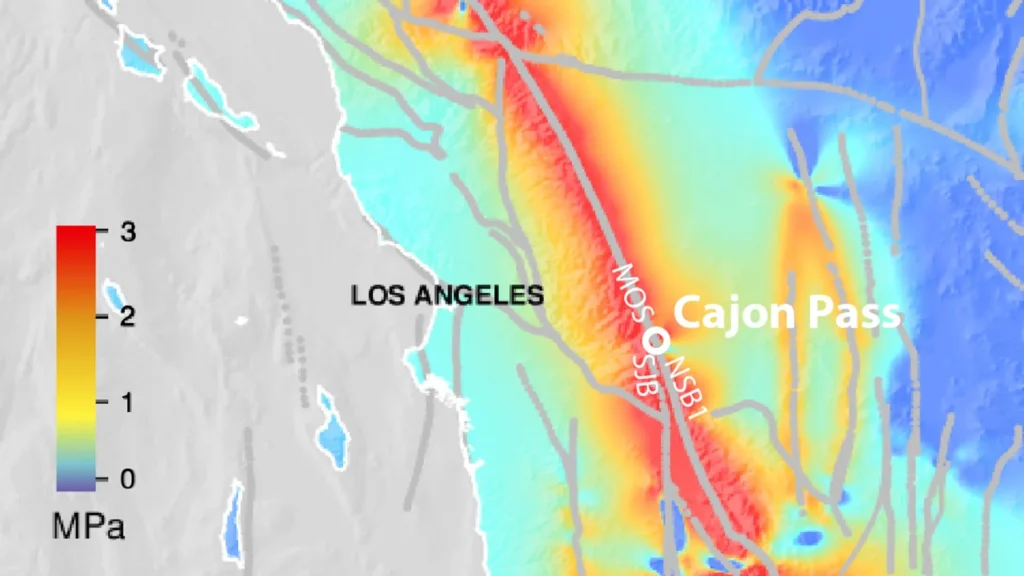
Southern California sits atop one of the most volatile and closely scrutinized tectonic landscapes on the planet. For decades, the region has been a focal point for geologists and seismologists attempting to solve a singular, high-stakes puzzle: how the San Andreas and San Jacinto fault systems interact to produce the next "Big One."
New research, published in the Journal of Geophysical Research: Solid Earth, has provided a chilling assessment of this geological tension. Led by Dr. Liliane Burkhard of the University of Bern’s Division of Space Research and Planetary Sciences, an international team of scientists has reconstructed 1,000 years of seismic history. Their findings indicate that tectonic stress in the fault network surrounding the Cajon Pass—a critical junction northeast of Los Angeles—has reached, and in some segments surpassed, the highest levels recorded in the past millennium.
The Anatomy of a Geological Junction
To understand the gravity of these findings, one must first understand the mechanism of the "earthquake gate." Earthquakes occur when tectonic plates, moving at a glacial pace, become locked against one another. As they remain stuck, elastic strain energy accumulates deep within the Earth’s crust. When the frictional strength of the fault is finally overcome, that stored energy is released in a sudden, violent rupture.
The San Andreas and San Jacinto faults act as the primary conduits for this energy in Southern California. While they operate as distinct systems, they converge at the Cajon Pass. This junction is not merely a geographic point; it is a complex geological nexus. Depending on the specific stress distribution at the time of a rupture, the Cajon Pass can act as either a firewall—halting a rupture in its tracks—or a bridge, allowing a seismic event to leap from one fault system to the other.
A Millennium of Seismic Data: A Chronology of Stress
The research team utilized a physics-based, four-dimensional earthquake cycle model to reconstruct the evolution of stress in the region. This simulation does not merely map the fault in 3D space; it tracks the temporal evolution of stress, accounting for how individual ruptures alter the strain on neighboring segments and how the deeper, more ductile layers of the crust slowly relax over centuries.
Building the 1,000-Year Record
The accuracy of the model rests on a multi-disciplinary approach to gathering historical data. The team synthesized evidence from:
- Radiocarbon Dating: Analyzing organic material trapped in past seismic ruptures.
- Dendrochronology: Examining tree rings that record evidence of sudden shifts or traumatic growth patterns following ground displacement.
- Historical Documentation: Integrating records of surface-rupturing events that have been documented since the late 18th century.
By inputting this data, the researchers were able to "run" the history of Southern California as a digital simulation. This allowed them to see exactly how the region moved from a post-earthquake state of relaxation to its current, highly pressurized condition.
The Significance of the "Quiet Period"
The Los Angeles region has been remarkably quiet since the massive magnitude 7.9 Fort Tejon earthquake of 1857. While this period of relative inactivity has allowed for the expansion of one of the world’s most dense urban centers, it has also provided the necessary time for tectonic stress to reach critical, historical extremes. According to the study, we are currently living in a state of high-pressure accumulation that has no recent precedent in the last thousand years.
Supporting Data: Measuring the Megapascals
The researchers quantified this risk using megapascals (MPa), a unit of mechanical stress. The findings provide a stark metric for the potential energy currently pent up beneath the surface.
- The San Jacinto-Bernardino Section: The model estimates current stress at 3.6 MPa, the highest value recorded in the entire 1,000-year simulation.
- The Mojave South Section (San Andreas): Stress levels here are estimated at 2.8 MPa.
The critical insight here is not just the absolute magnitude of the stress, but the correlation between the two segments. When both fault systems are highly stressed simultaneously, the likelihood of a "through-going" event—where an earthquake jumps the Cajon Pass to rupture both systems—increases significantly. The current configuration mirrors the conditions present before major, multi-fault ruptures in the distant past.
The "Earthquake Gate" Mechanism
The study highlights that the Cajon Pass is not a passive feature. Its behavior is entirely dependent on the "stress environment" of the faults entering it.
Historical events confirm this fluidity:
- The 1857 Fort Tejon Earthquake: A massive rupture that propagated along the San Andreas but stopped at the Cajon Pass, sparing the San Jacinto fault.
- The 1812 Wrightwood Earthquake: A more catastrophic scenario where the rupture successfully navigated the junction, engaging both fault systems in a single, continuous event.
Dr. Burkhard notes that the "earthquake gate" concept is vital because it explains why some earthquakes are contained while others escalate. Because both the San Andreas and San Jacinto systems are now simultaneously reaching historic levels of stress, the physical "path of least resistance" for a future rupture may now lie directly through the gate, connecting the two systems.
Implications for the Los Angeles Basin and Beyond
A multi-fault rupture would have consequences far exceeding a standard earthquake. If a seismic event were to traverse the Cajon Pass, it would affect a significantly larger geographic footprint, encompassing the greater Los Angeles area, San Bernardino, Riverside, and the Coachella Valley.
Infrastructure Vulnerability
The Cajon Pass is not only a geological gate; it is a critical artery for modern civilization. It serves as a major corridor for:
- Interstate Highways: Primary transit routes for freight and emergency vehicles.
- Rail Infrastructure: Essential for the national supply chain.
- Energy and Utility Lines: High-voltage power grids and natural gas pipelines that supply Southern California.
A rupture at this junction would not only trigger ground shaking of potentially catastrophic magnitude but could also sever the lifeblood of the region’s infrastructure, complicating recovery and emergency response efforts for months or even years.
Expert Perspectives and Official Interpretation
While the findings are sobering, the scientific community is careful to distinguish between "critical stress" and "imminent danger."
The researchers explicitly state that this study is not a prediction. "We cannot use this information to determine a date for an earthquake," Dr. Burkhard emphasizes. "What we can say is that the system is critically stressed, and that physics-based models give a clearer picture of the range of scenarios we should be prepared for."
The United States Geological Survey (USGS) and other partnering institutions view this model as a tool for "hazard assessment." By identifying the physical plausibility of multi-fault ruptures, urban planners and emergency management agencies can better calibrate their seismic retrofitting programs and disaster response drills.
Why This Matters for Policy
The framework developed by the University of Bern team is globally significant. It provides a blueprint for studying complex fault junctions in other regions, such as the North Anatolian Fault in Turkey or the Alpine Fault in New Zealand. By shifting the focus from "when" an earthquake will occur to "how" the system will respond under specific conditions, scientists are providing policy-makers with a more nuanced roadmap for resilience.
Conclusion: Preparing for the Plausible
The study serves as a scientific wake-up call. We are currently residing in a historical window where the tectonic landscape of Southern California is primed for a complex, multi-fault event.
While the exact timing of such an event remains hidden by the complexities of deep-crustal physics, the nature of the threat has been illuminated with greater clarity than ever before. The "earthquake gate" at Cajon Pass stands as a reminder that geological time does not care for human infrastructure. As the state of stress continues to hover at record highs, the onus remains on the scientific, political, and civil communities to prioritize the structural integrity and emergency preparedness of the region.
The message from the research is clear: The fault system is not just waiting; it is loaded. Understanding the "gate" that connects these systems is the first step toward surviving the day that this energy is finally, and inevitably, released.



