In 2024, the average U.S. electricity consumer experienced 11 hours of power outages, a significant uptick from the eight-hour average recorded in 2020. While these statistics aggregate data across apartments, suburban tract homes, and small businesses, the luxury residential sector is feeling the strain of an aging, increasingly unstable power grid more acutely than ever. For owners of sprawling estates and high-value properties, a standard "off-the-shelf" residential generator is no longer sufficient to maintain the lifestyle, security, and infrastructure they demand.
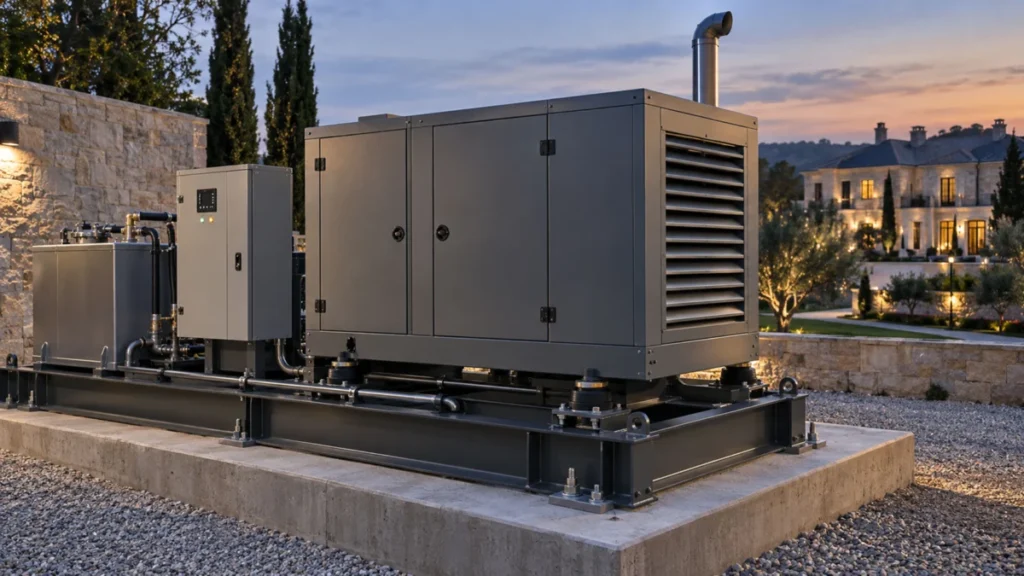
As a result, luxury home builders and estate managers are turning to a solution previously reserved for industrial and municipal facilities: the modular, skid-mounted backup power system. These factory-tested, integrated power plants—complete with generators, fuel systems, and sophisticated switchgear—are redefining how the most complex properties handle the volatility of the modern electrical grid.
The Limits of Residential Hardware
For decades, the standard for residential backup power has been air-cooled, retail-grade generator units. These systems are engineered for a specific, limited load profile: a refrigerator, a few lighting circuits, and perhaps a single HVAC compressor. Retail sizing worksheets often rely on the assumption that homeowners will accept "load-shedding"—a process where non-essential circuits are automatically cut to prevent the generator from stalling.
However, the modern luxury estate operates under a different reality. In these homes, there is no such thing as a "sheddable load." When a severe storm hits, the secondary professional-grade kitchen remains in use; the elevator must stay operational to ensure accessibility for all residents; and climate-controlled wine cellars, sump pumps, and sophisticated security systems cannot afford even a momentary lapse in power. When these demands are tallied, the required output quickly surpasses the capabilities of residential-grade hardware, pushing the project into the territory of light industrial power generation.
Chronology: From Field-Assembled to Factory-Integrated
The traditional construction model for backup power has long been a logistical nightmare for general contractors. It typically involved the procurement of separate components—the generator unit, the automatic transfer switch (ATS), fuel piping, and control cabinets—which would arrive on-site at different times.
The Traditional "Loose" Approach
- Procurement: Contractors would source components from various manufacturers, leading to fragmented supply chains and potential compatibility issues.
- On-Site Integration: Skilled electricians and mechanical contractors would spend weeks on-site attempting to wire, plumb, and program these disparate parts.
- Commissioning: Testing would occur only after the final connection, often leading to "discovery" of fault codes or integration failures during the final phase of construction—just as the owner is pushing for a certificate of occupancy.
The Modern Modular Shift
Today, the industry is pivoting toward the skid-mounted model. This approach moves the "heavy lifting" of integration upstream. A modular builder constructs the entire system on a single, welded steel frame. The generator, fuel day tank, switchgear, and complex controls are pre-wired and factory-tested as a single, cohesive unit. This shifts the project’s risk profile: instead of a "stick-built" installation prone to field errors, the builder receives a turn-key solution that arrives ready for utility connection.
Supporting Data: The Case for Industrial-Grade Resilience
The shift toward industrial-grade solutions is driven by three primary challenges that have become endemic to the modern estate.
1. The Multi-Service Entanglement
Many modern estates are not single buildings but "compounds." They feature a main residence, guest quarters, pool houses, barns, and staff accommodations—often served by individual utility meters. Managing a separate backup system for each structure is inefficient, resulting in multiple service contracts, disparate fuel management systems, and a lack of centralized control. A single, high-capacity skid-mounted system allows for one central hub, one fuel tie-in, and one point of maintenance, significantly reducing the complexity of long-term estate management.
2. Fuel Infrastructure as a Primary Engineering Challenge
On large-acreage properties, the lack of a municipal natural gas main often forces reliance on diesel or propane. Sizing these fuel systems is not a matter of guesswork. Engineers must adhere to strict guidelines like NFPA 110, which mandates fuel storage capacity at 133% of the volume required for the system’s class interval. Modular builders integrate the day tank, transfer pumps, and leak-detection systems directly onto the skid. This ensures the mechanical integrity of the fuel delivery system is verified before it ever reaches the job site.
3. The EV Charging Revolution
The proliferation of electric vehicles has fundamentally rewritten the residential load sheet. A garage equipped with two 48-amp Level 2 chargers draws more continuous power than the rest of the house combined. Many existing backup systems are entirely unprepared for this surge; a generator that worked perfectly three years ago may now trip the moment the vehicle chargers activate. Integrating power management software and load-priority logic into a centralized skid-mounted system allows for real-time monitoring and dynamic load balancing that simple residential units simply cannot replicate.
Official Industry Perspectives
"The risk in custom home building is almost always found in the final 10% of the project," says a lead consultant for high-end residential mechanical systems. "When you have a generator sitting on the critical path, you cannot afford a field-integration failure during the final walkthrough. By moving the generator and its control logic to a factory-tested skid, we effectively eliminate that site-level uncertainty."
Furthermore, trade associations have begun to emphasize the importance of "commissioning" in residential settings. As estates become more akin to small microgrids, the need for professional, documented testing protocols—once reserved for hospitals and data centers—is becoming the new standard for luxury property management.
Strategic Implications for the Builder
The adoption of modular power systems has profound implications for the construction timeline. By pulling the integration work into a factory environment, the builder reduces their site-based liability.
- Schedule Predictability: The site crew is responsible only for concrete pad preparation, trenching, and utility tie-ins. The "critical path" is no longer threatened by a shortage of specialized labor or faulty field-integrated components.
- Warranty and Maintenance: For the owner, the benefits are clear. Instead of navigating warranties across four or five different manufacturers for switches, engines, and fuel pumps, they have a single, unified warranty and one support contact.
- Future-Proofing: Modular systems are often designed with "headroom" in mind. As an estate adds solar arrays, battery storage, or additional EV charging capacity, the pre-engineered nature of these systems allows for easier integration of future energy upgrades.
Conclusion: The New Standard of Luxury
As the frequency of grid instability continues to rise, the definition of a "luxury home" is evolving. It is no longer just about the quality of the finishes or the square footage; it is about the resilience of the systems that power that lifestyle.
The transition to industrial-grade, skid-mounted backup power systems represents a maturation of the residential construction market. By prioritizing factory-tested reliability over the simplicity of retail-grade products, architects and builders are ensuring that the modern estate is not only beautiful but truly independent. In an era where power is the most essential utility, the "modular skid" is rapidly becoming the gold standard for those who demand total peace of mind.