

Introduction: A Window into Ancient Defenses
The shifting sands of Egypt’s Beheira Governorate have once again parted to reveal a profound chapter of the New Kingdom’s history. The Egyptian Ministry of Tourism and Antiquities announced this Wednesday the discovery of significant archaeological remains at the Tell Al-Abqain site, a location that served as a critical bastion of defense during the zenith of the Pharaonic era.
Spanning the years 1570 to 1069 BCE, the New Kingdom was a period defined by imperial expansion and the constant need to secure Egypt’s borders against external threats. Tell Al-Abqain stands as a silent sentinel of this era, established primarily as a military stronghold to repel incursions by nomadic Libyan tribes. However, as the latest excavations by a dedicated Egyptian archaeological mission suggest, this site was far more than a mere garrison; it was a thriving, self-sufficient community that integrated military discipline with the complexities of civilian urban life.
Chronology and Strategic Context
To understand the significance of Tell Al-Abqain, one must look at the geopolitical climate of the Nineteenth Dynasty. During this period, the western frontier of the Nile Delta was a porous and volatile zone. The Libyan tribes, particularly the Meshwesh, frequently sought to penetrate the fertile lands of the Delta, necessitating a robust defensive infrastructure.
Tell Al-Abqain was part of a sophisticated network of fortresses designed to function as an early warning system and a logistical hub for the Egyptian military. The archaeological evidence recovered during the current season reinforces the site’s role as a primary defensive node. By analyzing the structural layers and the recovered artifacts—such as the stela of King Merneptah—archaeologists have confirmed that the fortress remained a vital strategic asset throughout the reigns of some of Egypt’s most powerful rulers, including Ramesses II and his successor, Merneptah.
Supporting Data: An Urban Blueprint Unearthed
The most striking revelation of the current excavation is the sophistication of the fortress’s internal urban planning. Unlike temporary military encampments, Tell Al-Abqain was a permanent, well-organized settlement.
The Residential Complex
Archaeologists have uncovered a massive mudbrick residential complex connected directly to the fortress’s southern entrance. The layout of this area indicates a clear understanding of civic design. A main thoroughfare, running east-to-west, serves as the spine of the residential sector, intersected by a secondary road running north-to-south. This grid-like pattern suggests that the inhabitants were not merely soldiers living in barracks, but a society with established residential zones, suggesting a long-term habitation model.
Resource Management and Daily Life
The site provides a rare glimpse into the logistical reality of maintaining a frontier outpost. The discovery of grain storage silos and cylindrical pottery ovens indicates that the fortress was designed to be self-sustaining. By managing its own food production, the garrison reduced its dependence on long-distance supply lines, which were vulnerable to sabotage.
Adjacent to the southeastern corner of the fortress, excavators unearthed a series of residential chambers situated near previously identified wells. This proximity to water sources is evidence of a highly organized resource management system, ensuring that both the military garrison and the civilian support staff—families, artisans, and laborers—had consistent access to the most vital of all resources.
The Mystery of the Equine Burial
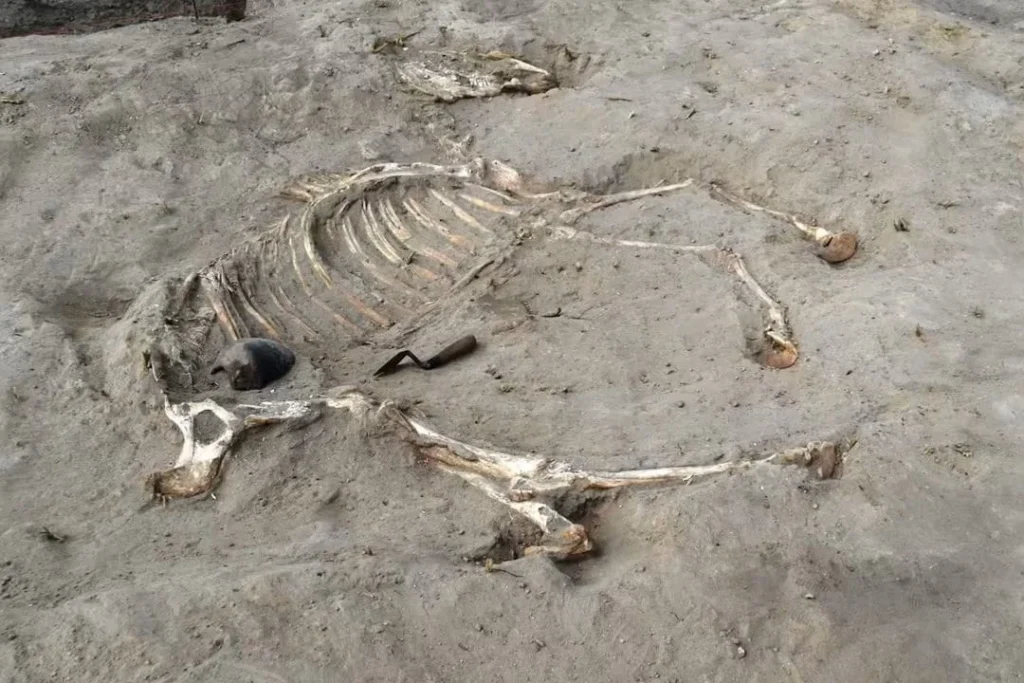
Perhaps the most anomalous and compelling find of the season is the ceremonial burial of a young male horse. In the context of Ancient Egypt, the horse was a symbol of elite status, military prowess, and the technological edge provided by the chariot.
The animal, described by the excavation team as possessing physical traits indicative of speed and agility, appears to have been treated with a level of care typically reserved for high-ranking companions. The presence of decorative harness fittings buried alongside the intact remains suggests that this was not a simple disposal of a draft animal, but a deliberate, honorific interment. This discovery raises fascinating questions: Was the horse a prized mount of a commander? Was it a sacrificial offering meant to protect the fortress? Or does it represent a deeper, perhaps ritualistic, cultural connection between the cavalry and the military elite of the period?
Epigraphic Evidence: The Power of the Pharaohs
The written record unearthed at Tell Al-Abqain bridges the gap between archaeology and history, providing a narrative of the site’s prestige.
The Stela of Merneptah
Among the most vital finds is a limestone stela fragment linked to the Nineteenth Dynasty ruler Merneptah, the son of Ramesses II. The hieratic text inscribed on the stone is a testament to royal propaganda and military ideology. It characterizes the king’s power by comparing it to that of Seth, the god of chaos, storms, and war—a fitting deity for a military fortress. This serves as a reminder that these outposts were also theaters of ideological warfare, intended to instill fear in encroaching enemies and pride in the soldiers who served there.
Royal Identity and the Libyan Threat
A second stela fragment displays the birth name, throne name, and Horus name of Ramesses II. The presence of the name of "Ramesses the Great" reinforces the historical weight of the site. A third, equally evocative fragment depicts a prisoner bound in a posture of submission. Notably, the prisoner’s clothing identifies him as a member of the Libyan Meshwesh tribe, providing visual confirmation of the very enemies the fortress was built to contain.
Small Finds: The Intimate Lives of Inhabitants
Beyond the grand architecture and royal inscriptions, the site has yielded a treasure trove of artifacts that humanize the inhabitants of Tell Al-Abqain.
- Religious Amulets: The discovery of scarabs inscribed with the names of deities and kings, alongside amulets for protection, fertility, and strength, reveals a population deeply rooted in the religious life of the New Kingdom.
- Domestic Goods: Everyday pottery vessels, loom weights, and pieces of jewelry provide a stark contrast to the military function of the site. These items illustrate a community where women, children, and specialized craftspeople contributed to the daily rhythm of life, weaving clothes and managing households far from the capital.
Official Responses and Implications
In a formal statement regarding the discovery, Egypt’s Minister of Tourism and Antiquities, Sherif Fathy, underscored the importance of the find. "The discoveries at Tell Al-Abqain are not merely about the military architecture," Fathy stated. "They provide a comprehensive narrative of the daily lives of the inhabitants. They allow us to see how the military and civilian spheres intersected, offering a more nuanced understanding of how Egypt maintained its sovereignty during the New Kingdom."
The implications of these finds are significant for the broader field of Egyptology. By moving beyond the study of monuments and tombs, researchers can now piece together the reality of life on the "periphery." Tell Al-Abqain serves as a microcosm of the Egyptian state—a place where the grandeur of the Pharaohs, the necessity of military defense, and the mundane reality of domestic life coalesced to sustain an empire.
Conclusion: A Legacy Preserved
As the excavation continues, Tell Al-Abqain promises to yield further insights into the social stratification and administrative sophistication of ancient Egyptian borderlands. The site stands as a testament to the resilience of the New Kingdom, a civilization that was as concerned with the practicalities of grain storage and urban logistics as it was with the building of eternal temples.
The story of Tell Al-Abqain is the story of those who stood at the threshold of the known world, holding the line for their Pharaoh, their families, and their gods. Through these discoveries, their legacy is once again brought into the light, reminding us that even the most formidable military strongholds were ultimately defined by the human lives contained within their walls.