In the landscape of high horology, few complications have captured the imagination of collectors quite like Louis Vuitton’s "Spin Time." Originally unveiled as a radical departure from traditional watchmaking, the Spin Time concept reimagined the display of hours not through traditional hands, but through a dynamic, mechanical dance of rotating cubes. As we enter the latter half of 2026, Louis Vuitton has cemented this mechanical marvel as a pillar of its horological identity, announcing five new permanent collection models that push the boundaries of both aesthetics and engineering.
Building upon the foundations laid by the celebrated limited-edition releases of 2025, the 2026 quintet represents a significant maturation of the line. By splitting the release into two distinct categories—the classic 39.5mm Tambour Spin Time and the more expansive, open-worked 42.5mm Spin Time Air—Louis Vuitton is catering to both the purist and the avant-garde collector.

Main Facts: A New Era for the Tambour
The latest additions to the Tambour collection are not merely variations in color; they are a deep dive into material science and mechanical versatility. The collection now features:
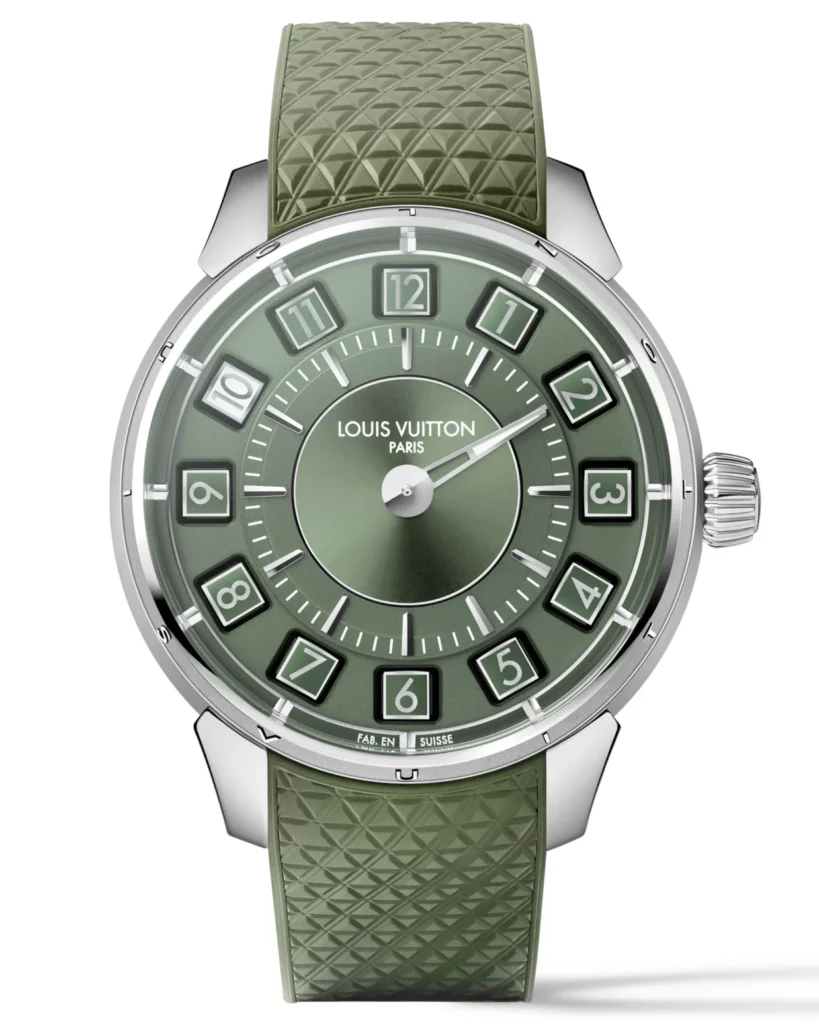
- The Tambour Spin Time Green: An 18k white gold entry point that emphasizes the purity of the jumping-hour complication against a vibrant, modern aesthetic.
- The Tambour Spin Time Australia’s Opal: A high-jewelry interpretation featuring 18k rose gold, a bezel and lugs set with blue sapphires, and a dial crafted from Australian opal, accented by diamond indexes.
- The Tambour Spin Time Air Blue: An open-worked masterpiece in 18k white gold that replaces standard hour numerals with a rotating nameplate spelling "Louis Vuitton."
- The Tambour Spin Time Air Antipode Blue: A sophisticated world-timer that utilizes the Spin Time cubes to track 24 global time zones.
- The Tambour Spin Time Air Flying Tourbillon Salmon: The flagship of the release, housing a flying tourbillon in a 950 platinum case with a striking salmon-toned dial.
These watches are driven by three proprietary in-house calibers (ST13.01, ST12.01, and LFT ST05.01), all of which boast a 4Hz frequency and a robust 45-hour power reserve.

Chronology: From Concept to Permanent Collection
The journey of the Spin Time complication is a testament to the "La Fabrique du Temps" workshop in Geneva, where Louis Vuitton crafts its most complex movements.
2009: The Genesis
Louis Vuitton introduced the original Spin Time, which turned the industry on its head by moving the hours to the perimeter of the dial. Twelve rotating cubes provided a mechanical "jump" every hour, a feat of engineering that required immense precision to ensure the instantaneous rotation of all twelve cubes.

2025: The Catalyst
Last year served as a testing ground for new design languages. The limited-edition models released in 2025 experimented with skeletonization and bold color palettes, proving that the Tambour case could house increasingly complex displays without losing its signature silhouette.
2026: The Permanent Shift
With the 2026 expansion, the maison has signaled that the Spin Time is no longer just a "showpiece" complication. By integrating these pieces into the permanent collection, Louis Vuitton is signaling to the market that it has the manufacturing capacity and the design consistency to support a high-end, multi-reference line of complicated watches.

Supporting Data: Engineering and Mechanics
The brilliance of the Spin Time lies in its movement architecture. Unlike a standard jump-hour, where a disc shifts behind an aperture, the Spin Time moves the entire display element.
The Caliber Breakdown
The three calibers employed across the 2026 range are testaments to the modularity of the design. The Caliber ST13.01 powers the standard models, optimized for the display of twelve distinct hours. The Caliber ST12.01 is the workhorse behind the "Air" models, allowing for the open-worked, floating aesthetic that gives the collection its name. The Caliber LFT ST05.01 is the most complex, tasked with the synchronization of the flying tourbillon and the minute track, a delicate balancing act that requires the tourbillon to sit at the very heart of the movement while the minute hand circles the cage.

Materials and Ergonomics
The decision to utilize 39.5mm cases for the standard models and 42.5mm for the "Air" variants is a calculated move in ergonomics. The 39.5mm size remains arguably the "sweet spot" for modern unisex luxury, while the 42.5mm size for the Air models provides the necessary negative space for the open-worked, airy aesthetic of the movement. The inclusion of calf leather straps for the Air collection versus rubber for the standard collection highlights a clear differentiation in market positioning: the standard models are "everyday" luxury, while the Air models lean toward "occasion" pieces.
Official Perspectives: The Vision Behind the Spin
Representatives from Louis Vuitton’s horological division have noted that the 2026 collection is a direct response to client feedback. "Our collectors don’t just want a watch that tells time; they want a watch that performs," stated one brand spokesperson.

The focus on the "Antipode" (the point on the earth diametrically opposite to another) reflects a trend in high-end watchmaking toward useful, world-traveler complications. By turning the Spin Time cubes into a world-timer, Louis Vuitton has successfully transitioned from a brand that uses complications for visual flair to one that uses them for practical, global utility.
Implications for the Luxury Watch Market
The expansion of the Spin Time collection has several profound implications for the industry.

1. The Normalization of High Complications
Historically, tourbillons and world-timers were rare, "halo" products. By making them part of a permanent, multi-reference collection, Louis Vuitton is normalizing the presence of high-complication watches in the portfolios of luxury fashion houses. It challenges the dominance of traditional "Big Three" watchmakers by offering a unique, patented alternative that is technically rigorous but visually distinct.
2. A Signature Design Language
In an era where many brands are reviving vintage archives, Louis Vuitton is doing the opposite: creating a new tradition. The "Tambour" shape, with its drum-like profile, has become an instantly recognizable icon. By anchoring the Spin Time within this shape, the brand is building a "brand moat" that is difficult for competitors to replicate without infringing on the unique mechanical layout of the cubes.

3. Shift Toward "Mechanical Art"
The "Air" models, with their open-worked displays, demonstrate a move toward the trend of "mechanical art." Collectors are increasingly looking for watches where the movement itself is the dial. By stripping away the backing and allowing the user to see the wheels and levers responsible for the jumping hour, Louis Vuitton is appealing to a demographic that values the "theater" of watchmaking as much as its accuracy.
4. Pricing and Accessibility
While the Australia’s Opal and the Platinum Flying Tourbillon models remain firmly in the ultra-high-end tier, the standard Green Spin Time serves as an entry point. This tiered strategy is essential for the brand’s long-term health, as it allows a younger, aspirational demographic to enter the ecosystem while providing the ultra-wealthy with high-jewelry, one-of-a-kind experiences.

Conclusion
The 2026 Tambour Spin Time collection is a bold, confident statement from Louis Vuitton. By successfully balancing the whimsical nature of the jumping cubes with the serious engineering of flying tourbillons and world-timers, the brand has proven that it is not merely a fashion house playing at watchmaking, but a serious manufacturer of horological art.
As these five models hit the shelves, the watch industry will be watching closely. If the success of the 2025 limited editions is any indicator, the permanent integration of these models will likely see them become the new standard-bearers for the brand. For the collector, the message is clear: the Spin Time is here to stay, and it is more dynamic than ever.