Tiffany & Co. Unveils Expanded West Coast Flagship at South Coast Plaza: A Fusion of High Jewelry, Architecture, and California Heritage
By
•
September 6, 2026
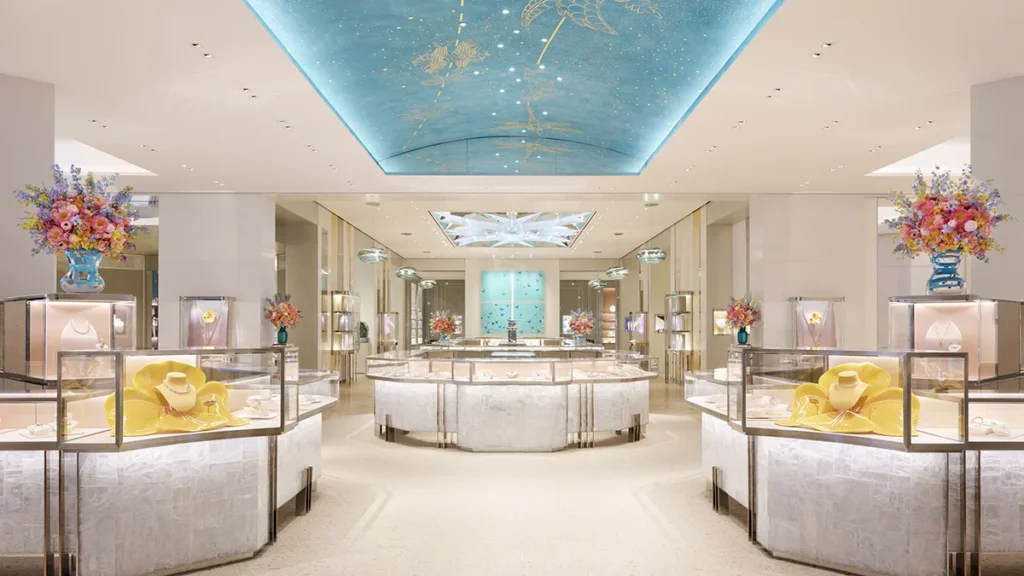
COSTA MESA, Calif. — Tiffany & Co. has officially unveiled its newly reimagined West Coast flagship at South Coast Plaza in Costa Mesa, California, marking a significant milestone in the storied American jeweler’s global retail elevation strategy. Spanning more than 15,000 square feet on the primary level of one of North America’s highest-grossing luxury retail centers, the boutique translates the ambitious architectural language first introduced at the company’s Fifth Avenue “Landmark” in New York into an expansive, region-specific luxury destination.
Conceptualized in collaboration with internationally renowned architect Peter Marino, the redesigned boutique reflects the broader transformation Tiffany & Co. has undergone since its 2021 acquisition by French luxury conglomerate LVMH Moët Hennessy Louis Vuitton. The space integrates world-class fine jewelry, museum-tier contemporary art, site-specific digital installations, and historical tributes to Southern California’s unique gemological heritage.
Main Facts: The Anatomy of a Reimagined Flagship
The South Coast Plaza boutique represents more than an interior renovation; it serves as a regional anchor for Tiffany & Co.’s fine and high jewelry collections on the Pacific Rim.
================================================================================
TIFFANY & CO. SOUTH COAST PLAZA FLAGSHIP AT A GLANCE
================================================================================
Location:                 South Coast Plaza (Main Level), Costa Mesa, CA
Footprint:                15,000+ square feet
Lead Architect:           Peter Marino Architect
Key Artists & Designers:  Oyoram (Digital Art), Hugh Dutton (Lighting Architecture)
Core Collections:         Bird on a Rock, HardWear, Lock, Knot, T, Sixteen Stone
Historical Highlights:    Archival Kunzite; Mesa Grande Morganite loan
Parent Entity:            LVMH Moët Hennessy Louis Vuitton (Acquired 2021)
================================================================================
Architectural & Interior Highlights
Designed by Peter Marino—who founded his New York-based firm in 1978 and spearheaded the transformation of Tiffany’s Manhattan Landmark, its Milan European flagship, and its massive Tokyo boutique—the Costa Mesa location balances the house’s heritage with the relaxed sophistication of coastal Southern California.
Digital Art by Oyoram: Upon entering, guests are greeted by dynamic digital screens created by visual artist Oyoram, presenting sweeping, ambient vistas of California’s coastline.
Custom Lighting Installation: Renowned architectural engineer Hugh Dutton created a bespoke, multi-tiered light fixture on the main floor, designed to mimic the refraction of light through precision-cut diamonds while illuminating the vitrines below.
Curated Collections: The boutique provides extensive dedicated salons for the brand’s most celebrated collections, including Jean Schlumberger’s Bird on a Rock, alongside contemporary core lines such as HardWear, Tiffany Lock, Tiffany Knot, Tiffany T, and the Sixteen Stone ring.
Chronology: Four Decades of Expansion at South Coast Plaza
Tiffany & Co.’s presence in Costa Mesa spans nearly four decades, mirroring the growth of Orange County into one of the world’s most affluent consumer markets.
1988 ------------------> 2020 ------------------> 2021 ------------------> 2023-2025 --------------> 2026
Initial Opening          First Major Expansion   LVMH Acquisition         Global Landmark          Reimagined Flagship
(~7,000 sq. ft. boutique (Footprint doubled      ($15.8B deal reshapes    Rollout (New York,       Opens (15,000+ sq. ft.
in Costa Mesa)           to ~14,000 sq. ft.)     brand strategy)          Milan, Tokyo)            Peter Marino design)
1. 1988: Establishing a Footprint
Tiffany & Co. first entered South Coast Plaza in 1988 with an approximately 7,000-square-foot storefront. At the time, the boutique represented an ambitious move into Southern California outside of traditional enclaves like Beverly Hills, positioning the brand to capture an expanding demographic of affluent suburban collectors and international travelers.
2. Late 2020: Pre-Acquisition Expansion
In late 2020, Tiffany completed a major relocation and expansion within the center, doubling its original footprint to approximately 14,000 square feet. This move laid the physical foundation for what would become the West Coast flagship, even as the global retail environment faced unprecedented disruptions.
3. 2021–2025: The LVMH Era and Landmark Blueprint
Following LVMH’s $15.8 billion acquisition of Tiffany & Co. in January 2021, the house initiated a worldwide campaign to elevate its brand equity. The centerpiece of this strategy was the April 2023 reopening of the 10-story Fifth Avenue Landmark in Manhattan, designed by Peter Marino and OMA. The commercial success of the Landmark served as the conceptual template for international flagships, including Tokyo’s Ginza and Omotesando locations and the European flagship in Milan.
4. 2026: The Reimagined West Coast Anchor
The current iteration expands the boutique past 15,000 square feet, completely overhauling the spatial layout, finishes, lighting, and hospitality suites to bring the location into full alignment with the house’s top-tier global flagships.
Archival Tributes: The California Gemological Connection
A defining feature of the redesigned Costa Mesa boutique is its deliberate connection to California’s natural gemological history. Tiffany & Co. has curated an archival exhibition within the store that underscores the house’s historic role in discovering and popularizing American gemstones.
+-----------------------------------------------------------------------------+
|               HISTORIC GEMOLOGICAL DISCOVERIES & TIFFANY                    |
+------------------------------------+----------------------------------------+
| Gemstone: Kunzite                  | Gemstone: Morganite                    |
| Discovered: 1902                   | Featured Specimen: Mesa Grande, CA     |
| Location: San Diego County, CA     | Significance: On loan from a private   |
| Named After: George Frederick Kunz | collection; complements historic pink  |
| (Chief Gemologist, Tiffany & Co.)  | beryl archival jewelry                 |
+------------------------------------+----------------------------------------+
George Frederick Kunz and San Diego Kunzite
In 1902, lilac-pink spodumene crystals discovered in Pala, San Diego County, were sent to George Frederick Kunz, Tiffany & Co.’s legendary chief gemologist. Kunz identified the specimens as a previously unrecognized variety of spodumene.
The gemstone was subsequently named Kunzite in his honor by Charles Baskerville, a professor of chemistry at the University of North Carolina. The South Coast Plaza boutique features archival jewelry pieces set with early-20th-century California kunzite, celebrating the jeweler’s regional scientific legacy.
Mesa Grande Morganite
Alongside kunzite, the boutique showcases an exceptional specimen of Morganite from the Himalaya Mine in Mesa Grande, California, on loan from a private collection. Kunz was also instrumental in naming this rose-hued beryl in 1910, dedicating it to financier and loyal Tiffany patron J. Pierpont Morgan. Displaying these mineral specimens alongside modern high jewelry contextualizes Tiffany’s contemporary gem-sourcing practices within a 180-year tradition of geological discovery.
Supporting Data: Luxury Retail Performance and Market Dynamics
The capital investment in South Coast Plaza comes amid robust commercial momentum for Tiffany & Co. under LVMH’s Watches & Jewelry division.
According to official disclosures from LVMH, the Watches & Jewelry business group registered a 7 percent organic revenue increase in the first quarter of 2026. The conglomerate specifically noted that Tiffany & Co. delivered an “excellent performance,” fueled by surging global demand for high jewelry and the continued momentum of the HardWear collection, which expanded its market share across both feminine and gender-neutral fine jewelry segments.
Retail Venue Strength
South Coast Plaza remains one of the most lucrative retail hubs globally, generating an estimated $2.5 billion in annual sales volume. By placing a 15,000-square-foot flagship in Costa Mesa, Tiffany capitalizes on a high concentration of ultra-high-net-worth individuals (UHNWIs) residing throughout Southern California, as well as inbound luxury tourism from East Asia and Latin America.
Official Responses and Executive Perspective
In corporate disclosures detailing performance across its Maisons, parent company LVMH emphasized the pivotal role of flagship transformations in sustaining long-term brand equity:
"LVMH continues to achieve organic growth… in a global environment impacted by geopolitical and macroeconomic uncertainties. Within our Watches and Jewelry division, Tiffany & Co. achieved an excellent performance, driven by the strong reception of high jewelry creations and the remarkable expansion of signature lines like HardWear."
— LVMH Financial Communications
Retail analysts and architectural commentators have echoed the strategic importance of the Marino partnership:
"The modern luxury consumer no longer responds to static sales counters," notes retail strategy analyst Claire Dumont. "What Tiffany and Peter Marino executed in New York, and are now standardizing in Costa Mesa, Milan, and Tokyo, is experiential world-building. Fine jewelry purchases at this price bracket are emotional and cultural transactions. Surrounding clients with museum-grade digital art by Oyoram, tailored lighting by Hugh Dutton, and genuine historical artifacts transforms retail square footage into an enduring cultural institution."
Implications for the Luxury Landscape
The unveiling of the Costa Mesa flagship carries strategic implications for Tiffany & Co., its parent conglomerate, and the broader hard-luxury market:
Decentralization of Luxury Flagships: While New York, Paris, and London historically commanded the lion’s share of flagship expenditures, high-yield suburban and regional hubs like South Coast Plaza now command equal architectural investment.
The "Marino Aesthetic" as Brand Identity: By consistently deploying Peter Marino Architect across major flagship locations worldwide, Tiffany has cultivated a cohesive spatial identity that balances classic New York glamour with regional artistry.
Escalation of High Jewelry Competition: As luxury houses like Cartier, Van Cleef & Arpels, and Bulgari expand their retail footprints, Tiffany’s integration of archival storytelling and gemological authenticity provides a distinct narrative edge in the ultra-luxury jewelry segment.
Integration of Hospitality and Culture: The transition toward expansive VIP viewing salons and rotating historical exhibitions reflects an industry-wide pivot where private client relations (VICs) generate a disproportionate share of high jewelry revenues.
Conclusion
The reimagined South Coast Plaza boutique reinforces Tiffany & Co.’s evolution into an apex luxury Maison. By marrying the grandeur of Peter Marino’s spatial architecture with digital art, custom engineering, and deep-seated California gemological history, the American jeweler has transformed its four-decade Costa Mesa presence into a flagship designed to anchor West Coast luxury retail for decades to come.