For the average horology enthusiast, the appreciation of a mechanical timepiece is often a passive experience. It is a study of aesthetics, brand heritage, and the rhythmic dance of gears observed through sapphire exhibition casebacks. While literature, high-definition videos, and forums provide a theoretical understanding of how a balance wheel oscillates or a hairspring breathes, there remains an impenetrable "fourth wall" between the collector and the caliber.
Taking a movement apart and—more dauntingly—successfully reassembling it is a task usually reserved for professional watchmakers. However, in the heart of Chicago, the historic Hampden Watch company is dismantling that barrier. With its "First Hand" workshop, the brand has created a unique, high-touch environment that allows enthusiasts to step off the sidelines and into the role of the creator, leaving at the end of the day with a Swiss mechanical timepiece they have assembled themselves.
The Genesis of an Experiment
In December 2025, Hampden Watch launched "First Hand" as a bold, experimental endeavor. The core question posed by the leadership team was deceptively simple: Could individuals with zero prior experience in micro-mechanics learn enough in a single, eight-hour session to successfully navigate the complex assembly of a Swiss movement, set the dial, install the hands, and produce a water-resistant, functioning wristwatch?

The answer, proven by thirty consecutive sold-out sessions and over 200 successful graduates, has been a resounding "yes." What began as a pilot program has now solidified into a cornerstone of the Hampden brand. With workshops already booked deep into 2027 and a massive new facility currently under development, the program has transcended its experimental phase to become a permanent fixture in the American watchmaking landscape.
The Anatomy of the Workshop: A Day in the Life
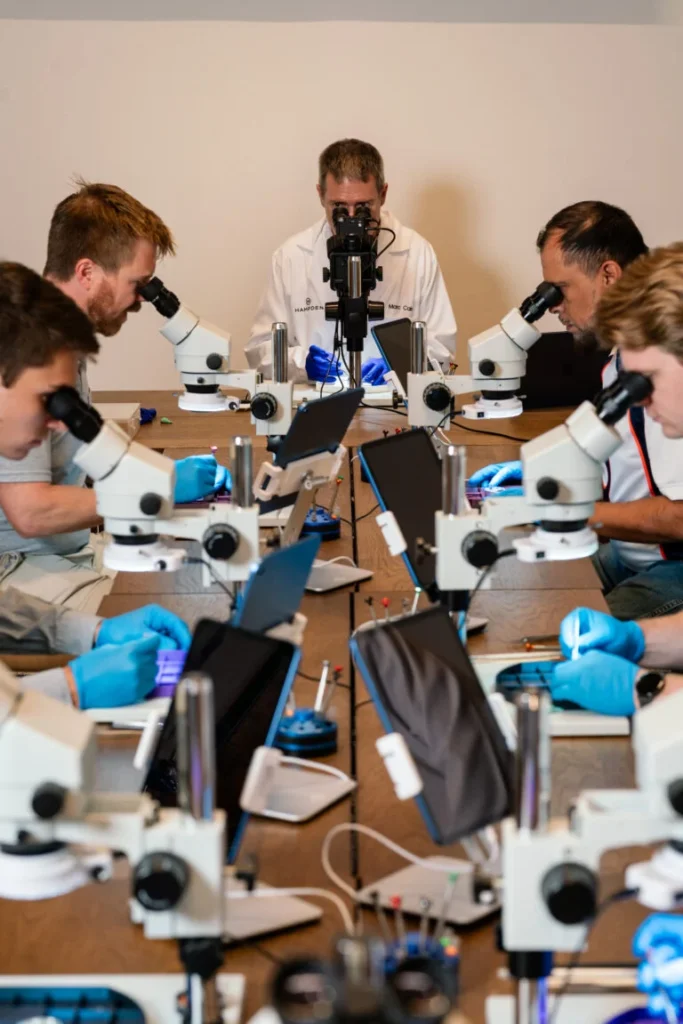
The "First Hand" experience is defined by its intimacy and precision. To maintain a high instructor-to-student ratio, each session is strictly capped at six participants, who are guided by a team of three professional watchmakers from 9:00 AM until 4:00 PM.
The day is structured to accommodate the roughly 90% of attendees who arrive with no formal training. The morning session begins with a foundational lecture on movement theory, focusing on the physics of the escapement and the mechanics of power reserve. Rather than utilizing traditional, eye-straining watchmaking loupes, Hampden equips every bench with professional-grade binocular microscopes. This ensures that the focus remains on the joy of discovery rather than the frustration of visual fatigue.

The 6498: A Mechanical Canvas
The central challenge of the workshop is the assembly of the Unitas-based 6498 manual-wind movement. Developed approximately 75 years ago, the 6498 is the gold standard for horological education. Its large, robust architecture makes the relationship between the barrel, the train, and the balance wheel readily apparent. It is a movement that rewards the learner with visibility, making it the perfect vehicle for those transitioning from admirers to makers.
To manage the varied learning speeds of the students, Hampden has engineered a proprietary software system integrated into iPads at every workstation. These digital guides offer high-resolution, step-by-step visual instructions that mirror the instructor’s live demonstrations at the front of the room. This "self-paced, instructor-supported" model ensures that no student feels left behind, nor is any fast-learner held back from the next stage of assembly.
A Legacy of American Horology
While the mechanical work is the primary draw, the "First Hand" experience is bolstered by a deep dive into history. During the workshop, participants are given a private, behind-the-scenes tour of the Hampden corporate archive.

The Wein family, who currently lead the brand, have been central to Chicago watchmaking since 1922. Their lineage is impressive, spanning four generations and six distinct brands: Hampden, Clinton, Benrus, Wolbrook, Douglas, and Neuvex. The Hampden name itself carries significant weight, dating back to 1877, with the Wein family acquiring the firm in 1958.
For the seasoned collector, the archive tour is often cited as a highlight. It provides a rare, tangible look at the evolution of American watch design and the resilient, multi-generational effort required to keep such a historic brand thriving in the 21st century.
The Finishing Touches: Crafting the Final Product
Following a chef-catered lunch, the workshop shifts from the internal mechanics to the exterior aesthetic. Students select their dials from an exclusive collection of eight designs inspired by the industrial landscape of Chicago. The options—which include names like Forged Orange, Harbor Blue, Patina Green, and Steelyard Gray—are reserved strictly for workshop participants. These watches are not sold in retail stores; they exist only as the fruits of the builder’s labor.

Once the dial and hands are set, the movement is cased in a 42mm housing featuring a sapphire crystal and an exhibition caseback. Before the day concludes, Hampden provides a final touch of personalization: the movement is engraved with the student’s initials and the year of assembly. The watch is then subjected to a rigorous water-resistance test, ensuring that the student’s work meets the same quality standards as a factory-produced timepiece.
Data and Implications: Why It Works
The success of "First Hand" is not merely anecdotal. With a perfect 5.0 rating across 60 verified reviews, the program has demonstrated that the desire for "experiential luxury" is at an all-time high.
The demographic reach of the program is equally telling. Approximately 40% of attendees travel to Chicago from out-of-state, with students arriving from both U.S. coasts and even as far as the Arctic Circle. The fact that graduates are actively recommending the program to their peers suggests that Hampden has successfully tapped into a core human need: the desire to understand, manipulate, and ultimately master a complex machine.

Future Expansion
The appetite for this experience has forced Hampden to plan for scale. The company is currently building a 1,700-square-foot facility dedicated exclusively to these workshops, slated for completion this winter. Furthermore, the company is preparing to launch an "Advanced Workshop" in October 2026. This follow-up program will shift the focus from the large manual-wind 6498 to the more complex Sellita SW200 automatic movement, housed in a more compact 37mm case, providing a logical progression for alumni looking to further their skills.
The Value Proposition
Priced at $2,100 USD, the workshop is a significant investment. However, when one considers that the price covers a full day of expert instruction, a private historical tour, a bespoke mechanical timepiece, and the intangible value of having successfully performed a delicate engineering task, the value becomes clear. It is not just the purchase of a watch; it is the acquisition of a skill and a story.
For the collector who has spent years staring through casebacks, wondering what lies beneath, "First Hand" offers the ultimate resolution. It takes the mystery out of the mechanism and replaces it with the confidence of someone who has placed every screw, installed every wheel, and heard the first tick of a movement they brought to life.

As Hampden continues to expand its educational footprint, the message to the watch community is clear: the best way to understand a watch is to build it. For those interested in securing their place at the bench, bookings are available through February 2027, with new dates released on the first of each month at the Hampden Watch website.