
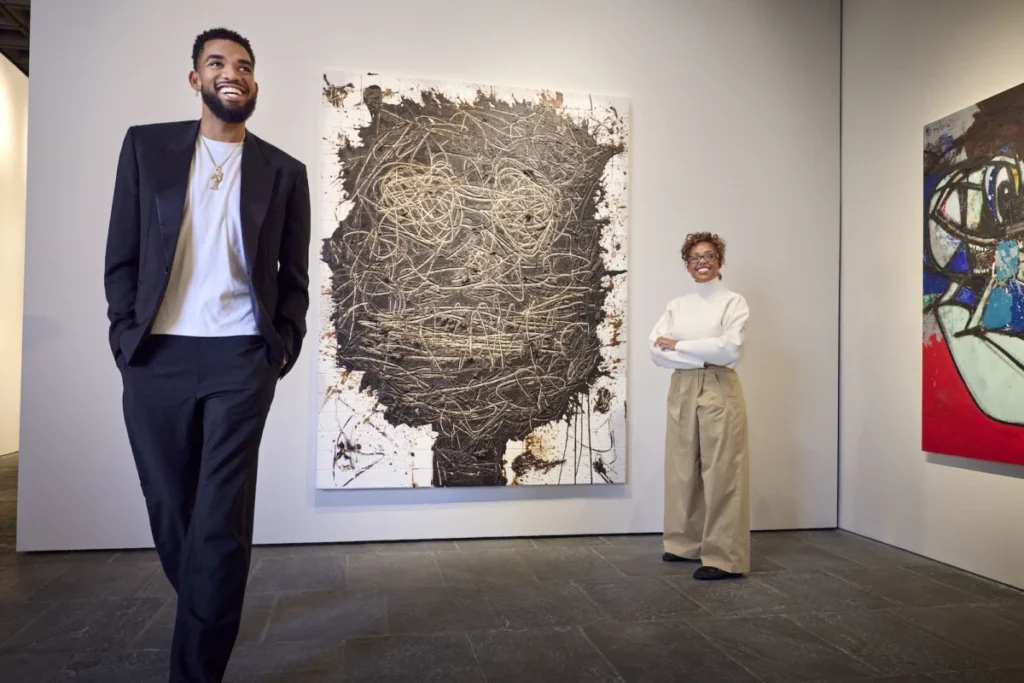
NEW YORK — The worlds of professional sports, high-fashion entrepreneurship, and blue-chip fine art are set to converge this autumn in a landmark event at Sotheby’s. On October 7, the venerable auction house will present its latest iteration of the "Contemporary Curated" series, a sale uniquely helmed by two of the most influential figures in modern culture: NBA champion Karl-Anthony Towns and lifestyle mogul Jordyn Woods.
The 10-lot selection, hand-picked by the power couple, represents a sophisticated dialogue between the grit of the basketball court and the refined aesthetics of the global art market. Featuring a roster of heavy hitters including Andy Warhol, Roy Lichtenstein, and Helen Frankenthaler, the auction is poised to capture the attention of seasoned collectors and a new generation of investors alike.
Main Facts: A Curated Vision of Modernity
Sotheby’s "Contemporary Curated" series has long served as a bridge between the traditional art world and the broader cultural zeitgeist. By inviting guest curators from the realms of music, film, and sports, the auction house provides a fresh perspective on established masterpieces. The October 7 sale is no exception, but it carries a heightened level of prestige given the current standing of its curators.
Karl-Anthony Towns, the six-time NBA All-Star and center for the New York Knickerbockers, enters this collaboration fresh off a historic championship run. His partner, Jordyn Woods, has successfully transitioned from a high-profile model to a formidable lifestyle entrepreneur. Together, they have selected a concise but potent group of works that reflect a "collected" lifestyle—one where art is not merely an asset, but a narrative of personal growth.
The auction is headlined by several museum-quality pieces:
- Andy Warhol’s Flowers (1964): An iconic acrylic-and-silkscreen work with an upper estimate of $3.5 million.
- Roy Lichtenstein’s Green Head (1979): A seminal work from his Expressionist series, also carrying a high estimate of $3.5 million.
- Helen Frankenthaler’s Return and Exit (1974): A vibrant canvas estimated to reach up to $2 million.
Beyond these titans, the sale includes works by John Chamberlain, George Condo, Sam Gilliam, Rashid Johnson, Ed Ruscha, Alma Thomas, and more. This diverse list demonstrates a keen understanding of the 20th and 21st-century canons, blending Pop Art, Color Field painting, and contemporary social commentary.
Chronology: From the Hardwood to the Auction Block
The path leading to this collaboration is a testament to the evolving "multi-hyphenate" nature of modern stardom. To understand the significance of this auction, one must look at the timeline of the curators’ rise to cultural prominence.
2024: The New York Transition
The foundation for this collaboration was laid in 2024 when Karl-Anthony Towns, a former NBA Rookie of the Year, was traded to the New York Knickerbockers. The move to the world’s art capital allowed Towns and Woods to immerse themselves in the New York gallery scene, fostering relationships with dealers and curators that would eventually lead to their involvement with Sotheby’s.
2025–Early 2026: Entrepreneurial Expansion
While Towns solidified his role as the defensive and offensive anchor of the Knicks, Jordyn Woods expanded her business empire. The launch of Woods by Jordyn, a lifestyle brand focusing on "accessible luxury" in clothing and home goods, demonstrated her eye for design and curation. During this period, the couple reportedly began building their private collection, focusing on artists of color and mid-century masters.
June 2026: The Championship Catalyst
In June 2026, the New York Knickerbockers clinched their first NBA Championship since 1973. Towns was instrumental in the victory, cementing his legacy in the city. This triumph significantly boosted his "marketability" beyond sports, positioning him as a symbol of New York excellence.
September 2026: The Sotheby’s Announcement
Following the championship celebrations, Sotheby’s announced that Towns and Woods would lead the October "Contemporary Curated" sale. The timing was strategic, coinciding with the lead-up to a major Roy Lichtenstein retrospective at the Whitney Museum, which has served to bolster interest in the artist’s secondary market.
Supporting Data: Market Valuation and Provenance
The financial stakes of the October 7 auction are significant. The 10 lots selected represent some of the most stable "blue-chip" investments in the current art market.
The Warhol Factor
Andy Warhol’s Flowers (1964) remains one of the most liquid assets in the art world. The specific iteration included in this sale boasts impeccable provenance, coming from the collection of Robert A.M. Stern, the renowned architect and former dean of the Yale School of Architecture. Stern’s eye for structural beauty and historical context adds a layer of intellectual prestige to the piece. Market analysts suggest that Warhol’s Flowers have seen a compound annual growth rate of approximately 7-9% over the last decade, making the $3.5 million estimate a conservative entry point for a work of this caliber.

The Lichtenstein Renaissance
Roy Lichtenstein’s Green Head (1979) is particularly noteworthy for its stylistic departure from his better-known "Ben-Day dot" comic style. By 1979, Lichtenstein was exploring "Expressionism" through a Pop lens—essentially using his cool, mechanical style to depict the "hot," emotional brushstrokes of German Expressionism. This meta-commentary on art history is highly prized by academic collectors. With a major retrospective opening at the Whitney Museum next month, historical data suggests that auction prices for the artist can see a "retrospective bump" of 15-20% as public interest peaks.
Color Field and Beyond
The inclusion of Helen Frankenthaler’s Return and Exit ($2 million high estimate) signals a robust demand for female pioneers of abstraction. Frankenthaler’s "soak-stain" technique revolutionized American painting, and her market has seen a dramatic correction upward in the last five years as institutions seek to rebalance their historical narratives.
Official Responses: The Curators’ Philosophy
In a joint statement released through Sotheby’s, Towns and Woods emphasized that their selections were driven by emotion and storytelling rather than mere investment potential.
"Art holds memories and tells stories," the couple stated. "Each work in this sale resonated with us for a different reason, and together they reflect the people, places, and experiences that continue to shape our perspective as collectors. We wanted to choose pieces that felt alive—works that could anchor a room and spark a conversation."
Jordyn Woods specifically commented on the Warhol Flowers, noting a personal connection to the imagery. "Flowers remind us of family, of remembrance, and of the garden we hope to create one day," she said. Her perspective highlights the "lifestyle" element of the auction, suggesting that high art should have a place in the domestic, personal sphere.
Karl-Anthony Towns focused on the technical and historical aspects of the collection, particularly the Lichtenstein. "I love seeing something that’s different from what people usually associate with him," Towns remarked. "As an athlete, you’re often put in a box. Seeing an artist like Lichtenstein break out of his own established style to try something new—like his Expressionist series—really speaks to me."
Sotheby’s specialists have praised the duo for their "sophisticated eye." A spokesperson for the house noted, "Karl-Anthony and Jordyn bring a unique energy. They aren’t just looking at names; they are looking at the soul of the work. Their curation reflects a modern, diverse, and deeply thoughtful approach to living with art."
Implications: The Celebrity-Curator Trend and Market Impact
The involvement of Towns and Woods in a Sotheby’s auction is indicative of a broader shift in the high-end art market. The "Contemporary Curated" series has previously featured icons like Victoria Beckham, Oprah Winfrey, and Ryan Murphy. However, the inclusion of a current NBA champion at the peak of his career marks a new chapter in the "financialization of celebrity."
1. The "Athlete-Collector" Archetype
Historically, professional athletes were seen as consumers of luxury goods (cars, jewelry, fashion). However, figures like Towns are shifting the narrative toward "cultural capital." By aligning himself with Sotheby’s and artists like Ed Ruscha and Sam Gilliam, Towns is positioning himself as an intellectual tastemaker. This move has long-term implications for his post-career trajectory, potentially opening doors into the worlds of design, philanthropy, and institutional boardrooms.
2. Diversifying the Collector Base
Celebrity-led auctions are a primary tool for auction houses to reach "HNI" (High Net Worth Individuals) who may not have traditional ties to the art world. Fans of the New York Knicks or followers of Jordyn Woods’ lifestyle brand may be introduced to the works of Alma Thomas or Rashid Johnson for the first time through this sale. This "onboarding" of new wealth is essential for the continued growth of the art market.
3. The Synergy of Art and Sport
The success of the Knicks in 2026 has created a "halo effect" around the team’s stars. In New York, where the economy and culture are inextricably linked, a championship victory translates into increased value for any project associated with the victors. Sotheby’s is effectively leveraging "Knicks Mania" to drive engagement for the October 7 sale.
4. Market Stability for Featured Artists
For the artists included, particularly those who are still active or whose estates are carefully managed (like Rashid Johnson or the Warhol Foundation), the endorsement of high-profile curators provides a "cool factor" that transcends traditional museum validation. This can lead to increased demand in the private treaty market and higher floors for future auction lots.
As the October 7 date approaches, the art world will be watching closely. Whether the "Towns-Woods" touch will lead to record-breaking hammers remains to be seen, but one thing is certain: the boundary between the stadium and the gallery has never been more porous. In the heart of New York City, the stars of the court and the stars of the canvas are finally playing on the same team.