Beneath the serene surface of the Pacific Ocean, nearly 2,200 kilometers down, a colossal, invisible transformation has taken place. For decades, the prevailing scientific consensus held that the liquid iron churning within Earth’s outer core followed a relatively steady, westward trajectory. However, new research published in the Journal of Studies of Earth’s Deep Interior reveals a startling anomaly: in 2010, a vast region of this molten metal abruptly shifted, pivoting from a weak westward flow to a powerful eastward surge.
This discovery, facilitated by over two decades of high-precision satellite data, challenges long-standing models of planetary geodynamics. It suggests that the Earth’s interior is far more volatile, turbulent, and dynamic than previously imagined, raising profound questions about the hidden mechanisms that sustain our planet’s protective magnetic shield.
The Engine of the Planet: How the Geodynamo Works
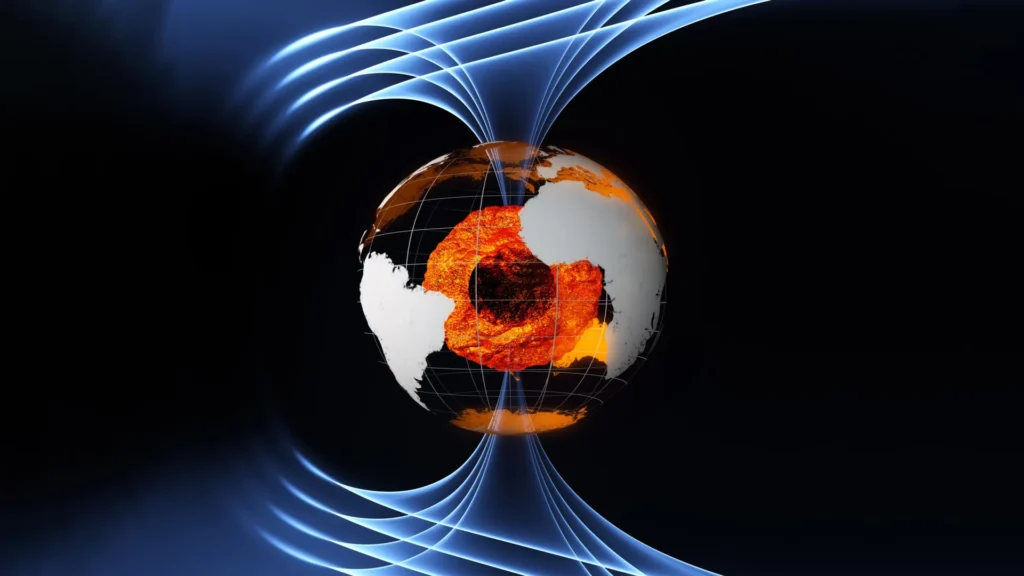
To understand the significance of this shift, one must first look at the "geodynamo"—the physical process that turns Earth into a giant magnet. The outer core is a turbulent sea of electrically conducting liquid iron and nickel. As this liquid metal flows around the solid inner core, it generates electric currents. These currents, in turn, create the geomagnetic field that envelops our planet.
For researchers, monitoring these flows is akin to taking a pulse. Because the outer core is unreachable by physical probes, scientists rely on the magnetic "fingerprints" these flows leave behind. By tracking variations in the geomagnetic field at the surface, geophysicists can infer the motion of the molten material deep below. Historically, this motion was categorized as a slow, westward-drifting current. The 2010 event, however, shattered the assumption that this system operates in a state of stable, predictable equilibrium.
Chronology of a Planetary Shift
The timeline of this discovery spans nearly thirty years of observational data, integrating legacy missions with cutting-edge satellite technology.
- 1997–2009: Ground-based magnetic observatories and early satellite missions, such as the German CHAMP and the Ørsted mission, provided a baseline of data. During this period, the prevailing westward circulation of the outer core appeared consistent.
- 2010: The "Pacific Reversal" occurs. Analysis of magnetic data indicates that a broad area of fluid beneath the equatorial Pacific undergoes a radical change, transitioning from a weak westward flow to a significant eastward flow.
- 2013: The European Space Agency (ESA) launches the three-satellite Swarm constellation, designed specifically to provide the most detailed survey of Earth’s magnetic field to date.
- 2017: A "geomagnetic jerk"—an abrupt, localized change in the acceleration of the magnetic field—is detected, further signaling that the core is in a state of flux.
- 2020–2025: Data analysis confirms that the strong eastward flow beneath the Pacific has begun to weaken, leading researchers to investigate whether the event was a temporary fluctuation or part of a long-term, multi-decadal oscillation.
Supporting Data: The Role of Satellite Precision
The ability to map the interior of the Earth from space is one of the greatest technical achievements of modern geophysics. The study, led by Frederik Dahl Madsen of the University of Edinburgh’s School of Geosciences, synthesized data from the Swarm and CryoSat missions to create a high-resolution map of core dynamics.
The Swarm satellites are uniquely equipped for this task. By flying in coordinated, polar orbits, the trio can differentiate between the magnetic signals generated by the core and the "noise" created by the crust, the oceans, and the ionosphere.
"Although Swarm was launched after the dramatic reversal event of 2010, it has provided high-precision data that tell us about the period that followed," says Anja Stromme, ESA’s Swarm Mission Manager. "The mission provides continuous global coverage, allowing us to track how core dynamics evolve in near-real-time, moving beyond the limitations of sparse ground-based observatories."
The data revealed not only the Pacific reversal but also wave-like accelerations and rapidly shifting flow structures that were previously buried under the "noise" of less sensitive instruments. These patterns suggest that the core is not just a steady engine, but one capable of rapid, localized surges of energy.
Official Responses and Scientific Interpretations
The implications of the study have sent ripples through the geoscience community. Lead author Frederik Dahl Madsen suggests that the Pacific reversal is not an isolated event but may be intrinsically linked to the planet’s deepest interior.
"The large-scale flow reversal raises new questions about the behavior of Earth’s deep interior," Madsen noted. "We hypothesize that the rise of the strong eastward flow is contemporary with a change in the behavior of the inner core, as inferred from recent seismological and geodetic data. These deep-seated changes suggest that the inner and outer cores are dynamically coupled in ways we are only just beginning to map."
Elisabetta Iorfida, ESA’s Swarm Mission Scientist, emphasizes that the study fundamentally shifts our understanding of the core-mantle boundary—the interface where the liquid outer core meets the rocky mantle. "This research challenges the idea that stable westward circulation is the rule," Iorfida states. "We are seeing that regional changes can emerge rapidly—within just a decade. This suggests a complex, interconnected system where the mantle and the core might be exchanging energy in a constant, unfolding dialogue."
Implications: Why the Core Matters to Us
While the turbulent activity 2,200 kilometers beneath our feet poses no immediate threat to life on the surface, it is of critical importance to our modern technological infrastructure.
1. The Magnetic Shield
The geomagnetic field acts as a planetary umbrella, shielding our atmosphere and technological systems from the constant bombardment of solar radiation and charged particles from the Sun. Any significant shift in the core’s flow can alter the strength and orientation of this field. Understanding these cycles is vital for long-term climate and atmospheric stability studies.
2. Navigation and Technology
The magnetic field is the foundation for global navigation. Changes in the core’s circulation affect the position of the magnetic poles and the accuracy of magnetic sensors. Spacecraft operations, aviation navigation, and even smartphone compasses rely on models of the magnetic field. As the core becomes more variable, these models must be updated more frequently to maintain accuracy.
3. Space Weather Forecasting
"Space weather"—the interaction between solar storms and Earth’s magnetic field—is a growing concern for telecommunications and power grids. By understanding the dynamics of the core, scientists can better predict how the magnetic field will react to external solar pressures, helping to protect critical satellites and electrical infrastructure.
Conclusion: A More Complex Interior
The discovery of the 2010 Pacific flow reversal serves as a humbling reminder of how little we truly know about the interior of our own planet. For years, the "stable" model of the outer core provided a sense of geologic comfort, but the data from the Swarm and CryoSat missions paints a picture of a world that is far more vibrant and unpredictable.
As researchers continue to analyze the data from the past two decades, the focus is shifting toward the "why." Is this reversal a one-off event? Is it a cyclical occurrence that happens every few centuries, akin to a heartbeat in the planet’s center? Or is it a sign that the Earth’s interior is undergoing a more significant, long-term shift?
Continued monitoring will be essential. Through the lens of high-precision satellite missions, humanity is finally peering into the dark, swirling heart of the Earth. What we find there will not only reshape our textbooks but will also deepen our respect for the turbulent, shifting forces that make life on the surface possible. The core, it seems, has many more secrets left to reveal.