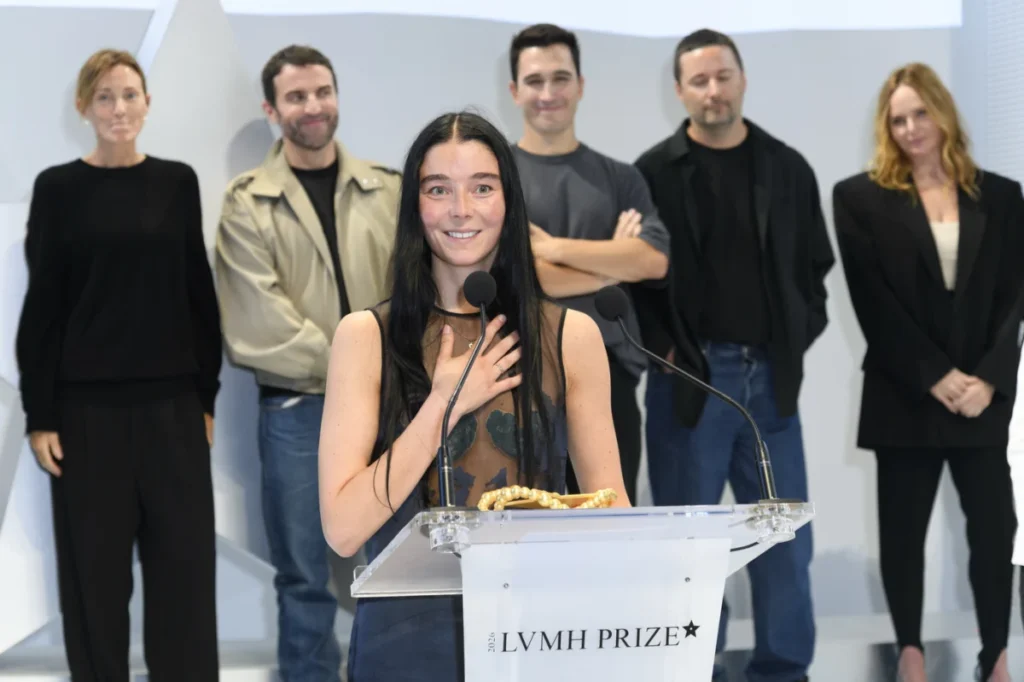
PARIS — In the rarefied atmosphere of the Frank Gehry-designed Fondation Louis Vuitton, the global fashion industry turned its eyes toward the future this Friday. Amidst the glass sails and architectural grandeur of the Bois de Boulogne, the LVMH Prize for Young Designers—the industry’s most coveted launchpad—crowned its latest visionary. Julie Kegels emerged as the victor of the prestigious 2024 edition, solidifying her place at the forefront of the next generation of creative talent.
The ceremony, a masterclass in luxury branding and star power, served as a poignant reminder of the enduring synergy between established heritage houses and the disruptive, avant-garde energy of emerging labels. As the LVMH group continues to solidify its dominance, the Prize remains its most potent tool for cultural relevance and creative scouting.
The Ceremony: A Star-Studded Coronation
The event was marked by a distinct blend of Hollywood glamour and institutional prestige. Dior ambassador and Academy Award-winning actress Jennifer Lawrence took to the stage to announce the grand prize winner, injecting a sense of cinematic occasion into the proceedings.
"The caliber of talent we have witnessed this year is a testament to the resilience and vision of the next generation," Lawrence noted during the presentation. As she unveiled Julie Kegels as the winner, the auditorium erupted in applause, signaling a widespread industry consensus that the Belgian designer’s work represents a vital shift in contemporary fashion.
The grand prize package is formidable, serving as both a financial lifeline and a strategic accelerator. Kegels receives 400,000 euros in funding, alongside a bespoke, year-long mentorship program. This mentorship is not merely an advisory role; it provides direct access to the vast intellectual and logistical infrastructure of LVMH Moët Hennessy Louis Vuitton. From supply chain optimization to retail strategy and intellectual property management, Kegels will be mentored by the very experts who steer global juggernauts like Louis Vuitton, Guerlain, Dom Pérignon, and Sephora.
The Chronology of Excellence
The journey to the final stage at the Fondation Louis Vuitton is a grueling, multi-month process designed to test not only the creative depth of a designer but their business acumen. The 2024 cycle began with thousands of applicants from across the globe, a number that was meticulously whittled down by an expert committee of buyers, journalists, and industry insiders.
Following the initial selection, the semifinalists were invited to Paris to showcase their collections to a panel of global experts. This stage is famously demanding, requiring designers to defend their creative vision while demonstrating a realistic path to commercial viability.
By the time the final eight candidates were selected, the tension in the fashion community was palpable. The finalists—a diverse cohort representing Belgium, China, Sweden, France, the United Kingdom, Spain, Georgia, and the United States—reflected the truly global nature of the competition. Throughout the final week, the candidates underwent rigorous interviews and portfolio reviews, culminating in the final presentation to the grand jury, which featured some of the most influential designers in the world, including Maria Grazia Chiuri, Nicolas Ghesquière, and Kim Jones.
Supporting Data: Honoring Innovation and Craft
While the Grand Prize took center stage, the LVMH Prize committee ensured that multiple facets of design excellence were recognized. Two additional accolades were presented, each carrying a 200,000-euro grant and a year of dedicated mentorship.
The Karl Lagerfeld Special Jury Prize
The runner-up prize, named in honor of the late creative visionary Karl Lagerfeld, was awarded to Chinese designer Zane Li for his label, Lii. The award was presented by Indian actress, film producer, and singer Priyanka Chopra Jonas.
The Karl Lagerfeld Prize is specifically designed to support designers who show unique creative voice and potential for long-term growth. Beyond the 200,000-euro cash injection, the prize provides a comprehensive advisory package. This covers critical operational pillars, including sustainable development—a mandate that has become increasingly non-negotiable in modern luxury—alongside communication strategy, copyright law, corporate legal structures, and advanced financial management.
The Savoir-Faire Prize
Recognizing the marriage of technical mastery and design, the Savoir-Faire Prize was awarded to Yoshita 1967, designed by Anil Padia. The award was presented by Thai actress and model Urassaya "Yaya" Sperbund, who also served as a member of the final jury.
The Savoir-Faire Prize highlights the importance of craftsmanship in an age of rapid production. For Padia, the grant and mentorship will focus on scaling the intricate production techniques that define the Yoshita 1967 aesthetic, ensuring that the brand’s technical brilliance can survive the transition from artisanal workshop to a scalable global business.
The Broader Finalist Field
The 2024 finalists, while not taking home the top three prizes, represent a significant cross-section of current fashion discourse. The group included:
- Petra Fagerström (Sweden): Known for her innovative take on silhouettes.
- Gabriel Figueiredo (De Pino, France): An emerging voice in French tailoring.
- Harry Pontefract (Ponte, U.K.): Focused on textile experimentation.
- Daniel del Valle (The Vxlley, Spain): A label gaining traction for its conceptual approach.
- Galib Gassanoff (Institution, Georgia): A designer celebrated for challenging traditional fashion structures.
- Colleen Allen (USA): Recognized for her sophisticated, structural design language.
Each of these designers, by virtue of reaching the final stage, has already gained a level of international visibility that typically takes years to cultivate. The LVMH platform serves as a catalyst, often leading to immediate retail interest and media coverage that can alter the trajectory of a brand overnight.
Implications for the Future of Fashion
The LVMH Prize is more than a competition; it is a barometer for the luxury industry. By selecting Julie Kegels and the other laureates, the LVMH group is signaling where it believes the future of fashion lies.
Sustainability as a Foundation
One of the most notable aspects of the 2024 prize is the heavy emphasis on sustainable development within the mentorship programs. For the Karl Lagerfeld Special Jury Prize in particular, guidance on sustainable manufacturing is a core component. This reflects a broader industry shift: the realization that long-term luxury growth cannot be divorced from environmental responsibility.
The Democratization of Expertise
The inclusion of mentorship in the prize structure is a strategic move that acknowledges the primary hurdle for young designers: the gap between creative talent and operational infrastructure. By providing access to the legal, financial, and marketing machinery of the world’s largest luxury conglomerate, LVMH is effectively de-risking the future of these brands. This creates a pipeline of talent that is not only creatively vibrant but also commercially resilient.
A Global Perspective
The diversity of the finalists—hailing from Georgia, Thailand, China, and across Europe and the Americas—underscores the decentralization of fashion influence. Paris remains the spiritual and logistical home of the industry, but the "next big thing" is increasingly likely to emerge from outside the traditional European hubs. The LVMH Prize serves as the bridge between these diverse creative hubs and the global market.
Conclusion: A Legacy in the Making
As the echoes of the ceremony fade and the winners prepare to integrate their brands into the LVMH ecosystem, the impact of the 2024 Prize is already taking shape. For Julie Kegels, the win is a defining moment—a transition from a promising independent designer to a figure of international standing.
For LVMH, the Prize remains a masterstroke of institutional stewardship. By investing in the visionaries of tomorrow, the group ensures that it remains at the center of the conversation, effectively curating the next generation of talent that will define the aesthetic and ethical standards of the luxury sector for decades to come. As the industry watches, the question is no longer who will emerge, but how these designers will leverage this extraordinary opportunity to reshape the very fabric of global fashion.