Goldgroup Mining Inc. (TSXV: GORO; NYSE American: GORO; FSE: 55G) has recently shifted market focus toward its extensive land package in Mexico, underscoring the massive exploration potential surrounding its core producing assets. By highlighting the geological diversity and district-scale potential of its Don David Gold Mexico S.A. de C.V. (DDGM) operations, the company is signaling a transition from a pure production model to a growth-oriented exploration play.
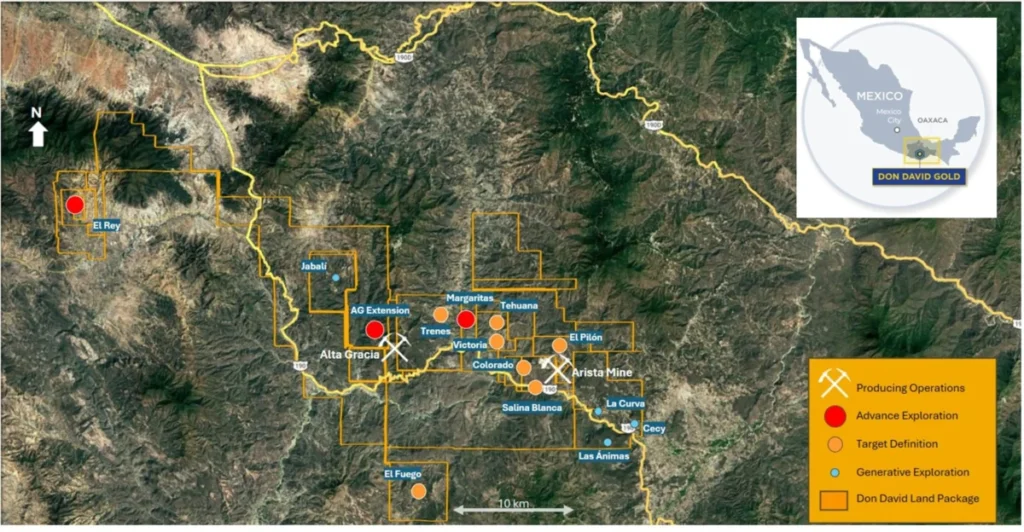
The Don David district, a 55-kilometer-long stretch along the San José structural corridor, serves as the centerpiece of this development strategy. With multiple proven epithermal systems and high-priority exploration targets currently under evaluation, Goldgroup is positioning itself to expand its footprint in one of Mexico’s most prolific mining regions.
The Core Assets: Arista and Alta Gracia
The DDGM district is anchored by two primary mining operations: the Arista mine and the Alta Gracia mine. While both contribute to the company’s current production profile, they represent distinct geological environments that highlight the versatility of the district’s mineralization.
The Arista Polymetallic System
The Arista mine is a hallmark of structurally controlled, epithermal mineralization. The deposit hosts three major vein systems—Arista, Switchback, and Three Sisters—which are primarily hosted by andesitic volcanic rocks. These systems are characterized by their polymetallic nature, with gold and silver occurring alongside significant concentrations of zinc, lead, and copper.
From an operational and exploration standpoint, Arista is a high-value asset. The complexity of its vein networks provides a twofold opportunity: first, the potential to extend known veins along strike and at depth; and second, the discovery of parallel or subsidiary structures within the broader hydrothermal system. Because the mineralization is not confined to a single, isolated deposit, the geological team has significant runway to identify new resources through targeted drilling.
The Alta Gracia Silver-Rich System
In contrast, the Alta Gracia mine offers a different geological profile, serving as a classic example of a low-sulfidation epithermal silver system. Unlike the polymetallic complexity of Arista, Alta Gracia is defined by quartz veins containing high-grade silver with associated gold, and relatively low base-metal content.
The primary veins, including the Mirador and Independencia systems, demonstrate the district’s ability to host high-grade precious metal mineralization. With several northeast-trending structures identified across the property, Alta Gracia serves as a testament to the district’s potential to host high-margin veins, providing a clear path for resource expansion and future discovery.
Regional Exploration: Beyond the Mine Gates
While production at Arista and Alta Gracia provides the immediate cash flow, the true long-term value for investors lies in the untapped potential of the regional land package. Goldgroup has identified two standout targets—Margaritas and El Rey—that exemplify the company’s "district-scale" growth strategy.
The Margaritas Prospect
Situated northwest of the Arista mine within the central segment of the San José structural corridor, the Margaritas project area is a high-priority exploration target. Historical data has already confirmed the presence of gold-silver epithermal veins. The company’s current interpretation suggests that Margaritas is not merely a collection of isolated veins but could represent a segment of a significantly larger, more extensive vein system. Ongoing exploration is focused on linking these historical intercepts into a coherent, resource-grade model.
The El Rey Prospect
Located near the northwestern extremity of the DDGM land package, the El Rey prospect represents a distinct, precious-metal-dominant style of mineralization. Characterized as a low-sulfidation epithermal system, El Rey has historically yielded narrow but exceptionally high-grade gold and silver intercepts. Much of this mineralization is located at relatively shallow depths and shows signs of oxidation, which simplifies potential extraction. For Goldgroup, El Rey represents a "gold-focused" counterbalance to the polymetallic complexity of the Arista system, diversifying the company’s geological risk.
Chronology of Development: A Strategic Roadmap
The recent announcement follows a sustained period of technical activity aimed at defining the future of the DDGM district.
- Mid-2026 (July 31): The company successfully concluded a 25,726-meter drilling campaign. This program was specifically designed for resource definition, expansion, and infill, ensuring that the current mine plans are supported by high-confidence data.
- August 17, 2026: Goldgroup released the selected results from the 25,726-meter program. This release was pivotal, as it provided the market with technical validation of the mineralization trends at both Arista and Alta Gracia.
- September 1, 2026: To bolster its visibility in the investment community, the company initiated a marketing services agreement with Lakefront Media LLC. This partnership is designed to facilitate a broader awareness campaign regarding the company’s operational milestones and exploration upside.
Management Perspective: Unlocking the District
Javier Reyes, Chairman and CEO of Goldgroup, has been vocal about the company’s strategic trajectory. In recent statements, he emphasized that the Don David district is fundamentally misunderstood if viewed only through the lens of current production.
"What makes Don David particularly exciting is the scale and diversity of the exploration opportunities," Reyes noted. "We are not looking at a single deposit; we are looking at a district-scale land package extending approximately 55 kilometers. Our producing mines demonstrate the potential, but targets such as Margaritas and El Rey provide the growth runway. We believe we are only beginning to unlock the full exploration potential of the Don David district."
This perspective underscores a shift in corporate culture toward aggressive, data-driven exploration. By leveraging the cash flow from existing operations to fund the testing of regional targets, Goldgroup is minimizing the need for dilutive financing while maximizing the probability of discovery.
Implications for Investors and the Market
The market’s reaction to Goldgroup’s recent disclosures hinges on three key factors:
- Reserve Replacement: The 25,726 meters of drilling are critical for maintaining the mine life of Arista and Alta Gracia. Continued success in these programs directly correlates to the company’s valuation and its ability to sustain steady cash flows.
- Resource Expansion: The identification of parallel vein systems and the maturation of targets like Margaritas and El Rey suggest that the total resource base could be significantly larger than currently reported. This potential for "blue-sky" discovery is a primary driver for junior and intermediate mining stocks.
- Market Visibility: The engagement of Lakefront Media reflects a deliberate effort to reach a wider audience of retail and institutional investors. In the current commodity cycle, visibility is as important as geology, and the company is clearly working to bridge the gap between its technical success and its market capitalization.
Regulatory and Technical Compliance
The technical integrity of Goldgroup’s operations is overseen by Christopher Richings, P.Eng, Vice President of Technical Services. All scientific and technical information disclosed by the company adheres to the standards set forth in National Instrument 43-101. As an employee of the company, Mr. Richings ensures that all exploration programs—from the initial sampling to the final interpretation of drill data—meet the rigorous requirements for public reporting, providing a layer of transparency for shareholders.
Furthermore, the recent marketing agreement with Lakefront Media is subject to the review and acceptance of the TSX Venture Exchange. This compliance oversight ensures that all communications regarding the company’s potential are balanced, factual, and aligned with standard corporate governance practices.
Forward-Looking Strategy: Building an Intermediate Producer
Goldgroup Mining Inc. continues to pursue its goal of evolving into a larger-scale intermediate precious-metals producer. This objective is underpinned by a four-pronged strategy:
- Production Growth: Utilizing the cash flow from the Don David and Cerro Prieto mines.
- Exploration: Aggressively testing the 55-kilometer San José corridor.
- Mine Optimization: Applying modern technical methods to improve recovery and lower operating costs.
- Project Development: Advancing the San Francisco Gold Project and the Back Forty Project to diversify the company’s asset portfolio geographically.
As the company moves through the latter half of 2026, the focus will remain on the conversion of exploration success into measurable resource growth. Investors will be watching closely to see if the drill results from the regional targets can replicate the grade and continuity seen in the existing mines. With a clear roadmap, a diversified portfolio, and a management team focused on unlocking the district’s hidden wealth, Goldgroup Mining Inc. is positioning itself as a significant player in the North American precious-metals sector.