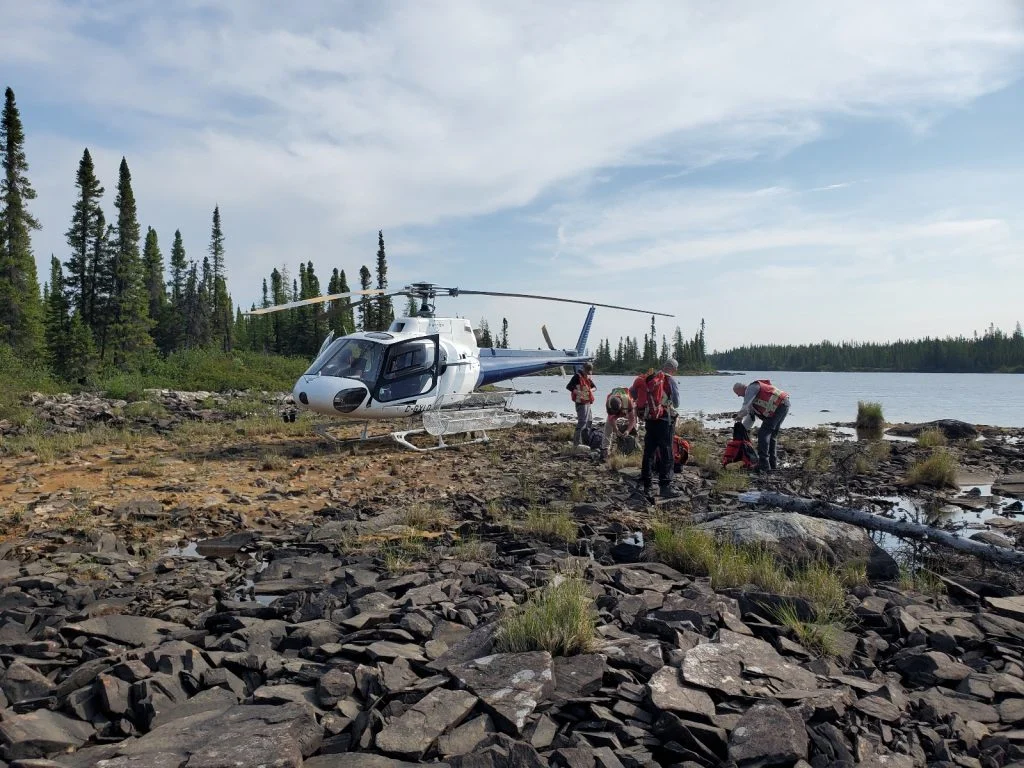
VANCOUVER, BC – Azincourt Energy Corp. [TSXV: AAZ; OTCQB: AZURF; FSE: A0U0] has officially commenced its highly anticipated summer diamond drilling and comprehensive prospecting program at the Harrier Uranium Project. Situated within the heart of Labrador’s prolific Central Mineral Belt (CMB), the project represents a strategic cornerstone in the company’s efforts to capitalize on the surging global demand for clean energy fuels. With the mobilization of crews, helicopter support, and drilling equipment, Azincourt is positioning itself to systematically unlock the potential of the Snegamook uranium deposit and surrounding mineralized corridors.
Main Facts: A Strategic Foothold in the CMB
The Harrier project spans approximately 13,000 hectares across five distinct license groups, encompassing a region known for its complex geological structural corridors. The project’s geological footprint is particularly noteworthy due to its proximity to significant regional deposits, including Atha Energy Corp.’s Moran Lake C and Anna Lake deposits, as well as Paladin Energy Ltd.’s Michelin deposit. While these regional assets serve as critical geological context, Azincourt’s internal focus remains firmly fixed on the high-grade potential hidden within its own tenements.
The Snegamook deposit serves as the primary focal point for the current campaign. Historically, the area has demonstrated significant uranium mineralization, with over a dozen distinct zones identified across the broader Harrier property. Historical surface rock samples have yielded exceptional grades reaching up to 7.48% triuranium octoxide (U₃O₈), with ten separate zones reporting concentrations exceeding 1.0% U₃O₈. Although these historical results require independent verification to meet modern NI 43-101 standards, they provide a compelling roadmap for the company’s current exploration efforts.
Chronology of Exploration: From Reconnaissance to Drilling
The 2026 exploration season began in mid-August with a two-week, helicopter-supported reconnaissance and mapping phase. This foundational work was essential for refining drill targets and assessing untested radiometric anomalies that were identified in earlier structural mapping campaigns.
Following the completion of the mapping phase, the company transitioned its focus toward operational readiness. By early September, the diamond drilling program officially broke ground, targeting approximately 2,000 metres of core extraction across six to ten strategic drill holes.
This phase is not merely exploratory; it is a verification exercise. The program is specifically designed to twin historical drill holes—particularly those from the 2007 and 2008 campaigns—to reconcile past data with contemporary geological understanding. By rehabilitating and re-examining core samples stored at the Kanairiktok facility, Azincourt’s geological team aims to establish a consistent data set that can eventually support the declaration of a maiden mineral resource estimate.
Supporting Data and Geological Context
The technical merit of the Harrier project is anchored in its structural complexity. The Snegamook deposit, located approximately 1.3 km southeast of the "Two Time" zone, features a 20- to 50-metre-wide section of brecciated and altered Monzo diorite. This lithological environment, characterized by strong chlorite, hematite, and carbonate alteration, is geologically analogous to the nearby Two Time zone, suggesting a shared genesis for the uranium enrichment.
Verification of Historical Results
As part of its rigorous due diligence, Azincourt conducted check sampling during the 2025 prospecting program to validate the historical record. A 10-centimetre check sample from drill hole SN-08-06 returned an impressive 2.71% U₃O₈, providing a significant boost to the company’s confidence in the historical data. Another sample from SN-08-18 returned 0.35% U₃O₈.
While the company cautions that these short, selective samples are not necessarily representative of broader grade or width, they confirm the presence of high-grade uranium in the Snegamook area. The overarching objective is to convert these promising, but historically isolated, data points into a coherent, compliant resource model.
Target Areas of Interest
Beyond Snegamook, the broader Harrier project hosts several "hot spots" slated for further evaluation:
- The Brook Showing: A high-priority area where recent 2025 sampling returned 6.28% U₃O₈, following up on earlier samples that returned 4.86% U₃O₈. Planned work includes ground radiometric surveys and soil sampling.
- Boiteau Lake & Anomaly 7: Ongoing evaluation of outcrop and boulder occurrences to trace the source of high-grade mineralization.
- Minisinakwa Claim Group: This area remains a geological puzzle. Two boulder samples retrieved from magnetite-rich metasediment returned 1.02% and 1.79% U₃O₈, respectively. The company is treating this as a high-potential "greenfield" opportunity, with plans to trace the source of these anomalous boulders in future field seasons.
Official Responses and Corporate Strategy
The scale of this operation has required a significant logistical undertaking. Managing the Florence Lake exploration camp, located 170 km north of Goose Bay, requires precise coordination. Azincourt has engaged Titjaluk Logistics Ltd. for camp and helicopter services and Quesnel Brothers Diamond Drilling Ltd. to execute the 2,000-metre core program.
Executive Commentary
Mark Tommasi, CEO of Azincourt Energy, emphasized the importance of this phase for the company’s market positioning. "This late summer program represents an important step forward for Azincourt as we begin advancing the Snegamook uranium deposit and broader Harrier project in a more systematic way," Tommasi stated. He noted that the dual focus—improving market visibility through a refreshed corporate identity and executing a high-stakes field program—is designed to build a pipeline of quality uranium targets that will serve the company for years to come.
Trevor Perkins, Vice-President of Exploration, added technical clarity to the mission: "Azincourt’s initial drilling at Snegamook is designed to confirm selected historical mineralized intervals, improve our understanding of the deposit geometry and test opportunities to expand known mineralization. In parallel, the broader 2026 field program will continue advancing additional uranium occurrences across Harrier, with the objective of developing a stronger pipeline of drill-ready targets."
Marketing and Investor Engagement
To bolster its market presence, Azincourt has entered into a strategic agreement with Native Ads Inc., a Delaware-based firm. Under this $150,000 contract, Native Ads will provide comprehensive digital media, data analytics, and content distribution services over the next 12 months. This initiative is designed to ensure that the progress made at the Harrier project is effectively communicated to the global investment community, subject to TSXV approval.
Implications: The Future of the Central Mineral Belt
The resurgence of interest in the Central Mineral Belt is driven by the global imperative to secure uranium supplies for the energy transition. To date, the CMB has seen no active uranium production, yet the region’s potential is underscored by the significant resource bases of neighboring projects. For instance, Paladin Energy’s Michelin project alone reports 127.7 million pounds of U₃O₈, illustrating the regional capacity for large-scale mineralization.
For Azincourt, the implications are clear: the Harrier project is no longer a collection of historical prospects but a primary asset undergoing intensive validation. If the 2026 drill program successfully confirms the continuity of the Snegamook mineralization, the company will have cleared the most significant hurdle on the path toward a maiden NI 43-101 mineral resource estimate.
By focusing on systematic exploration, the rehabilitation of historical core, and the identification of new, high-grade anomalies, Azincourt Energy is positioning itself as a key player in the Canadian uranium sector. As the global shift toward clean energy continues, the results of the 2026 Harrier drilling program may well prove to be a defining moment in the company’s history and a significant addition to the inventory of prospective uranium assets in Labrador.
Disclaimer: This article is for informational purposes only and does not constitute financial advice. Investors are encouraged to conduct their own due diligence and consult with a qualified financial advisor before making any investment decisions. The historical results mentioned have not been independently verified by Azincourt Energy and are subject to future testing.