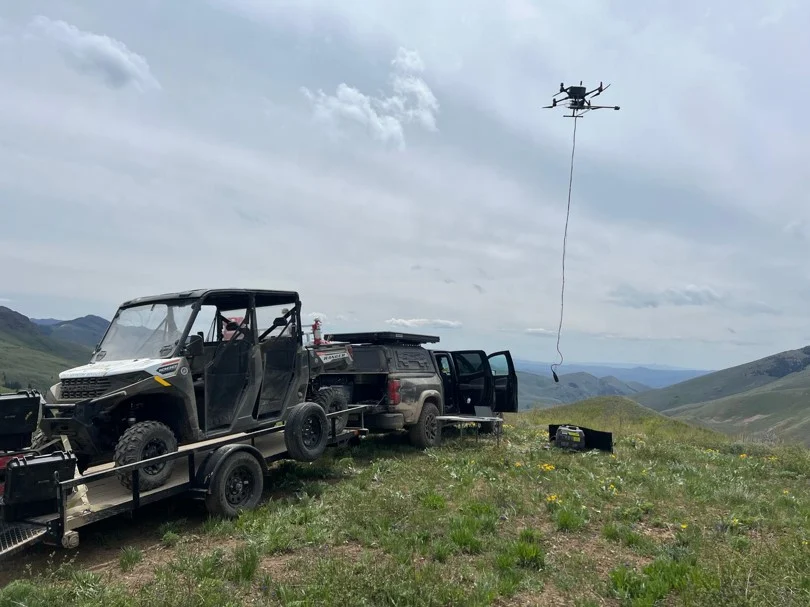
VANCOUVER, BC – Western Star Resources Inc. (CSE: WSR) (OTC: WSRIF) (FRA: 4K2), a mineral exploration firm increasingly recognized for its strategic focus on critical minerals within the United States, has announced a significant technical advancement at its 100%-owned Eagle Point tungsten project in Hidalgo County, New Mexico. The Company confirmed the mobilization of a specialized geophysical field crew to the property, tasked with executing a high-resolution unmanned aerial vehicle (UAV) magnetic survey.
This development marks a pivotal shift in the company’s exploration methodology, moving away from reliance on legacy regional datasets toward precise, modern geophysical mapping. As the global demand for tungsten—a vital component in aerospace, defense, and high-tech manufacturing—continues to climb, Western Star’s systematic approach to its American asset portfolio is gaining traction among stakeholders.
Main Facts: The Eagle Point Geophysical Initiative
The primary objective of the current field operation at Eagle Point is to deploy UAV-based magnetic sensors to map the property’s subsurface geology with unprecedented clarity. The survey will utilize a line spacing of 25 to 50 meters, a density that is expected to provide a vastly superior resolution compared to the existing, coarse-resolution regional data provided by government surveys.
Project Goals and Technical Targets:
- Structural Definition: The survey is designed to define the geometry and exact extent of the limestone-intrusive contact zones. These contacts are the primary geological "traps" for mineralizing fluids in the region.
- Magnetite-Bearing Tactite Identification: The focus is on locating tactite bodies, which serve as the host rocks for scheelite (a primary tungsten ore mineral).
- Subsurface Continuity: A critical aspect of the survey is to identify these tactite bodies even when they are obscured beneath younger, post-mineralization cover.
- Strike Extension: Historical workings at Eagle Point have already identified eight distinct skarn bodies. This survey aims to map these bodies along strike to determine if the mineralization extends beyond the historically documented zones.
The data harvested from this survey will be integrated directly into the company’s ongoing geological mapping and sampling programs. By creating a refined structural model, Western Star intends to prioritize high-potential targets for its upcoming maiden drill program, currently slated for 2026.
Chronology of Exploration: Building Momentum
Western Star Resources has been engaged in a methodical expansion of its technical knowledge base across its portfolio of tungsten assets. The decision to deploy UAV technology at Eagle Point is not a standalone event but rather the latest chapter in a broader, successful exploration strategy.
The Path to Eagle Point
- Early Assessment: Upon acquiring the Eagle Point project, Western Star relied on historical data that confirmed the presence of eight skarn bodies. However, management recognized that regional data was insufficient to guide modern drilling.
- Proof of Concept: The company successfully utilized drone-based magnetic surveys at its Rowland and Whitestar properties. The efficacy of these surveys in identifying potential mineralized trends gave the Board the confidence to apply the same technology to the New Mexico site.
- Current Phase: The mobilization of the field crew in the current quarter represents the transition from broad-brush reconnaissance to targeted, high-precision exploration.
- Future Roadmap: Following the interpretation of the magnetic data, the company plans to synthesize results with geochemical sampling to finalize drill-site permits, ensuring that the 2026 drilling program is optimized for discovery and resource definition.
Supporting Data: Why Tungsten?
The strategic pivot toward tungsten is underscored by the material’s status as a "critical mineral." Essential for its extreme hardness and high melting point, tungsten is a foundational element in the manufacturing of superalloys for jet engines, carbide cutting tools, and armor-piercing munitions.
The Western Star Advantage
Western Star Resources has positioned itself at the intersection of domestic security and resource development. By focusing on past-producing assets in Nevada and New Mexico, the company is targeting regions with proven historical geology, effectively de-risking their exploration profile compared to greenfield "wildcat" projects.
The use of UAV magnetics is particularly suited for skarn-hosted tungsten deposits. Because scheelite is often associated with magnetite-bearing tactite, magnetic susceptibility contrasts can be mapped effectively to identify hidden mineralization. By closing the gap between 50-meter-spaced historical regional data and modern 25-meter-spaced UAV data, Western Star is essentially looking through the "noise" that hindered previous operators.
Official Responses: Insights from Leadership
Blake Morgan, President and CEO of Western Star Resources, underscored the significance of this deployment during a recent update to shareholders.
"Given the promising results obtained from the drone magnetic surveys at Rowland and Whitestar, we are moving forward with this strategy at Eagle Point," Morgan stated. He noted that the company is moving beyond the limitations of legacy data. "The only existing geophysics covering the area is coarse-resolution, widely spaced regional government data. By utilizing the drone, we expect to map out the prospective limestone-granite contact in much greater detail."
Morgan emphasized that the Eagle Point exploration program is currently outperforming internal benchmarks. "With the ongoing Eagle Point exploration program exceeding expectations so far, we wanted to immediately add that next layer before our maiden drill program in 2026. We also expect assays back from our second-phase exploration program at Rowland and Whitestar, alongside an update on the ongoing Eagle Point program."
The technical validity of these operations is overseen by Jasper Mowatt, a consultant to the Company and a Qualified Person under National Instrument 43-101. His oversight ensures that all data collection meets the rigorous standards required for future mineral resource reporting and disclosure.
Implications: The Road to 2026
The implications of this survey extend well beyond simple data collection. For Western Star Resources, this is a de-risking exercise that serves several vital corporate functions:
- Permitting Efficiency: Regulatory bodies require clear, evidence-based rationales for drill programs. By submitting high-resolution magnetic maps, the company strengthens its position during the permitting process, potentially reducing the timeline for approval.
- Target Optimization: The cost of drilling is significant. By using geophysics to "see" the subsurface, the company can ensure that every meter of diamond drilling is targeted at the most prospective zones, maximizing the probability of intersecting high-grade mineralization.
- Market Credibility: In the junior mining sector, the ability to execute on technical milestones is a key indicator of management quality. By delivering on the promise to modernize exploration at Eagle Point, Western Star is building trust with the investment community.
- Strategic Positioning: As Western Star advances its portfolio in Nevada and New Mexico, it is increasingly becoming a potential partner or acquisition target for larger entities looking to secure domestic, stable sources of critical minerals.
A Disciplined Future
As the geophysical crew begins their flight paths over the New Mexico desert, the focus remains firmly on the technical execution. The integration of this new data with the existing geological map is expected to be a force multiplier for the project.
While the company maintains exploration exposure in British Columbia, the primary engine of value creation for Western Star is clearly the U.S.-based tungsten portfolio. With a clear timeline to the 2026 drilling campaign, the company is effectively building a "pipeline" of projects—moving from regional evaluation to precision targeting, and finally to resource estimation.
Investors are encouraged to monitor the company’s official corporate website and upcoming regulatory filings for the results of this survey, as well as the anticipated assays from the Rowland and Whitestar properties. In an era where domestic supply chains are a national security priority, Western Star Resources is proving that a disciplined, technology-led approach to exploration is the most effective way to unlock the potential of American mineral assets.
Disclaimer: This article is for informational purposes and does not constitute financial advice. Mineral exploration involves significant risks. Readers should review Western Star Resources’ official disclosures and seek professional advice before making any investment decisions.