

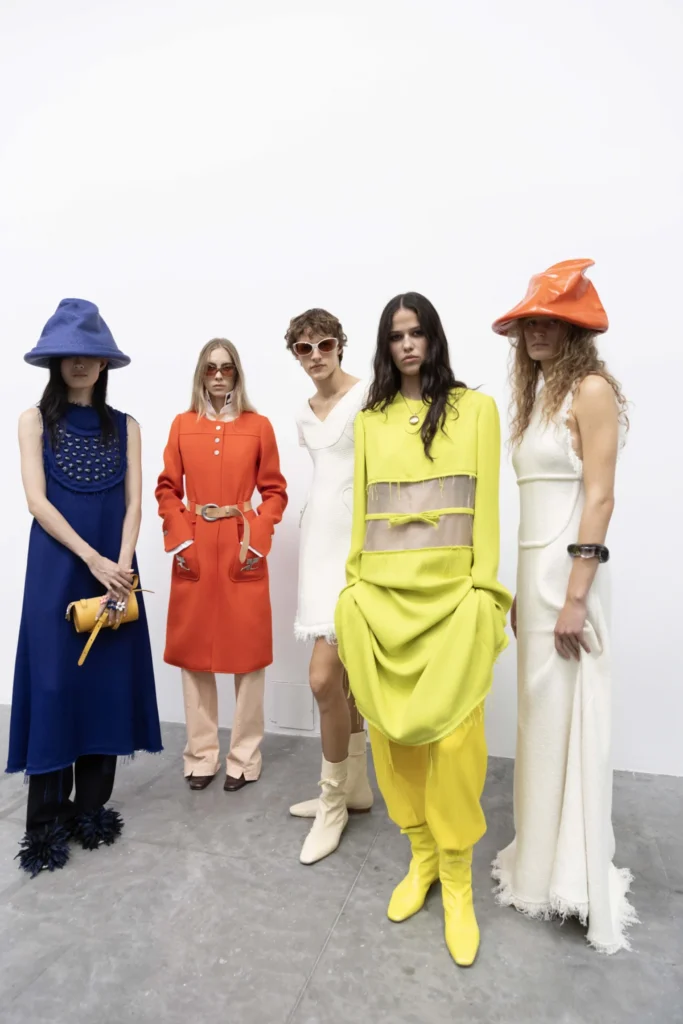
The fashion industry thrives on the tension between heritage and reinvention. Few houses possess a DNA as distinct—or as rigid—as Courrèges. For the past five years, the brand has been synonymous with the sharp, monochromatic, and architectural precision established by Nicolas Di Felice. However, as the industry gathered at the Palais de Tokyo this Wednesday, it became clear that the winds of change have arrived in the form of Drew Henry. His debut collection for the house is not merely an update; it is a profound, messy, and spirited reclamation of the brand’s original, more eccentric soul.
The Archive as an Archaeological Site
The transformation began in the quiet, stark-white expanse of the Courrèges showroom. Tucked away on a corner table, nestled amidst the pristine order of the brand’s current aesthetic, sat an unlikely outlier: a pumpkin-colored, cloche-like hat. To the untrained eye, it looked as though it had been carelessly discarded—perhaps even sat upon. It lacked the rigid geometry that has defined the brand’s modern revival.
This object, unearthed from the archives, was a creation of the legendary milliner Jean Barthet. It served as a vital clue for Henry, who spent his early tenure at the house digging into the pre-1964 era, long before founder André Courrèges launched the epochal "Space Age" collection that solidified the brand’s reputation for sterile, futuristic minimalism.
"Trying to find original imagery of that stuff is tricky," Henry explained, gesturing to the sprawling layout of archive pieces that informed his vision. "When we finally got everything into the room and laid it all out, the sheer amount of color was staggering. It wasn’t just the white, white, white we’ve come to expect. There was a human, tactile history there."
For Henry, that pumpkin-colored hat became a talisman. "There’s a humor to it," he remarked. "I like that it’s a bit ‘f—ed up.’ I think for me, that’s something that translates directly into the clothes and the way I work. Perfection can be stagnant. A bit of chaos is where the life is."
Chronology of a Creative Pivot
To understand the significance of Henry’s debut, one must look at the trajectory of the house. Founded in 1961, André Courrèges’ maison was initially a hotbed of experimental silhouettes and vibrant, almost psychedelic energy. It was only after his seismic 1964 collection that the world began to associate the brand exclusively with white vinyl, silver accents, and severe A-line cuts.
Henry, a South African-born Central Saint Martins graduate, arrived at the house with a pedigree that suggested a mastery of restraint. His tenure with Phoebe Philo—both during her seminal era at Celine and later with her eponymous label—instilled in him a deep appreciation for the commercial viability of "solid pieces." Yet, Henry’s task was to reconcile that disciplined background with a desire to dismantle the house’s recent aesthetic homogeneity.
The lead-up to the show was a study in balancing the brand’s heavy institutional memory with his own stylistic impulses. By integrating the "punky" attitude of personal icons like James Baldwin, Tracy Chapman, and Cher, Henry sought to move the conversation away from the space-age minimalism that had dominated the house since 2019 and toward a more eclectic, "devil-may-care" expression.
Supporting Data: The Anatomy of the Collection
The collection presented at the Palais de Tokyo was an exercise in "zhuzhing" the established codes. The staple ribbed knits, vinyl jackets, and A-line dresses were present, but they felt fundamentally altered.
- Tactile Textures: Henry introduced raw edges to lean jackets, moving away from the factory-finish aesthetic that has defined recent seasons.
- Color Theory: Where the brand previously relied on a monochromatic palette, Henry flooded the runway with "zesty" colors—bright, aggressive, and undeniably optimistic.
- Structural Subversion: Perhaps the most audacious move was the reinterpretation of the A-line dress. Henry not only modified the cut but flipped it entirely, creating a unisex garment that challenged the house’s traditional gendered silhouettes.
- The Details: From metallic logos to oversized, high-waisted belts, the accessories leaned into a sense of maximalism. Even the "HotPants"—a nod to the brand’s history—were reimagined with a cheeky, cut-out hole over the posterior, signaling a willingness to court controversy.
Official Perspectives and Industry Implications
The fashion press, often wary of drastic shifts, found themselves divided by the "ballsiness" of the presentation. Henry’s ability to inject "psychedelic touches"—including cartoony floral bra tops and cage jumpsuits adorned with tufty, textural flowers—suggests a designer who is less concerned with the sanctity of the brand’s archives than with their utility as a playground.
"This was a confident, if occasionally imperfect, debut," noted one industry insider. The "imperfection" cited—the raw hems, the chaotic styling—is precisely the point. Henry is intentionally distancing himself from the sterile, high-polish finish that has become a luxury industry standard.
The implication for the brand is significant. Courrèges had successfully captured the "cool" market by doubling down on a specific, recognizable look. By pivoting toward a more fluid, punky, and unpredictable identity, Henry is taking a gamble. He is betting that the consumer of 2025 is tired of the polished, algorithm-friendly aesthetic and is ready for something with more grit, more history, and significantly more personality.
The Road Ahead: Beyond the Squishy Hat
As the dust settles on the Palais de Tokyo, the question remains: Can a legacy house survive such a jarring shift in temperament? Henry’s debut suggests that the answer is yes, provided the designer has the stamina to sustain the vision.
He has already proven that he can handle the "solid commercial pieces"—the lean tunics and body-skimming knits that provide the house with its financial floor. But his true ambition lies in the "lightness" he claims to be exploring. He wants to bring the house back to a time when it was not just a symbol of the future, but a manifestation of the now.
Will the pumpkin-colored, misshapen hat become a recurring motif? Probably not. Henry himself laughed off the idea of its direct revival, acknowledging it as a point of inspiration rather than a blueprint. However, the spirit of that hat—the willingness to be unconventional, the courage to look "f—ed up" in a showroom of pristine white—is the defining characteristic of this new chapter.
Conclusion: A Rebellious Renaissance
Drew Henry’s debut was not a polished, safe exercise in heritage preservation. It was a messy, loud, and undeniably human intervention. By acknowledging the chaotic beginnings of André Courrèges’ house and blending them with his own experiences under the tutelage of the industry’s greatest minimalists, Henry has carved out a unique space for himself.
The house of Courrèges is no longer just about the future; it is about the intersection of the archival past and a gritty, untethered present. If the clothes are any indication, the coming seasons will be characterized by a departure from the "uniform" of the last five years and a descent into something far more interesting. Henry has shown his cards, and while the result may not be perfect, it is undeniably alive. In an industry that often favors the antiseptic, a little bit of "f—ed up" might be exactly what the doctor ordered.



